
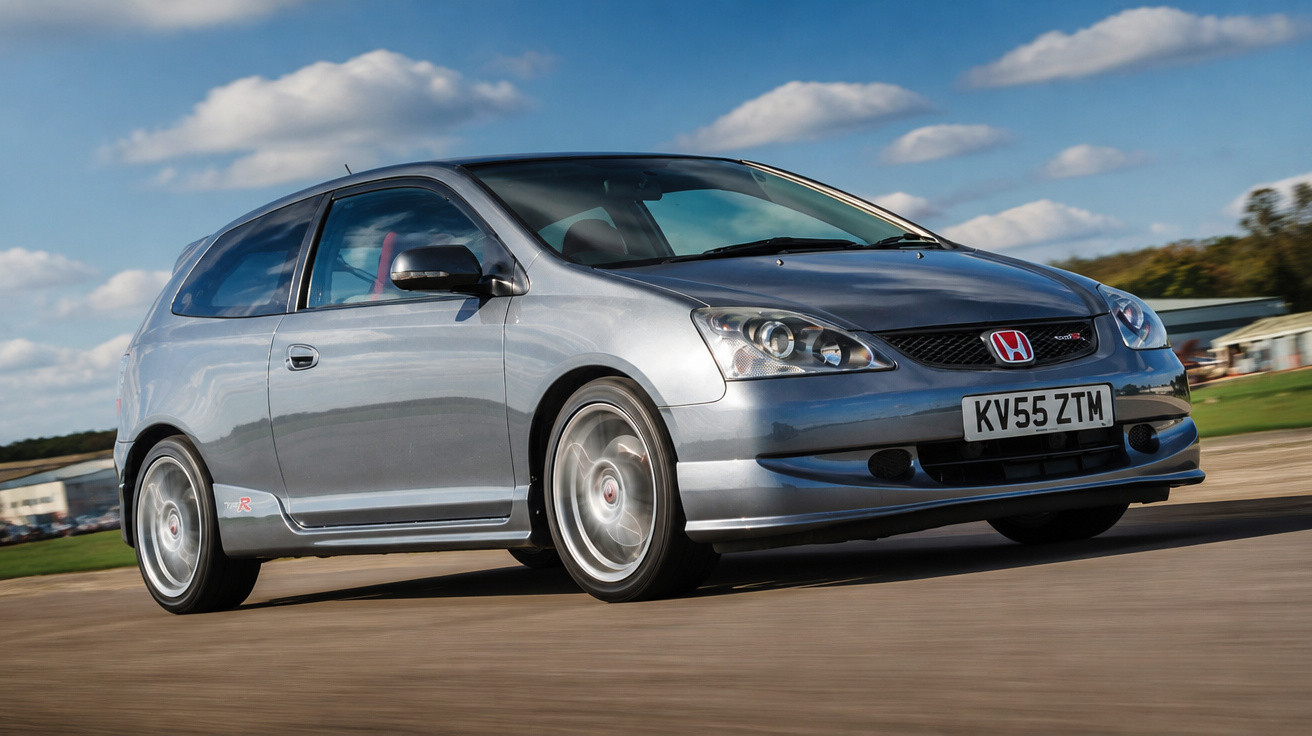
I’ve encountered this car rather often before. Twenty years ago, it seemed I was behind the wheel of a Type R almost weekly, as part of another attempt to decide which hot hatch was the best. Hot hatches – remember those? Before driving this EP3, I tried to recall it and concluded that the Civic’s engine, indeed the entire powertrain, was its highlight, while the chassis was its shortcoming.
It appears my memory had played tricks on me. The chassis is excellent; it is the steering that falls short. There is, however, a good reason this is the Civic everybody talks about. Its 1997 FK9 predecessor had VTEC variable valve timing, certainly, but it never quite conformed to the European hot hatch template. We simply were not sure which category it belonged in.
Honda Civic Type R EP3: boxy but practical
Honda made the successor box-shaped to make matters clearer. The EP3 was soon dubbed the breadvan. It is an unusual-looking machine, with its single-angle nose and vertical rear giving it the appearance of a stylishly compressed MPV. People carriers were hugely popular at the time, and Honda also ensured the EP3 was useful inside, with respectable rear accommodation and a 315-litre boot. None of that, though, was what had us wiping sweaty palms on our trousers.
Photography: Dean Smith
The gearlever had been positioned high on the dashboard, only a handspan from the similarly delightful steering wheel. Honda had also installed an excellent pair of Recaro seats and crisp white instruments. It looked the part, but more importantly, it felt right too.
I recall the driving position seeming lofty. It no longer does, now that crossovers have conditioned us all. I also remember it sitting on a threshold: it had the dimensions and practicality of a Golf or Megane, yet carried the enthusiasm and character of a Clio or Mini. It does not seem large now, but it remains tremendously agile and nimble.
The EP3 VTEC powertrain needs revs
You simply need to rouse it first. It is like Orangina. Cruise about gently and you will question the hype: the ride feels somewhat wooden, the engine delivers no torque, and although there is satisfaction in controls this precise, there is little sense that you are at the helm of something special. You have to search for it.
Give it a shake and raise the revs. At 6,000rpm, it snaps awake and charges forwards as though it has received an intravenous triple espresso, with its induction noise barking feverishly. I do not know whether there is any truth in the assertion that Honda’s VTEC system has never suffered a mechanical failure, but it feels indestructible.
It is accompanied at every stage by one of the finest gearshifts: a neat, cool metal lozenge that nestles perfectly in your palm and performs mechanical ballet as it flicks through the gate. Every car enthusiast ought to experience a great Honda powertrain. It need not be this one; an S2000, NSX or Accord Type R would do, but it must have a manual gearbox and natural aspiration.
As the engine works harder, the suspension seems to discover another operating level. There are no adaptive dampers, yet it feels as if there might be. It is firm and wooden when you are merely pottering around, but ask more of it and it reveals a fluency I had entirely forgotten.
It enters bends with some body roll, lifts an inside rear wheel and darts around cleanly and crisply. There is no differential, but at least on dry roads, you do not much miss one. The result is the full package: an eager Beagle of a car.
The EP3 is a miniature masterpiece, and if high mileages do not worry you – they should not – one can be bought for under £5k. Yet, amid all that ability, the numb steering is unexpected.
Never mind. You will manage. I would choose this every time over the FN2 that succeeded it. That genuinely had a wooden chassis. Or at least, that is how I remember it.
Comments
No comments yet. Be the first to comment!
Leave a Comment