
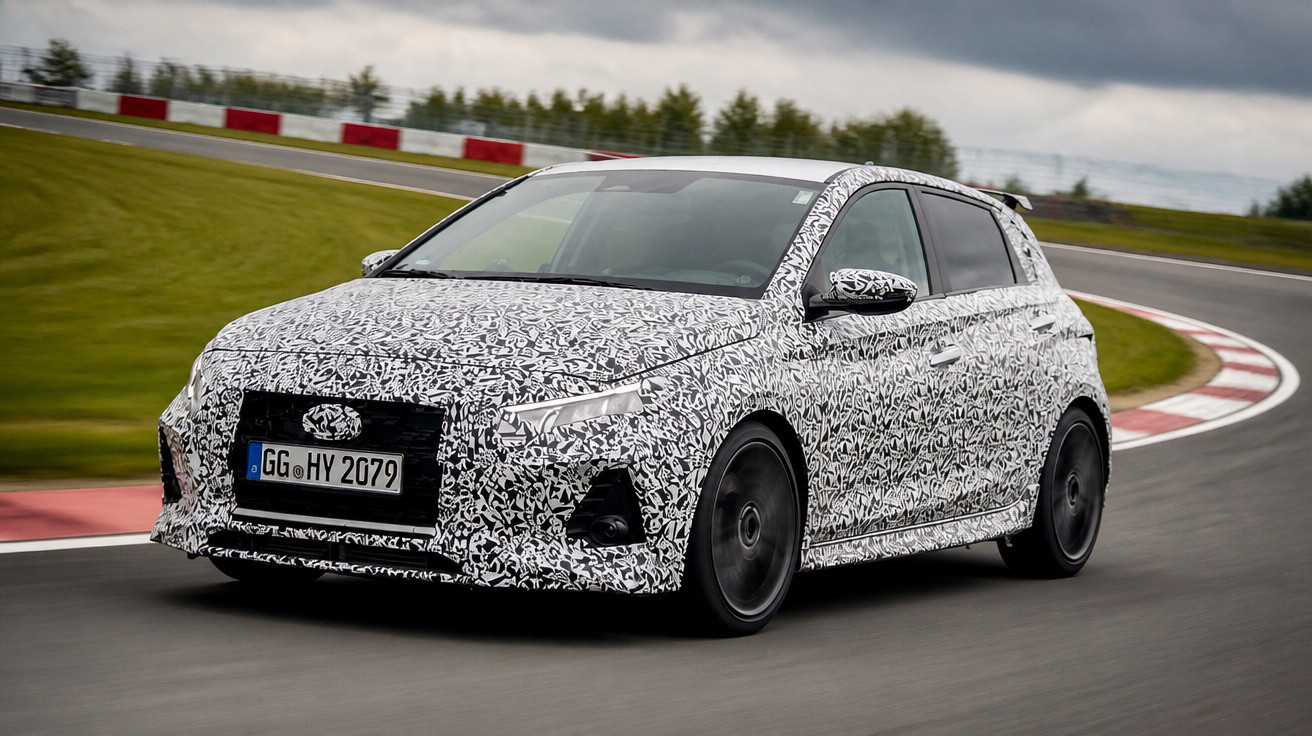
It is not quite finished yet, then?
Not yet. However, Hyundai understands the significance of the i20N, and appreciates that 2020 has been far from enjoyable. So a preview drive in this almost-complete hot hatch around Nürburg village, followed by several laps of the Nürburgring GP circuit, sounds exactly like the remedy required. Cheers.
Hyundai i20N: the smaller N hot hatch
Is this effectively the i30N’s younger sibling?
Exactly. The family-focused i30N hatchback and Fastback compete with cars such as the Golf GTI, Cupra Leon, Focus ST and Megane RS, whereas the Hyundai i20N is a compact, performance-enhanced supermini.
That particular market has become rather sparse lately. The excellent Fiesta ST remains, alongside the underwhelming Polo GTI, but there is little else. There is currently no Cupra Ibiza, Fabia vRS, Corsa VXR or Clio RS. The timing looks ideal for a fresh contender to make its move.
Do the figures stack up?
This is not really a car defined by statistics, yet its outputs appear well judged. Beneath the bonnet sits a 1.6-litre turbocharged four-cylinder engine, rather than a highly strung three-cylinder unit like that fitted to the Fiesta ST or the considerably more exotic Toyota GR Yaris. It produces 201bhp and 275Nm. That feels suitably judged, does it not?
Drive goes to the front wheels through a proper limited-slip differential. There is just one transmission available: a six-speed manual. Hyundai is reserving its impressive new eight-speed DCT paddleshifter for the i30N and the larger, taller N models that will arrive later.
Chassis, drivetrain and N equipment
Very appealing. What else is there?
The mechanical layout is straightforward, and the same is true of the suspension. Its dampers use a single factory calibration, so they cannot be adjusted if you want a softer ride. There is a mechanical differential at the front, but the touchscreen offers no means of altering its locking ratio. You simply have to trust that the N team knows what it is doing. On the evidence of the i30N and the Veloster N sold in America, it certainly does.
Do not mistake that simplicity for a lack of sophistication, though. The i30N built its reputation partly on its driving modes and broad configurability, and the N Division has brought that approach to this new entry-level model.
Fine. What are the toys like?
Launch control is fitted as standard. You may never actually use it, but it is reassuring to know it is available. A steering-wheel rev-match button makes the engine automatically blip the throttle during downshifts. There are also the modes, collectively labelled by Hyundai as the ‘N Grin Control System’. Not the most appealing name.
You will soon learn to ignore Normal and Eco modes, instead focusing on Sport. It sharpens the engine response, releases a little more sound, gives the steering extra weight and relaxes the stability control. Yet that is only the beginning.
‘N’ mode turns everything up to the maximum. Naturally, an ‘N Custom’ setting is included too: the useful mix-and-match option that allows favourite configurations to be stored. This is probably where i20Ns will spend 95 per cent of their time.
That sounds like a generous kit list.
There is more. Shift-up lights are included, while the power-steering motor has a bespoke calibration intended to counter torque steer. The front brakes measure a substantial 320mm, the suspension is significantly tougher than that of a regular i20, and even the bodyshell has been reinforced so the suspension can be tuned precisely. None of this comes cheaply in a hot hatch, so hopefully the finished car will still be reasonably priced.
One more pub fact, then.
Want proof of how seriously Hyundai has approached this project? The i20N’s pedals have been calibrated to permit left-foot braking, just as a racing driver would do. Most hot hatches assume you have panicked or forgotten which foot operates which pedal when they detect braking while you are aiming for an apex. Not this one. That is serious engineering for a pumped-up Hyundai i20 that served as the official pace car for the 2020 Indoor Lawn Bowls World Championship.
First-drive impressions of the Hyundai i20N
What are the initial impressions?
It is difficult to judge the styling or cabin properly because both remained under camouflage. The seat offers strong grip and supportive bolsters, although it does not lower particularly far for anyone who, like me, prefers to sit close to the floor. As in the i30N, there is a very thick steering wheel, alloy pedals and a ball-shaped gear lever. All the expected ingredients are present.
The digital instruments are sharp, and their graphics and colours change completely as you work through the modes. There is ample theatre to make this feel like a properly special small car.
Press the starter button and the engine sounds deeper than a standard supermini four-cylinder, although it lacks some rawness, crackle and growl. Engineers say that is on the list of jobs still to be completed, though emissions filters make extracting that character increasingly difficult.
There are no complaints about the gearshift or brakes. Their weights are purposeful and well matched. The Fiesta ST has a cleaner, more mechanical shift action, but the Hyundai is not far behind.
Plant the throttle and there is abundant traction. Perhaps the smooth German B-roads, which are arguably even less bumpy than the nearby grand prix circuit, flatter the front axle, but the steering wheel shows little urge to wrench itself from your hands and escape through the window. With almost none of its 201bhp going to waste, more power is unnecessary.
How quick is it likely to be?
There are no official performance figures yet, but it will plainly cover 0-62 mph in six-point-something seconds. In other words, it is quick enough.
More encouragingly, it feels like an N model even if you had been guided towards it blindfolded. There is the positive feel of the controls and the sensation of a square, taut and grippy wheelbase beneath you, yet one that reacts readily to lifting off the throttle or turning in under braking. That is central to the N bloodline, and it has survived the shrink ray.
Based on this short first drive, it does not have the Fiesta’s addictive, if partly artificial, impression of agility. Ford’s class leader behaves as though it would happily run on three wheels. Its set-up centres on a sharp front end and an exceptionally mobile rear that wants to wag its tail at every roundabout. The i20N takes a more straightforward approach. That may make it a more intelligent and less tiring car for long journeys and daily duties, although perhaps less hilarious during a brief, spontaneous blast.
So is it grown-up by exactly the right degree?
It is too early to be certain, but there is an irony here. The larger i30N is among the less mature and more unruly hot hatches in its class, and is all the more likeable because of it.
A longer drive will be needed to discover how many layers its multi-mode character really possesses, but the specification promises plenty. Could we have one fairly soon, Hyundai? 2020 has been rather tiresome. We have earned this one.
Comments
No comments yet. Be the first to comment!
Leave a Comment