
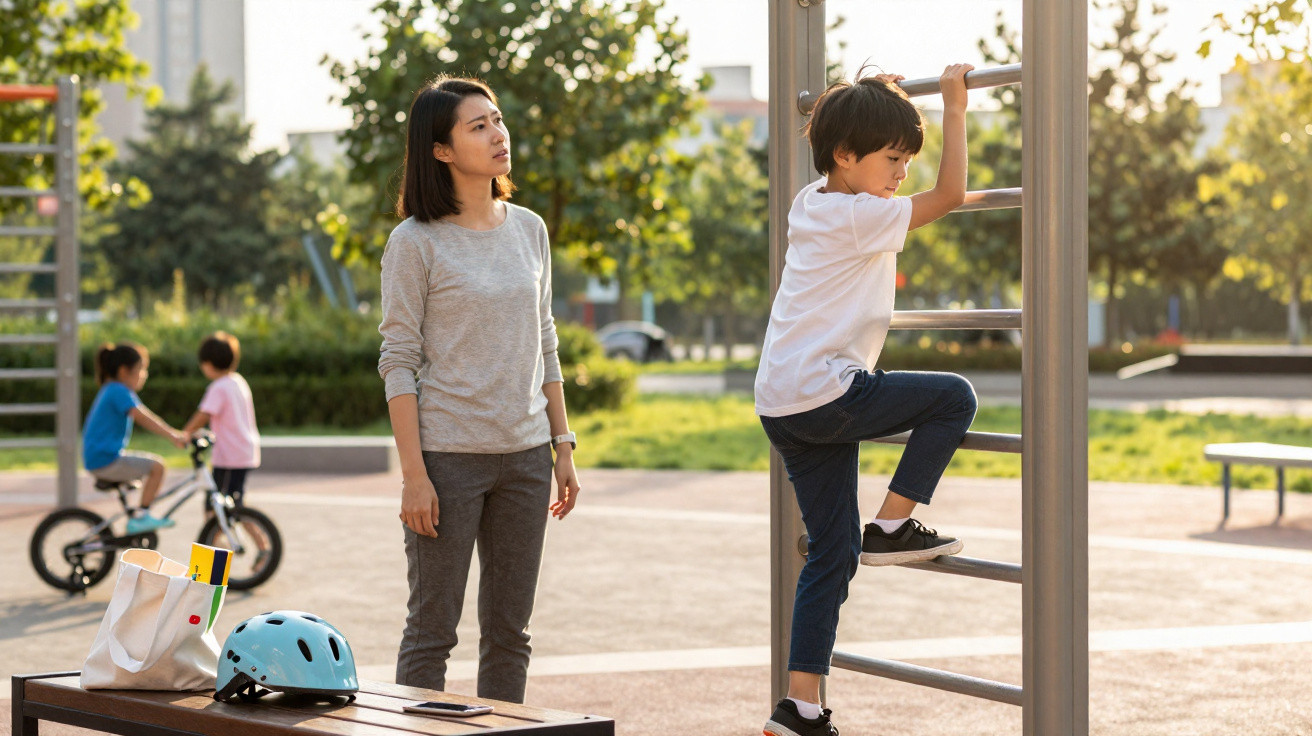
A healthy, bright ten-year-old stands rooted at the kerb. Although the road is clear and the signal is red, his mum holds an arm across his chest like a rollercoaster restraint. With her phone in one hand and worry in the other, she checks the road again and again. He silently rolls his eyes. He already knows the routine: don’t run, don’t climb, don’t speak to strangers, don’t, don’t, don’t.
Nearby, other parents perform the same uneasy ritual. They grip rucksacks, consult tracking apps and murmur cautions as though reciting prayers. We assure ourselves that it all comes from love.
But the children seem exhausted rather than secure.
There is clearly something wrong with this picture.
When protection becomes a soft cage
Spend time at any playground and the atmosphere is unmistakable. Children are not simply playing; they are watched like junior staff in a hazardous workplace. Parents wait beneath slides, follow children around climbing frames and leap forward when someone stumbles, before the child has even begun to cry.
What emerges is an uncomfortable blend of security and restriction. The message children receive is: the world is unsafe, you are vulnerable, and you cannot manage without me. We might call it gentle parenting or conscious parenting, yet an increasing number of psychologists use another, quieter term: overcontrol. The label fits.
In the 1980s, most children in Europe and North America were walking to school independently by the age of nine. Now, plenty of parents would not allow even a twelve-year-old to cross a peaceful road alone. A UK survey found that children’s “roaming radius” - the distance they may travel from home - has contracted by nearly 90% over only four generations.
Meanwhile, childhood anxiety, sleep problems and stress are increasing. Strikingly, the period of helmets, content filters and parental controls is also one in which children appear more mentally overwhelmed than before. It is an uncomfortable correlation, which may be why we so seldom examine it.
The simple reality is this: children cannot develop courage when they are covered in bubble wrap.
If adults intervene at every point of discomfort, children’s nervous systems never have the opportunity to learn, “Oh, I can handle this.” Their minds remain in a “somebody will save me” state. Although this may feel compassionate at the time, it gradually weakens resilience. A child who never hears their own inner “I did it” voice grows into a teenager who doubts that voice even exists.
We believe we are shutting fear out. At times, we are actually teaching it to them.
Teaching real safety rather than staying on red alert
There is an alternative that does not mean leaving children to cope with chaos alone. It begins by replacing continual control with shared responsibility. Rather than only telling children to “be careful”, we show them what “careful” means in practice.
At a road junction, instead of automatically pulling them back, pause and guide them: “What do you see? Is the car stopped? Where will you look before crossing?” Walk the route together repeatedly. Eventually, watch from a distance as they cross on their own, even if your heart is racing, and resist stepping in. That is not neglect; it is training.
Many parents privately worry that easing their grip will make others see them as “a bad parent”. In response, they compensate through restrictions, warnings and tracking technology. They prohibit sleepovers, monitor every moment online and fill each afternoon with plans, before collapsing onto the sofa and wondering why everyone feels worn out and tense.
Most of us recognise the moment when we hear ourselves say “Be careful” for the 15th time in an hour, without being entirely sure what the warning is for. The motivation is loving. Over time, however, children may absorb the idea that the world is somewhere they are unequipped to manage.
“Real safety isn’t about removing all risk,” says child psychiatrist Dr. Lauren Knoll. “It’s about giving children enough practice with small risks that they’re not destroyed by the big ones.”
Begin with micro-risks
Allow your child to pour their own juice, handle a blunt knife or climb slightly higher than you find comfortable. Such moments help them practise judgement.Try “If–then” coaching
Rather than saying “Don’t run,” say, “If you want to run, then check first: is the ground clear, are people around you, are you wearing good shoes?” This creates internal guidelines instead of demanding external obedience.Talk through frightening moments
Following a fall or disagreement, discuss what occurred and what they handled well, rather than focusing solely on mistakes. This is how experience becomes wisdom instead of simply becoming fear.Relax one rule at a time
Pick one area - screen time, outdoor play or homework - and slowly transfer some responsibility. Observe the outcome, make adjustments and repeat.
Let children feel life so they can live it
Modern parenting can involve cushioning children against every rough edge: boredom, irritation, conflict and even small disappointments. We often rush to provide an answer, diversion or negotiation before they have had time to experience the feeling. As a result, children may miss learning that sadness passes, anger settles and boredom can inspire creativity.
From the outside, a more lasting approach can seem almost uneventful. You remain beside a crying child rather than instantly solving the issue. Instead of “It’s okay, don’t cry,” you say, “I’m here. This is hard.” You give siblings a few minutes to disagree before intervening. If a teacher is slightly unfair, you do not immediately email the school.
This is not about allowing children to be overwhelmed by distress or disregarding genuine risks. It is about choosing tolerable discomfort over permanent dependence. If your teenager forgets their sports kit, do not travel across town as their personal assistant; let them speak to the coach and deal with the outcome. When your eight-year-old wastes their pocket money and regrets it, resist replacing it.
In truth, nobody manages this every day. But whenever we do, we communicate something powerful: you can cope with what life brings, and I trust you to do so.
Often, the biggest challenge is not the child’s response but ours. Their tears can trigger guilt, their anger can bruise our ego, and their boredom can make us fear that we are “not doing enough”. Many contemporary parenting rules reinforce those worries rather than reduce them: endless guidance on flawless routines, exceptionally healthy snacks, zero risk and continual stimulation.
Gradually, candid parents begin to ask a quieter question: perhaps children do not need us to be perfect protectors of their comfort, but dependable witnesses to their development. Perhaps the greatest gift is not a life with no knocks, but a secure base from which they can fall, reflect and try once more - without us hurrying in to alter the script.
| Key point | Detail | Value for the reader |
|---|---|---|
| Protection vs overcontrol | Shows how relentless supervision and rules rooted in fear can undermine children’s self-belief and resilience. | Helps parents recognise when care has subtly become control and make changes before anxiety takes hold. |
| Teaching real safety | Provides practical methods for sharing responsibility with children through micro-risks and coaching. | Offers practical ways to raise children who can judge danger and make sensible choices without continual adult supervision. |
| Allowing tolerable discomfort | Supports allowing children to experience boredom, frustration and natural consequences with appropriate support. | Strengthens emotional resilience and independence, while reducing stress for parents and children over time. |
FAQ:
Question 1 How can I tell whether I am overprotective or simply responsible?
Consider recurring patterns: if you frequently stop your child doing things you did at their age, or if fear makes you say “no” before assessing the genuine risk, you may be moving towards overprotection.Question 2 Will more freedom put my child in genuine danger?
The aim is not unrestricted freedom but guided freedom. Begin gradually, remain close initially, discuss possible situations and increase independence as they demonstrate sound judgement and reliability.Question 3 My child is already very anxious. Is it too late to alter our approach?
No. Start with very small changes, such as allowing them to order their own meal, talk to a shop assistant or attempt a new activity while you observe from a little further away.Question 4 What happens if other parents think I am “too relaxed”?
You are raising your own child, not responding to the neighbourhood’s opinion. Understanding genuine risks and making deliberate decisions matters more than copying another person’s level of worry.Question 5 How do I control my own fear while giving my child more room?
Acknowledge it - “I’m scared something will happen” - take a breath before responding, and set rules during calm periods rather than in panic. Some parents also find that speaking with a therapist or trusted friend helps them separate real risks from imagined ones.






Comments
No comments yet. Be the first to comment!
Leave a Comment