
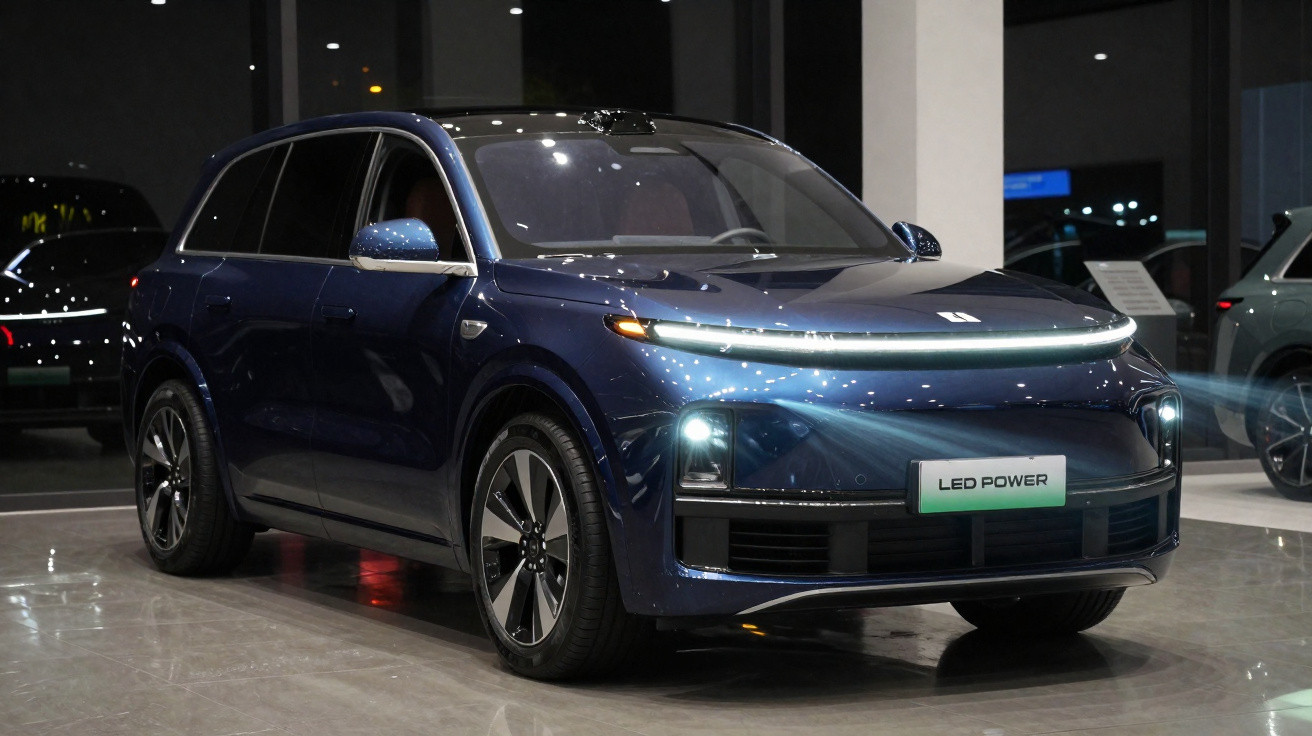
You are driving home along a dark two-lane road. There is a light drizzle, some fog, and one of those familiar stretches where the white line appears to melt into the darkness. You are on edge, gripping the steering wheel, thinking about tomorrow’s meeting. Then it happens: a bend, an approaching car… and your entire view erupts into white light. You squint and slow down; for a second or two, you are almost blind. Once your eyes recover, your heart is racing and you say what everybody says: “Those damn LEDs are going to cause an accident one day.”
A research team has now quantified and tested that exact experience in the laboratory.
Its conclusion confirms what drivers’ eyes have been telling them for years.
LED headlights: when “seeing better” blinds everyone else
In theory, LED headlights sound ideal. They are brighter, whiter and more energy-efficient, cutting through darkness like stadium floodlights while giving drivers the comforting sense of daylight. Car manufacturers market them as a safety feature, an upgrade and even a modest luxury. Use them once on a country road and the appeal is obvious: details appear crisper, signs stand out and road markings become visible again.
For people outside that car, however, the experience can be entirely different.
Researchers at several European road-safety laboratories examined hundreds of real-life encounters involving cars fitted with LED headlights and approaching drivers. They recorded light intensity, glare angles, pupil response times and the time drivers needed to regain their position in the lane after being dazzled. Their finding was stark: beams that improve visibility for the driver in an LED-equipped vehicle can greatly increase discomfort - and temporary partial blindness - for those coming towards it.
That familiar feeling of “I can’t see anything for a second” is not merely subjective. It can be measured.
From a technical perspective, LEDs do not necessarily produce more total light than older halogen lamps. The difference lies in their spectrum, beam pattern and the height from which modern SUVs and crossovers project their light. Their whiter, more “blueish” output scatters differently within the eye, as well as in rain, fog and on wet tarmac. This produces sharp contrasts and severe reflections that the human visual system struggles to process rapidly.
Put simply, the retina was not designed to cope with approaching mini-suns positioned at eye level.
What the study really says… and what you can actually do
The researchers began with a straightforward scenario: two cars pass each other at night, both travelling at about 80 km/h. They modelled various headlamp types, mounting heights, beam patterns and levels of dirt on the lenses. They then measured the distance at which an approaching driver experienced discomfort, and when their visual performance began to decline. One figure appeared repeatedly, and it is unsettling: one or two seconds of impaired vision is normal, while three or four seconds is not uncommon.
At 80 km/h, this can mean travelling more than 50 metres while “half-blind”.
Most drivers have experienced it: meeting an SUV with intensely white lights on a wet road, only for the whole scene to become a fluorescent mirror. The study documents precisely this effect. On wet surfaces, LED glare rises sharply because the road effectively becomes a huge reflective sheet. In driver-view footage, the tarmac no longer appears black, but as a faded grey surface on which lane markings disappear. One participant even lifted his hands from the wheel for a fraction of a second, instinctively trying to shield his eyes.
It is that reaction, repeated by thousands of motorists every night, that genuinely concerns road-safety specialists.
The scientists also draw attention to an issue that receives little discussion: age. As we grow older, our eyes take longer to adjust to abrupt changes in light. In laboratory tests, drivers aged over 60 needed almost twice as long to regain full contrast sensitivity after intense LED glare. This does not make them “bad drivers”; it simply means biology is quietly increasing the risk. Put a 25-year-old in a low sports car in front of tall SUV LEDs and you’ve basically created a test of reflexes.
On an actual road, with tiredness, rain and stress added to the mix, it becomes a hazardous combination we already understand all too well.
How to cope in the age of dazzling LED headlights
The study does not simply criticise manufacturers and regulations. It also identifies small, practical actions that can substantially reduce the danger for everyone. The first is headlamp adjustment. Most newer cars feature a small dial that lowers the beam when the boot is heavily loaded or rear passengers are travelling. Realistically, very few people adjust it every day. Yet the tests indicate that lowering it by only one setting can dramatically reduce perceived glare for approaching drivers, while making very little difference to the driver’s own visibility.
The few seconds of light range you give up allow somebody else to keep their eyesight.
Another useful habit is to direct your gaze slightly to the left when you are dazzled, towards the white line or roadside edge, instead of looking directly at the approaching lamps. This is not about courtesy; it is self-protection. The study found that drivers trained to do so maintained better lane positioning and reported lower stress levels. It is also best not to clean the inside of the windscreen with a sleeve or an unsuitable cloth. Fine smears and greasy halos turn every approaching LED into a burst of stars.
It may sound obvious, but this sort of small detail can be the difference between something that is merely irritating and something that is truly dangerous.
Researchers also stress a point rarely mentioned in advertising: eyes need rest. Long night journeys with constant LED glare drain concentration far more than most of us acknowledge. One of the report’s authors put it plainly:
“We have improved how much the driver of one car can see, but we have worsened how safe everyone else feels sharing the road with them.”
They recommend several practical measures:
- Clean headlights and the windscreen regularly, both inside and out
- Lower the beam when carrying passengers or heavy luggage
- Reduce speed slightly when an approaching car is clearly dazzling you
- Have a mechanic check headlight alignment once a year
- Use dipped beams in lit urban areas rather than relying entirely on automatic mode
These are not heroic measures. They are minor, human-scale adjustments in a world where technology has advanced faster than our night vision.
When progress feels too bright for comfort
The story of LED headlights is something of a parable for modern motoring. We wanted greater efficiency, cleaner styling and a premium light signature that makes every model instantly recognisable. We achieved all of that, along with genuinely improved visibility for the person at the wheel. But we also introduced new discomfort, greater fatigue and the quiet flash-for-flash conflict in which each driver accuses the other of “not dipping their beams”.
The study does not claim that LEDs are inherently bad. It says they are powerful tools that our roads, regulations and even our habits have not yet fully adapted to.
Some countries are already imposing stricter limits on maximum glare and testing adaptive matrix systems that shape the beam to avoid shining directly into approaching eyes. Such systems are intelligent and promising, but they remain uncommon and costly. Meanwhile, most of us travel beneath a patchwork of older halogens, harsh aftermarket LEDs and newly fitted factory optics aimed slightly too high. The laboratory data merely confirms what night-time motorists have been saying on forums and around family dinner tables for years.
At times, progress does not feel like a seamless journey. It feels more like a series of minor shocks that we gradually learn to accept.
What this research quietly asks is straightforward: how much comfort are we prepared to sacrifice for individual “visibility”? And are we willing to accept that the safest road at night is one where everyone can see “well enough”, rather than one where a few drivers see perfectly while others flinch and blink behind them? If you have ever arrived home after driving at night with sore eyes and a clenched jaw, you already know the answer. You probably felt it long before a scientist measured it.
The headlights have changed. Our eyes have not.
| Key point | Detail | Value for the reader |
|---|---|---|
| LED glare is measurable | Studies show 1–4 seconds of degraded vision after crossing bright LEDs | Helps drivers understand their discomfort is real, not “in their head” |
| Small adjustments matter | Lowering headlight aim and cleaning glass can significantly cut glare | Offers easy actions to feel safer at night with any car |
| Age and conditions amplify risk | Older eyes and wet roads increase dazzle and recovery time | Encourages adapted speed, breaks and more empathy between drivers |
FAQ:
- Are LED headlights actually more dangerous than halogens? They are not automatically more dangerous, but their whiter spectrum, beam pattern and mounting height can create more intense glare for approaching drivers, particularly on wet roads or when fitted to SUVs.
- Can I dim my factory LED headlights? No, there is no brightness control, but you can alter their vertical aim, use the manual height dial when the car is loaded, and avoid needless full-beam use or badly adjusted aftermarket bulbs.
- Do yellow-tinted glasses help against LED glare? They may improve contrast slightly for certain people, but they do not eliminate the underlying glare and can reduce the overall light reaching the eye, which is not ideal in very dark conditions.
- Is it worth upgrading my old halogens to LED bulbs? Only where the headlamp unit was designed for LEDs and the bulbs are approved for road use; inexpensive retrofit kits often create more glare and may even be illegal, despite seeming brighter from the driver’s seat.
- What’s the safest reaction when I’m suddenly dazzled? Ease off the accelerator, hold your lane by focusing towards the left edge of the road, do not stare at the source of light, and wait a second or two before accelerating again.

Comments
No comments yet. Be the first to comment!
Leave a Comment