
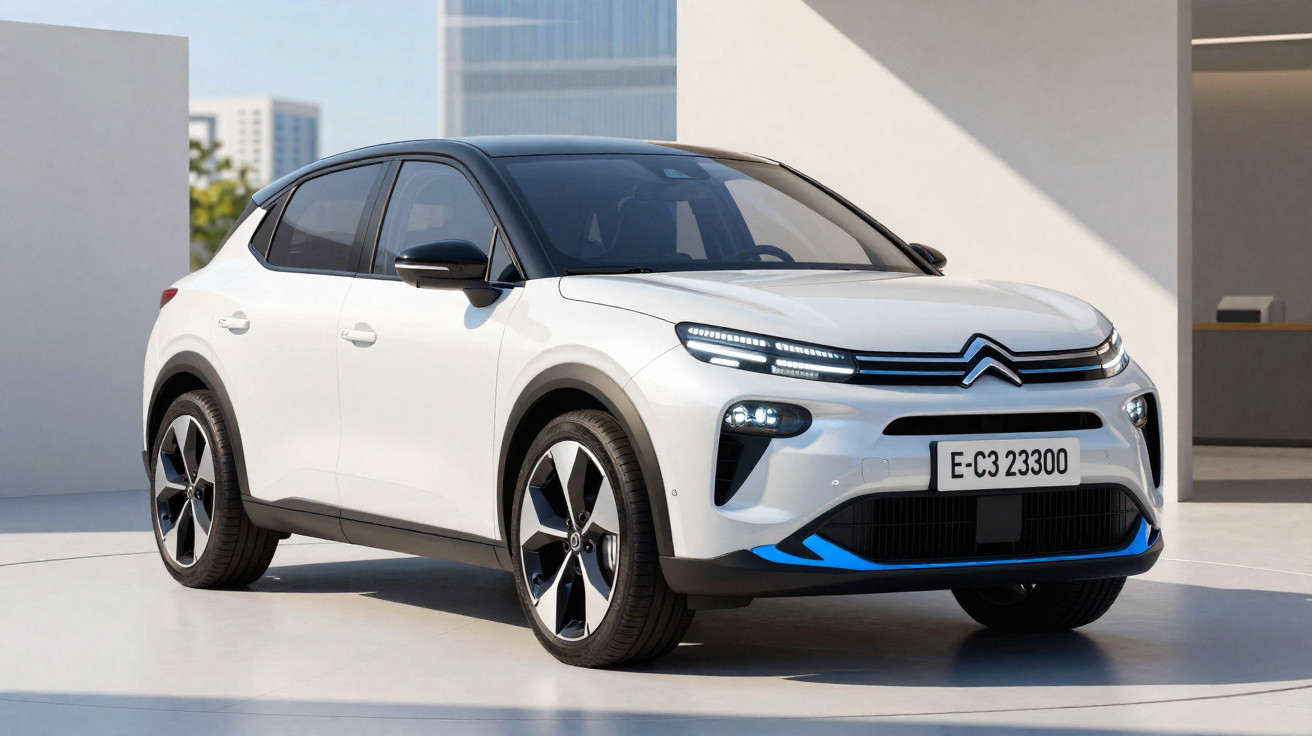
Price is the Citroën ë-C3’s strongest selling point, making it the least expensive electric car in its segment. But what has been sacrificed to achieve it?
Introduced in 2002, the Citroën C3 needs little introduction. Since the first generation, more than 5.6 million examples have been sold worldwide, making it the French marque’s best-selling model of all time.
With this fourth generation, Citroën intends to go further still, placing a major focus on an all-new fully electric variant called the ë-C3. Its headline price is just €23,300, which makes it the cheapest electric model in the B-segment.
An even more affordable version will arrive in 2025, fitted with a smaller battery of around 30 kWh and offering only 200 km of range. Prices for this ë-C3 will start at €19,990.
But is price everything? How many compromises were needed to reach these figures? We travelled to Austria for an early drive to find out.
A formula for success
One of the “secrets” behind this price is Stellantis’ new global Smart Car Platform. Based on the e-CMP architecture, it was optimised with Tata for the Indian and South American markets.
However, it will also underpin further compact models intended for Europe. The ë-C3, along with the C3, is simply the first of them: the recently unveiled Fiat Grande Panda is another example, as is the new C3 Aircross.
It is worth noting that this platform is not the one used by fully electric versions of models such as the Jeep Avenger and Fiat 600. Those cars use the e-CMP2 platform.
Where is the Oli influence in the Citroën ë-C3?
At 4.02 m long, the new Citroën ë-C3 is comparable in size with cars such as the Dacia Sandero and Peugeot 208. Yet, having grown by 9.3 cm in height to reach 1.58 m overall, it now clearly positions itself as a crossover.
That impression is strengthened by numerous more rugged-looking details, beginning with the upright front end and its uncomplicated lines. Several elements draw inspiration from the Citroën Oli, a concept car we previously had the opportunity to drive on public roads.
Most notable is the new C-shaped light signature, alongside the new badge inspired by an older Citroën emblem. It makes its production-car debut here.
The bumpers are also hard to miss, as are the wheel arches with their prominent plastic cladding. Together, they emphasise the car’s robust character and give it a more distinctive identity.
Straightforward but practical
The links between the new C3 and the Oli continue inside, where the cabin represents a complete break from that of the previous generation.
This is immediately clear from the dashboard, which uses simple horizontal lines. It is also apparent in the projected head-up display - still a screen, and fitted as standard across the range - which replaces a conventional instrument cluster.
The construction is deliberately uncomplicated, with mostly hard-touch plastics. Even so, the fit and finish feel solid and reassuring.
Piano-black trim on the centre console and recycled-material fabrics decorating the dashboard help improve the overall impression of quality, which is better than I expected. I must admit, though, that the cabin could do with a splash of colour, as it felt rather “grey-looking”.
Even so, the compact steering wheel deserves a mention - it will not appeal to everyone, but I liked it - as do the 10.25-inch touchscreen, available on the range-topping Max version, automatic air conditioning, reversing camera, and standard Android Auto and Apple CarPlay compatibility.
Naturally, the extensive range of standard driver-assistance systems should not be overlooked either. These include rear parking sensors, cruise control with a speed limiter, autonomous emergency braking, a lane-departure warning, traffic-sign recognition and a driver-attention warning.
What about space?
For a clearer idea of the space available inside and what this model has to offer, I invite you to watch the featured video.
That said, I can already confirm that the rear bench is suitable for two occupants, while the boot holds 310 litres. It is not a particularly striking figure, but it seems sufficient for the needs of a small family.
Up to 320 km of range
During this first drive around Vienna, Austria, the first version I tested was the range-topping ë-C3 Max. It has a 113 hp, 125 Nm electric motor, reaches 100 km/h from rest in 11s and has a top speed of 135 km/h.
Power comes from a 44 kWh LFP lithium iron phosphate battery supplied by Chinese company SVOLT, which provides a range of up to 320 kilometres.
The power, acceleration and range figures are not especially impressive, particularly when compared with other Stellantis offerings. Nonetheless, they are sensible figures when the purchase price of this electric car is taken into account.
A surprise on the road
The first thing you notice from behind the wheel of the Citroën ë-C3 is its high level of comfort. This is down to the suspension, which uses a twin hydraulic bump-stop system for each spring-and-damper assembly.
The system can manage compression and rebound independently, helping to reduce the body’s vertical movements.
We have already encountered this technology in other models from the French brand, but Citroën deserves credit for fitting it at this price point, especially as it is standard on every version.
And it makes a real difference. Although the Citroën ë-C3 is relatively tall, it never leans excessively through bends.
It is not a sprinter - and does not need to be
Do not expect the punchy acceleration found in some other fully electric cars. The Citroën ë-C3’s performance is consistently modest, but it never disappoints, not least because there is no loss of traction, as is often the case with more powerful electric models.
In urban conditions, where the ë-C3 feels most at home, it is always nimble and, above all, very easy to drive. There are no driving modes; the transmission alone has a “C” setting, which reduces the level of regeneration.
The steering also merits praise, with suitable weighting, as does the brake pedal. It feels very progressive from the start of its travel and is particularly well calibrated in the transition between regenerative and hydraulic braking.
And the petrol version?
During this first drive, I also covered a few dozen kilometres in the purely combustion-powered C3, which uses a 1.2-litre three-cylinder engine producing 100 hp.
This variant is cheaper still, with prices starting at €14,990. It remains simple to use, but in my view it loses out in refinement and dynamic behaviour - the battery’s additional weight, positioned low down, ultimately benefits the ë-C3.
On top of that, the engine feels short of breath at higher revs. It is paired with a six-speed manual gearbox.
Which is the best version?
Of the versions tested, I have no doubts about the more appealing one: the ë-C3, with prices beginning at €23,300 for the You version. The Max version I drove rises to €27,800. Naturally, this applies to buyers with somewhere to charge it, either at home or at work.
I am curious to see whether the smaller-battery version arriving in 2025 will give up many advantages compared with this model. At €19,990, it appears, at least on paper, to be one of the market’s most interesting electric cars.
For many users, after all, 200 kilometres of range will not be an issue. Dacia demonstrated exactly that with the launch of the Spring.
Speaking of the Spring, it is a good time to clarify that Dacia’s electric car sits in the A-segment, for city cars. The Citroën ë-C3, in the B-segment for superminis, therefore offers more space, range and versatility.
If you are not ready for a fully electric car, the petrol C3 is undoubtedly an option worth considering: it too becomes one of the most affordable offerings on the market.
Comments
No comments yet. Be the first to comment!
Leave a Comment