
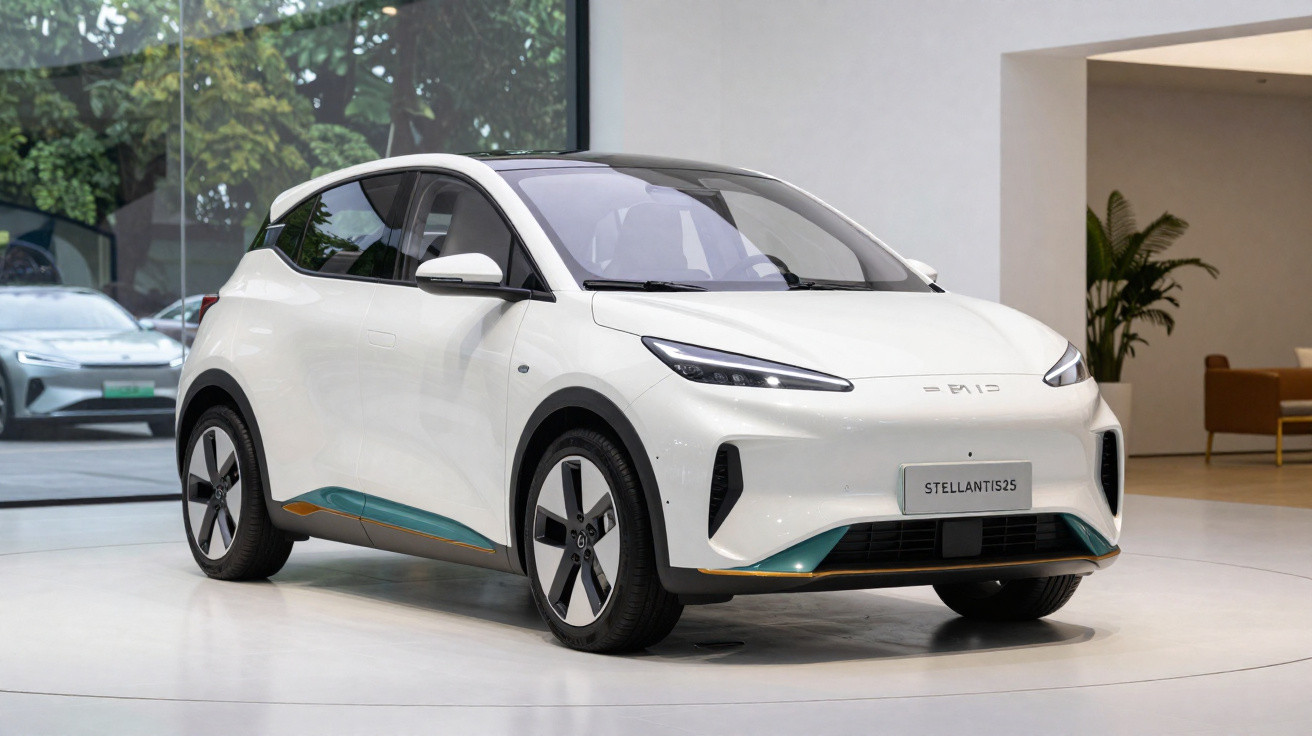
At the latest Munich Motor Show (IAA Mobility 2025), which opened on 8 September, Jean-Philippe Imparato, Stellantis’s European chief, unveiled two proposals primarily intended to cut the sector’s emissions without relying exclusively on sales of fully electric cars.
As well as lowering emissions, both measures could help modernise the vehicles currently on the road. Their average age continues to rise, both in Portugal, where it has already exceeded 14 years, and across Europe, where the average has reached 12 years.
One proposal would give manufacturers CO₂ credits linked to a scrappage incentive scheme, while the other calls for the introduction of an entirely new vehicle category.
Stellantis proposals to renew Europe’s vehicle fleet
The first measure would operate as a type of offset mechanism for manufacturers: scrapping an older car and replacing it with a new vehicle, or a used one less than three years old, would generate a credit of 70 g CO₂/km.
The second proposal involves a new European approval category for compact vehicles measuring under 3.5 m in length. Modelled on Japan’s kei cars, it would apply less demanding safety regulations in order to keep retail prices below €15,000.
Imparato said both proposals have already been submitted to the ACEA (European Automobile Manufacturers’ Association), although the response has been mixed. A meeting with the European Union is scheduled in Brussels for 12 September, following the Strategic Dialogue on the future of the sector.
Stellantis’s European chief maintained that renewing the existing fleet is vital, and that concentrating solely on electric vehicles will not be enough. Even if EV market share rose to 30% - it currently stands at 15.6% in the European Union and 17.4% across the continent - this would represent only 4.5 million cars a year, compared with more than 250 million vehicles now in use in Europe.
With the average age of Europe’s car fleet exceeding 12 years - and 150 million cars more than a decade old - he said that, at the present pace of transition, “the fleet would continue to age by one month every year”, underlining the urgency of renewal.
Renewing the fleet
By encouraging motorists to exchange older vehicles for new or nearly new cars, with carbon credits provided in return, Jean-Philippe Imparato argues that “in this way, manufacturers could meet their CO₂ targets without having to pay fines or rely on state subsidies”.
Affordable compact cars below €15,000
Meanwhile, the proposal for a new vehicle category designed to ensure that cars, whether petrol or electric, can be sold for under €15,000 addresses a price point that is almost absent from today’s European market. It takes inspiration from Japan’s kei car model, which restricts dimensions, engine size and power, and Brazil’s Popular Car scheme, limited to engines of up to 1,000 cm³ and 90 hp.
The figures cited by Imparato illustrate the situation. In 2018, 49 models priced at up to €15,000 were sold in Europe; today, almost none are available: “(In 2018) one million cars were sold in Europe for less than €15,000; today we are at 90,000 units”.
He concludes that the category he is proposing could revive the city-car segment, where sales have been falling year after year: in 2024, they dropped by 22%, with 545,000 units sold (Source: Dataforce).
Yesterday, Ursula von der Leyen, President of the European Commission, also addressed the issue in her State of the European Union speech, proposing the Small Affordable Cars Initiative. This aligns with the position advocated by Stellantis and the Renault Group:

Comments
No comments yet. Be the first to comment!
Leave a Comment