
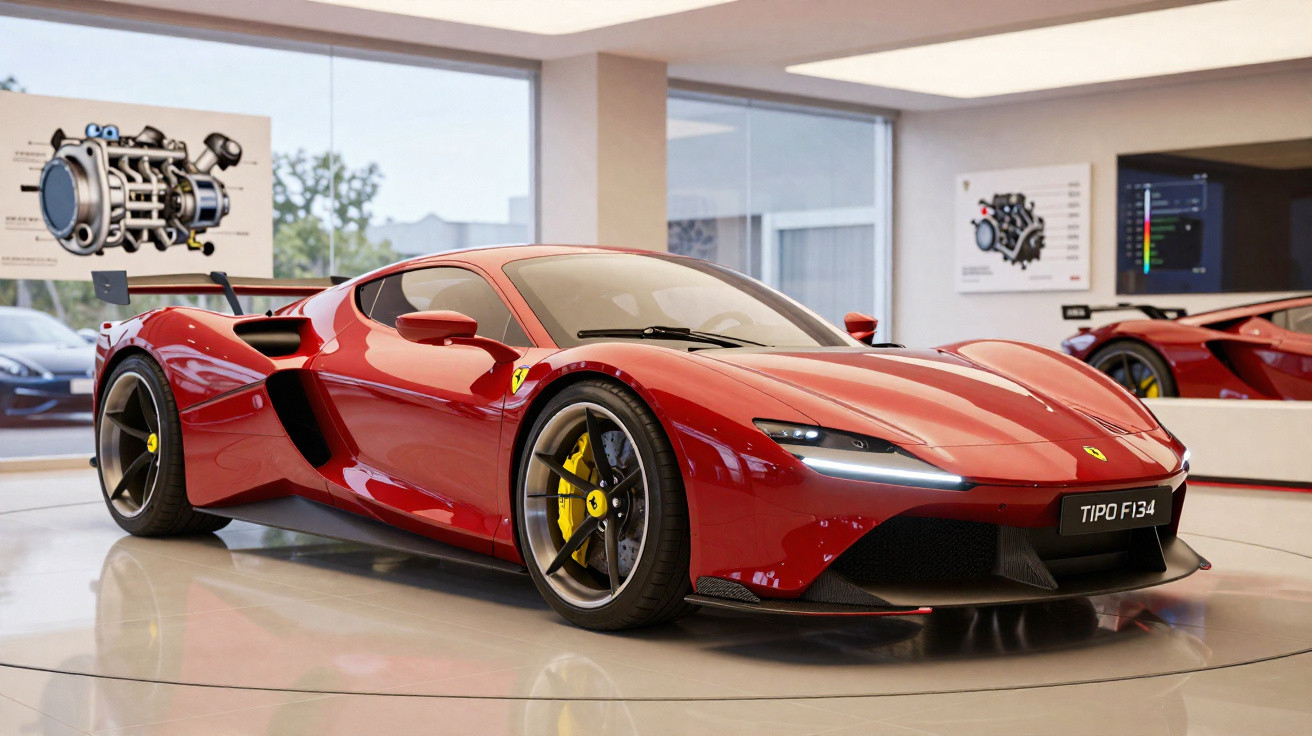
A test bed for a Ferrari V6
Ferrari-developed engines tend to bring epic V12s and V8s to mind, rather than compact three-cylinder units. The Tipo F134 is the exception.
Created during the 1990s, the Tipo F134 was almost certainly never intended to become a Ferrari production three-cylinder engine - especially some two decades before such engines became commonplace. Instead, it was born from the need to test and validate new technological solutions.
There was no need to build an entire engine for this purpose, only part of one. That explains the Tipo F134: it represented half of the V6 that Ferrari ultimately intended to create.
Two-stroke technology in the Ferrari Tipo F134
The innovative aspect of this 1.3-litre three-cylinder engine was that it used a two-stroke cycle and a supercharger.
Two-stroke engines are more readily associated with motorcycles than cars, although they have also been used in automobiles. They offer several benefits: they are more compact, lighter and simpler, while potentially being more thermally efficient than the four-stroke engines fitted to our cars.
However, one of the main reasons they largely “disappeared”, even from motorcycles, is the pollution they produce. This is largely caused by the fuel-oil mixture they require and by fuel losses when operating outside their optimum rev range.
During the 1990s, though, the motor industry saw renewed interest in the two-stroke engine, with several manufacturers investing in its development. As this project demonstrates, Ferrari also explored this possible evolution of the internal-combustion engine through the Tipo F134.
A concentration of sophistication
The Drivetribe video below takes a closer look at Ferrari’s Tipo F134.
Well-known presenter Mike Fernie introduces this rare engine and reveals how far ahead Ferrari was in reducing or eliminating the drawbacks traditionally associated with two-stroke engines.
For instance, the small three-cylinder unit already used multipoint injection rather than a carburettor. Although two-stroke engines do not require them, it also featured exhaust valves operated by a camshaft.
A supercharger was one of the crucial additions that enabled the “reinvented” two-stroke engine to meet its power and emissions targets. As well as increasing the volume of intake air, it was essential for clearing exhaust gases, improving combustion efficiency.
The Tipo F134 produced 130 hp from its 1.3-litre capacity - equivalent to 100 hp/litre. This would have translated into 260 hp for the intended V6, with 2.6 litres of capacity and therefore two 1.3-litre banks arranged in a “V”.
Even at the time, these were not remarkable figures, at least for a supercar: the Ferrari F40, with its 2.9 V8 twin-turbo engine, achieved 162.8 hp/litre.
That lends credibility to rumours that Ferrari studied a turbocharged Tipo F134 variant, which would have raised output to 216 hp. That equates to 166 hp/litre, or 432 hp when once again considering the V6.
History shows that the Tipo F134 never became a production engine. Yet, at a time when Formula 1’s technical director has even discussed the possibility of the championship using two-stroke engines with solutions similar to those seen in this three-cylinder unit, could Ferrari revisit the lessons learned during its development?




Comments
No comments yet. Be the first to comment!
Leave a Comment