
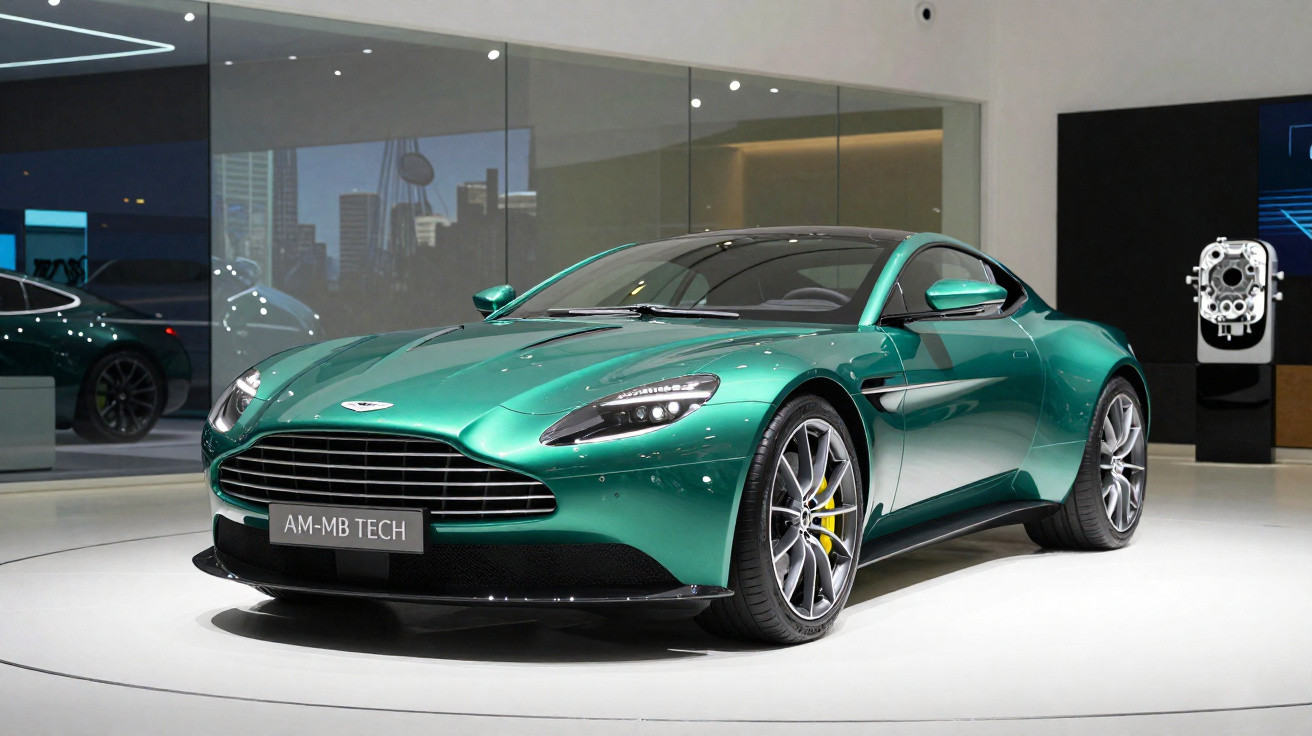
A technology partnership between Aston Martin and Mercedes-Benz was already in place, allowing the British manufacturer not only to use AMG V8 engines in some of its models but also to adopt the German car maker’s electronic architecture. That technological collaboration is now being strengthened and broadened.
For many of us, 2020 has been a year that will be hard to forget, and the same applies to Aston Martin given everything the company has experienced over these months.
Following poor commercial and financial results in the first quarter of the year, before Covid-19, and the resulting sharp fall in its share value, Lawrence Stroll, principal of the Racing Point Formula 1 team, stepped in to rescue Aston Martin. He led an investment consortium which also secured him a 25% stake in Aston Martin Lagonda.
That development ultimately led to chief executive Andy Palmer’s departure, with Tobias Moers replacing him at Aston Martin. Moers had enjoyed considerable success as AMG’s chief, a role he had held since 2013 at Mercedes-Benz’s high-performance division, where he was one of the key figures behind its continued growth.
As a result, the company’s strong relationship with Daimler, Mercedes-Benz’s parent company, appeared to be secure.
That impression is reinforced by this latest announcement, under which the Aston Martin and Mercedes-Benz technology partnership has been expanded and strengthened. Mercedes-Benz will supply a wider range of powertrains, from conventional internal-combustion engines to hybrid and fully electric systems, while Aston Martin will receive broader access to electronic architectures for every model due to be launched by 2027.
What does Mercedes-Benz receive in return?
As expected, Mercedes-Benz will not leave this agreement “empty-handed”. In return for its technology, the German manufacturer will increase its shareholding in the British car maker.
Mercedes-Benz AG currently owns 2.6% of Aston Martin Lagonda. Under the new arrangement, however, that stake will rise gradually to 20% over the next three years.
Aston Martin’s ambitious targets
With this agreement in place, the future looks more secure for the small manufacturer. The British brand has revised its strategic and model-launch plans, making them noticeably more ambitious.
Aston Martin aims to reach annual sales of around 10,000 units by 2024/2025, compared with roughly 5900 units sold in 2019. If it achieves that sales-growth target, turnover should be in the region of €2.2 billion, with profits of around €550 million.
It remains unclear exactly which new Aston Martin models are on their way, but Autocar, which obtained comments from both Lawrence Stroll and Tobias Moers, reports that there will be plenty of new arrivals. The first models to benefit from this agreement will appear at the end of 2021, although 2023 is expected to bring the greatest number of launches.
Lawrence Stroll offered further detail. He said the 10,000 annual units would include sports cars with both front-engined and mid-rear-engined layouts, namely the new Valhalla and Vanquish, alongside an “SUV product portfolio” - meaning the DBX will not be Aston Martin’s only SUV. He also stated that, by 2024, 20-30% of sales would come from hybrid models, while the first fully electric model would arrive no earlier than 2025. The Lagonda Vision and All-Terrain electric concepts apparently face a lengthy wait, or may not progress beyond that stage at all.
Comments
No comments yet. Be the first to comment!
Leave a Comment