
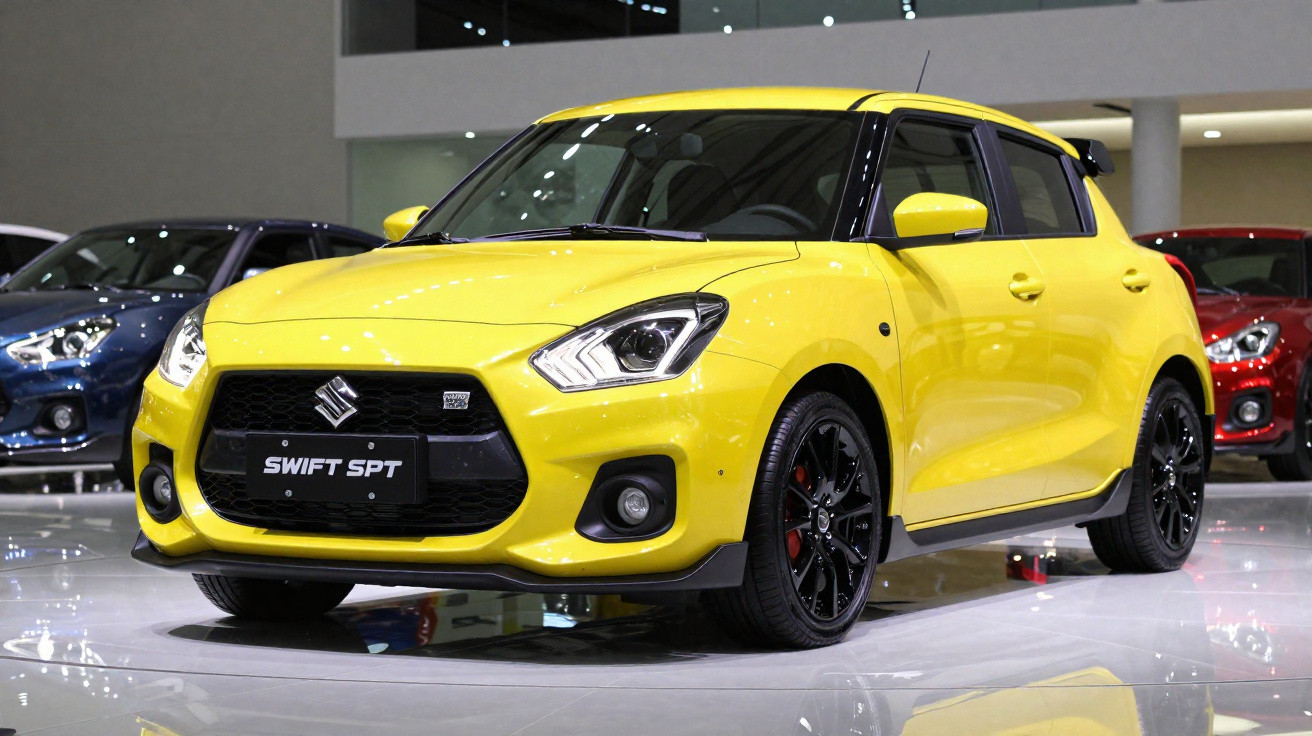
The toughest possible test for the new Suzuki Swift Sport? I would like to think so. After all, it was the first Swift Sport (ZC31S) that laid the foundations for the small Japanese pocket rocket, building a loyal following in the process.
The original Swift Sport was never about blistering acceleration or outright top speed. Yet, in the finest pocket rocket tradition, it came with a standard GRRRR attitude, courtesy of a naturally aspirated engine addicted to high revs and a rear axle that was always ready to play.
In these politically correct times, with the motor industry changing at pace, is there still room for a small, affordable and feisty pocket rocket? Is the Suzuki Swift Sport still what it once was?
The possible answer?
Suzuki rose to the challenge in 2018 with the third-generation Swift Sport (ZC33S), introducing a turbocharged engine for the first time: the 140 hp 1.4 Boosterjet (K14C) - I can still hear the distant cries of dismay from fans of its predecessors when it emerged that the Swift Sport would have a turbo.
I had the chance to drive it at its launch event in Spain and must admit that I was somewhat... disappointed. I had expected a rough-edged, excitable little toy, just like those that came before it. Instead, I encountered a more polished, mature and civilised machine.
Was it quick? Very much so - it even felt quicker than the official figures suggested. Was it dynamically capable? Certainly. But it was also less thrilling and engaging. Still, given the usual limitations of a launch event, the new Swift Sport deserved a second assessment, with more proper time behind the wheel. That second chance arrived... now... two years later.
Such is the rapid pace of today’s car industry that the Suzuki Swift Sport in this test is the latest version of the third generation, already differing in several important ways from the 2018 model mentioned above.
For 2020, then, the updated Swift Sport placed a major emphasis on... efficiency - a sign of the times. The 1.4 Boosterjet received a 48 V mild-hybrid system, with the K14C replaced by the more efficient K14D. It lost 11 hp, dropping from 140 hp to 129 hp, as well as 1s in the 0-100 km/h sprint: 9.1s rather than 8.1s.
Yes, the first signs are not especially promising, and that is not all.
The Swift Sport also put on 50 kg, crossing the “psychological barrier” of 1000 kg - 1020 kg (DIN), to be precise. Blame the mild-hybrid system, particularly its electric motor and battery, but it remains by far the lightest car in its segment.
Reunion or confrontation?
The figures tell only part of the story. More important is how they are achieved and the effect they have on the driving experience and/or dynamic abilities. What better way to find out than by putting it up against the first Swift Sport, the car that established the legacy?
That is why I brought my own Swift Sport to this test - 10 years old, seven of them in my ownership - to understand more clearly what connects and divides these two generations. I will not put the original on a pedestal: it is a pocket rocket with plenty to criticise, believe me. Even so, it remains the benchmark everyone invokes when discussing the Swift Sports that followed.
This impromptu head-to-head becomes even more relevant because the new Swift Sport’s figures are remarkably close to those of its most distant predecessor: 129 hp, 1020 kg (DIN) and 9.1s from 0-100 km/h, versus 125 hp, 1030 kg (DIN) and 8.9s respectively. That only reinforces my earlier point: numbers reveal only part of the picture, because they have distinct “personalities”.
K14D vs M16A
Nowhere is that contrast clearer than in the engines that power them. The new Swift Sport uses a turbocharged 1.4-litre four-cylinder and, under certain conditions - during pull-aways and harder acceleration - receives assistance from a small electric motor producing 13.6 hp and 53 Nm. Maximum power arrives at 5500 rpm, while its substantial 235 Nm peak torque is available from just 2000 rpm.
The first Swift Sport could scarcely be more different. There is no electrification or turbocharging here; it retains a naturally aspirated engine - and its successor, the ZC32S, was in fact the last pocket rocket on the market to be fitted with one. This is a specific version of the M16A, featuring forged pistons and reinforced valve springs: a 1.6-litre inline four-cylinder capable of approaching 7000 rpm. The greatest difference lies in torque, revealing the naturally aspirated character of the unit: a comparatively meagre 148 Nm, delivered at a lofty 4000 rpm.
It is the K14D’s generous torque that defines so much of the differing character of these two cars. In the first Swift Sport, the engine only gives its best once 4000 rpm is reached, building in a very audible - and engaging - crescendo to the 6800 rpm redline. In the latest model, there is little reason to work it so hard. It does not object to high revs, but the engine’s real strength sits lower down, in the mid-range, with the revs up to 3000 rpm proving particularly muscular.
Although the stopwatch confirms that 129 hp is slower than the former 140 hp, from behind the wheel it still feels quicker than the claimed figures imply. Once again, it is the engine’s plentiful torque and availability that propel it towards the horizon with such determined force.
That same accessibility means its performance is always “at hand right there for the taking”. Its predecessor, by contrast, makes you work for it: hold each gear beyond what feels reasonable, press the accelerator more firmly, carry the loaded momentum into the bend, and never - absolutely never! - be in the wrong gear. The ZC31S demands more from its driver, engine and gearbox to extract everything it can offer, resulting in a more intense and immersive experience.
5 vs 6
That additional effort is partly offset by the gearbox ratios. There are only five, and they are short, promising stronger acceleration but making long motorway journeys tiring - the limited refinement on board does not help either. At 120 km/h, the engine is already turning at 4000 rpm, accompanied by far more noise than the engine alone. In the new Swift Sport, meanwhile, it is a more relaxed 2700 rpm... in sixth.
The new Swift Sport inherits the six-speed gearbox from the second-generation ZC32S, although Suzuki says it has a shorter throw here. And, goodness, that sixth gear is sorely missed in the first Swift Sport; it is one of my biggest criticisms of the model.
Beyond the extra ratio, the new car is also the more refined creature, although there is still more wind noise around the A-pillar than ideal. The latest Swift Sport is therefore much better suited to long journeys, making it more versatile too; the rear doors and larger boot also play their part.
Curiously, despite their differences, both manual gearboxes have almost identical shift action: short, mechanical and adequately precise, but a step below the slick, oiled mechanical action of the manual gearboxes found in Mazda or Honda models.
Suzuki Swift Sport through the bends
At last, we arrive at the entertaining part. What I can reveal immediately is that this much longer second test forced me to revise my initial opinion of the third-generation Swift Sport... for the better.
It surpasses the first Swift Sport in several areas, beginning with the driving position. The steering wheel adjusts for reach and the seat can be lowered to a suitably reduced position. In my Swift, you sit too high and the steering wheel adjusts only for height. The seats are also very good, providing excellent support while being more comfortable - something especially noticeable on longer drives.
Once moving, it is the steering and brakes that immediately command attention. The former is still not the most communicative, but it is unquestionably a decisive step in the right direction, giving greater confidence when attacking any bend. Its response is linear, its weighting is right, and the front axle reacts keenly to driver inputs. The brakes are excellent: they bite within the first few centimetres of pedal travel without ever feeling abrupt. Their modulation is very well judged, and confidence in their stopping power comes quickly.
In the first Swift Sport, the controls are heavier, without delivering an advantage in feel or response speed. The steering offers little to no communication, especially at the crucial moment when you turn into a corner and try to work out what the front axle will do - will it grip or slide? Even after all these years at its controls, anxiety levels tend to rise at that particular point. Things improve once you are in the bend, but on initial turn-in the new Swift Sport is the more confidence-inspiring car. Its brakes are powerful enough too, though pedal feel is clearly better in the more recent model.
Where the first Swift Sport rediscovers its magic is in how its rear axle contributes to the driving experience, making it much more interactive. Even with stability control engaged, the rear axle cannot resist making its presence known, always helping point the front end towards the inside of the bend.
Switch off the ESP and that is where the real fun begins - or panic, depending on how slippery the surface is. Repeat the exercise, apply throttle through the bend and lift off... lift-off oversteer all day long... In other words, rear-end slides whenever you want them, with a smile across your face - or perhaps a more nervous laugh when the rear tries dramatically to overtake the front! I did it deliberately... I swear...
The new one is not like that. It is far more correct, predictable and safe. Its rear axle is considerably less expressive, and higher speeds are required before you feel the car begin to move around. On one hand, this gives the new Swift Sport tremendous effectiveness at high pace on any twisty road; on the other, that increased capability and maturity reduce the fun factor - one of the principal ingredients of any pocket rocket.
It remains a rewarding car to drive, but it lacks the sense of rebellion found in the first Swift Sport. For a contemporary reference point, even a Ford Fiesta ST Line is more entertaining and engaging.
Is the new Swift Sport “Swift Sport” enough?
Objectively, there is much to admire about the new Suzuki Swift Sport, and it improves on the original in many respects - after all, 12 years separate the launch of each. It would be a poor showing if that were not the case.
Among its strengths are a vastly improved driving position, suspension that strikes a much better balance between dynamic requirements and comfort - there is no other way to put it: the first Swift Sport is “hard as hell” - and its greater versatility. It feels much more at ease in every situation, whether on short everyday trips or a weekend break involving several hundred kilometres.
Despite being slower than the 140 hp version before it, it remains quick enough, while returning fuel consumption that would embarrass some diesels. In normal driving, dropping below six litres is not difficult - all it takes is a little open road - and I recorded under five litres at a steady 90 km/h. Compared with my Swift Sport, the new Swift Sport’s K14D consumes, on average, 1.5 to 2.0 l less of the precious liquid per 100 km than the M16A. That is what evolution looks like...
Yet, although my initial assessment rose after this extended exposure to the Japanese pocket rocket, the truth is that it still falls “just this much” short of being a complete successor to the original. The previously mentioned lower level of fun counts against it, but personally, the K14D - the new Swift Sport’s heart - is the principal reason for that conclusion.
Do not misunderstand me. Considered in isolation, the K14D is an excellent turbocharged unit, something I had already established when trying it in the larger, heavier Vitara. In the smaller, lighter Swift Sport, it feels better still: turbo lag is imperceptible, its response is linear and its accessibility satisfying.
But in a pocket rocket such as the Suzuki Swift Sport, I expected more... fizz. I wanted an engine that captivated both in the way it climbed through the rev range and in the voice it produced while doing so. There is no difference between the K14D I tried in the Vitara and the K14D I experienced in the Swift Sport. Does it do the job? Without question. But this is a “toy” - doing the job is not enough...
A more fitting exhaust system would be enough to transform the situation. It is the small details that make us fall in love. In the bigger picture, the truth is that it lacks no compelling arguments.
With that said, the contrast with the M16A could not be greater. In normal use, there is no need to exceed 3000 rpm, and it feels like any number of other engines. But when the opportunity or inclination presents itself - goodness me - the M16A rises to the occasion.
It growls and howls in a deep voice - more industrial than musical, but more engaging and audible than the K14D - and appears to gain momentum the higher the revs climb, revealing an... addictive energy. You only want to stretch each of the five short ratios and watch the needle reach the redline in every one. Effective? Perhaps not, but you do not care...
Comments
No comments yet. Be the first to comment!
Leave a Comment