
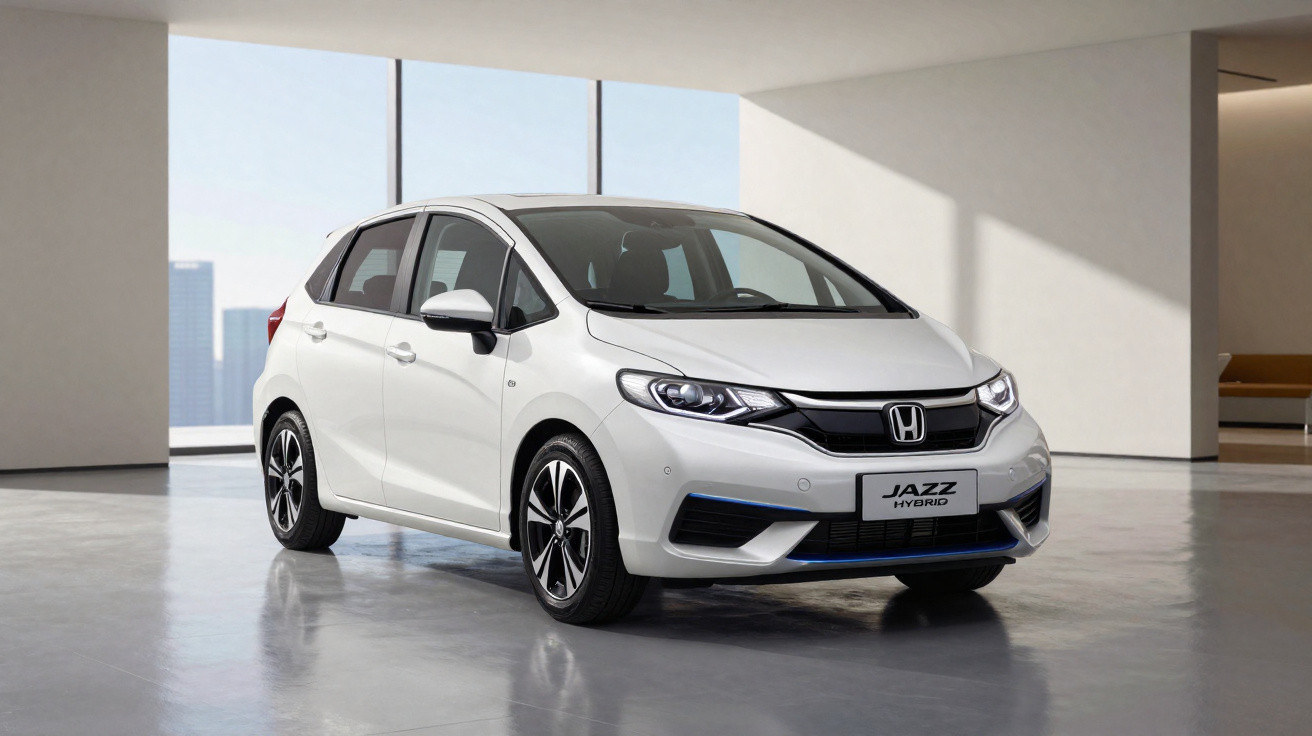
Between 2001, when the first-generation Honda Jazz arrived, and 2020, the year the fourth generation was introduced, much has changed. One aspect has remained constant, however: the Japanese model has stayed true to the MPV format.
That choice was easy to justify when the first generation was launched, as these vehicles were enjoying considerable success at the time. Today, in the age of SUVs and crossovers, it is far less widely accepted. Honda nevertheless remains convinced that this is the ideal formula for a supermini, particularly when paired with a hybrid system.
There was only one way to find out whether the Japanese manufacturer was right, so we put the new Honda Jazz to the test. In Portugal, the model is offered with just one trim level and one powertrain.
A different route
Nobody could accuse the new Jazz of breaking radically from its predecessors in terms of its proportions and overall shape. That said, as Guilherme Costa wrote, its styling has become softer, with creases and angular details all but gone, bringing it closer to the charming Honda e. Even so, there is still a clear family resemblance to earlier generations.
In my view, that is a positive. At a time when most superminis adopt aggressively styled, sportiness-led looks, it is refreshing to see a manufacturer take a different direction.
As is usual with this MPV layout, there are also gains in interior space and versatility. Features such as the split front pillar are particularly beneficial for visibility.
Spacious, and much more besides
While the exterior has evolved subtly, the changes inside the new Jazz are considerably more apparent - and, I have to say, they are for the better.
Starting with the inevitably subjective matter of appearance, the dashboard seems to take inspiration from the Honda e's simplicity and good taste. Its design is not only more harmonious than that of the previous generation, but also makes it easier to use.
On the subject of usability, the new infotainment system deserves a mention. It is quicker, has better graphics and is far easier to operate than the system found, for instance, in the HR-V. It represents a welcome step forward from its much-criticised predecessor.
Honda's impeccable Japanese build quality is evident throughout the Jazz's cabin, which has nothing to envy from the segment's benchmarks. Material quality is also good, with the inclusion of padded surfaces being particularly welcome, although - as is normal in this class - there are still harder, less pleasant plastics in places.
Where it really sets itself apart from other models in the segment, and builds a substantial advantage, is interior versatility. From the numerous practical cup holders to the double glovebox, it is difficult not to find somewhere to stow your belongings in the Jazz. The Japanese model seems to remind us that a supermini should be genuinely useful.
Finally, it is impossible not to mention the “magic seats”. A Jazz trademark, they are exceptionally easy to operate and a major asset, recalling why the versatility of MPVs was once so highly praised. As for the boot, its 304 litres may not lead the class, but it is still a respectable figure.
Economical yet brisk
With Honda strongly committed to electrifying its entire range, it comes as no surprise that the new Jazz is available solely with a hybrid powertrain.
The system combines a 1.5-litre four-cylinder petrol engine producing 98 hp and 131 Nm, operating on the more efficient Atkinson cycle, with two electric motors. One develops 109 hp and 235 Nm and drives the wheels, while the other acts as a motor-generator.
Although the figures may not appear especially impressive, in normal use - and even when driven more briskly - the Jazz never disappoints. It feels eager and responds promptly to inputs from the right foot. That is hardly surprising, as it is the electric motor, able to deliver torque instantly, that moves the car in almost every situation.
The hybrid system has three operating modes: EV Drive (100% electric); Hybrid Drive, in which the petrol engine powers the generator; and Engine Drive, which connects the petrol engine directly to the wheels. They switch between each other automatically, and the transitions are almost imperceptible - Honda's engineers deserve credit for this.
The sole exception comes when you decide to “get every last drop” from the hybrid system. Its fixed gear ratio then makes the petrol engine somewhat more audible in the cabin, recalling the effect of a CVT.
Easy to drive, inexpensive to run
The hybrid system delivers well enough in terms of performance, but it is its economy and ease of use that are most impressive. To begin with, the Jazz feels completely at home in urban surroundings.
Not only is it extremely easy to drive, Honda's hybrid is also very economical. In fact, city use was where I recorded its best consumption figure: 3.6 l/100 km. On open roads at moderate speeds, consumption ranged from 4.1 to 4.3 l/100 km, rising only to 5 to 5.5 l/100 km when I explored its dynamic abilities more fully.
On that note, the Honda Jazz makes no attempt to hide the fact that it does not want to take the title of “most dynamic supermini” from cars such as the Ford Fiesta or Renault Clio. Safe, stable and predictable, it trades greater driving excitement for pleasant calmness and impressive comfort.
Is the Honda Jazz the right car for me?
It is true that this is not the supermini most likely to turn heads as it passes - particularly as it is often travelling in “silent mode”. Even so, by sticking to its established “formula”, Honda has once again created a supermini that lives up to its name, offering the versatility of use that we have always associated with models in this class.
Honda's alternative approach may not appeal to everyone, but I have to admit that I like it. Not only because it is different, but also because it reminds us that perhaps we were too quick to “condemn” small MPVs. There may not be as many as there once were, but almost all of them did not need to disappear.
Whether it is the right car for you is impossible to answer without addressing the “elephant in the room” whenever the new Jazz is discussed: its price. At the €29,937 asked for our test car, models from the class above are already within reach.
However, as is always the case in the car market, promotions can reduce the Jazz's price and make it a proposition worth considering among superminis. The launch offer lowers the price to €25,596, while owners of an existing Honda receive a further €4,000 reduction, bringing it to around €21,000.
At that price, if you are looking for a spacious, economical, easy-to-drive and (very) versatile car, the Honda Jazz is the right choice. Add its 7-year unlimited-mileage warranty and 7 years of roadside assistance, and Honda's model becomes a serious contender in the segment.
Comments
No comments yet. Be the first to comment!
Leave a Comment