
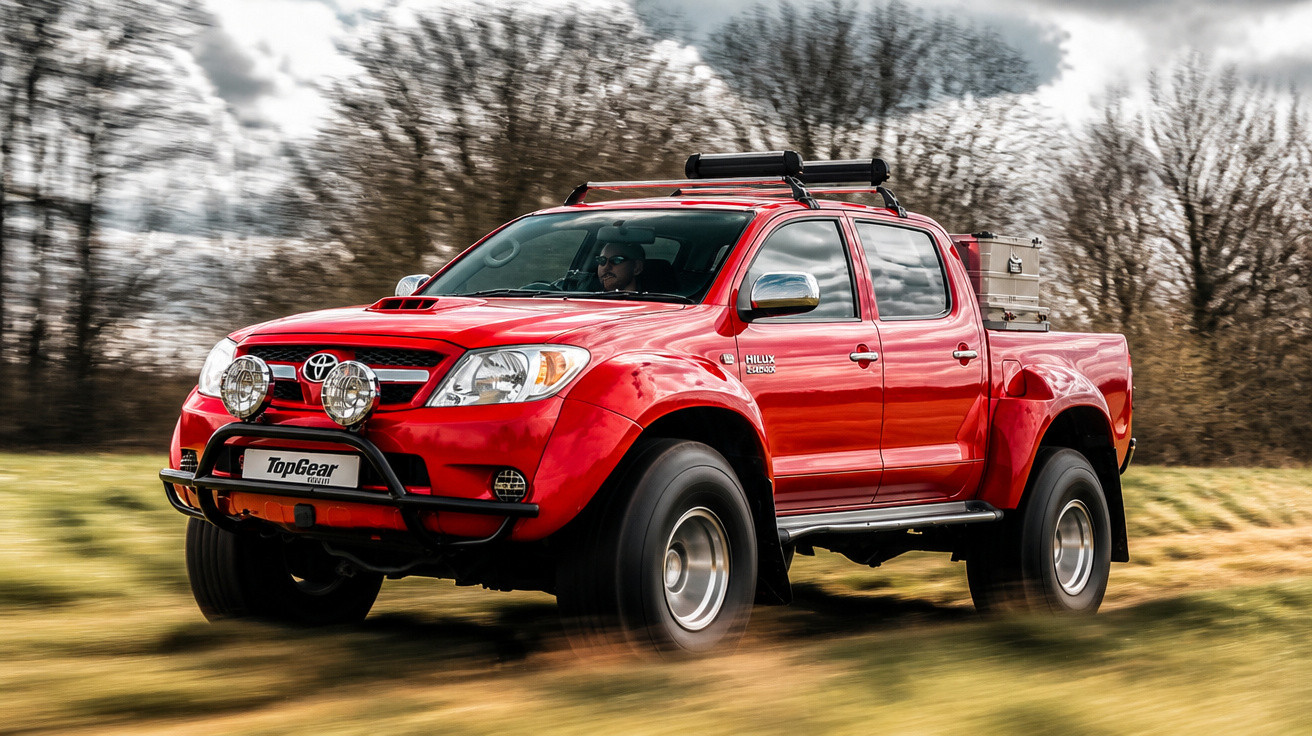
When you strip everything back, it is simply a Hilux. Yes, it has oversized tyres and a gun case, but those are merely cosmetic additions. Remove them and nothing fundamental changes. Those accessories did not make this Toyota formidable: the Hilux was tough from the outset.
It only required an opportunity to demonstrate it. That opportunity arrived, more than once, on Top Gear television during the 2000s. On one occasion, it was blown up along with the 23-storey building on which it stood. On another, it was driven towards a volcano. It survived every time.
The Hilux that reached the magnetic North Pole
This example, though, was a true record holder: the first vehicle ever to reach the magnetic North Pole. It carries that distinction without any fuss. There is no sense of inner glow or the weathered, distant demeanour of a veteran explorer. It is merely a Hilux, getting on with Hilux duties.
Photography: Jonny Fleetwood
That said, Arctic Trucks, Icelandic specialists in expedition conversions, modified it to cover 450 miles across the Polar ice cap from Resolute in northern Canada. Its suspension was strengthened, while the front double wishbones were shifted slightly forwards to accommodate the enormous 38in tyres (£2,500 a pop). Heavy-duty differentials and a sump guard were fitted, along with an additional fuel tank and fuel resistant to freezing.
Yet its essentials remained wholly factory-standard: the 3.0-litre diesel engine coupled to a four-speed automatic gearbox, the chassis, heater, seats and everything else. As Jeremy observed in the film, everything else gave up: the radios, microphones, cameras, batteries and humans all failed somewhere along the route. The Hilux did not.
Driving the Arctic Trucks Toyota Hilux today
Seeing it now brings mixed feelings. Before driving it, I rewatched the film (S9 E7, available on iPlayer). Watching it charge through snowdrifts, thunder over ice fields and repeatedly show itself impervious to every Arctic challenge made me feel rather sorry for it.
There is another reason the encounter feels bittersweet. Some heroes are best encountered, while others are not; this belongs in the second group. That becomes clear almost immediately after setting off. It is just a Hilux. Naturally it is-that is precisely its special ability. Still, its achievement leads you to anticipate something more, an aura around it. Instead, the surviving cabin additions are what recall its former mission: heavily tinted windows to cut Arctic glare, door-mounted lamps to illuminate Jeremy and James for the cameras, additional brackets, a marina navigation system and gaffer tape all over the place.
Because of its achievement, you expect more, you expect an aura to surround it
Once under way, it is laborious. The diesel is a coarse, clattering old unit, the gearbox eases lazily between ratios, and the entire drivetrain seems weary and uninspiring. It is not especially keen to accelerate, brake or, certainly, turn. None of this was important, however. Its sole task was to continue onwards. That remains the impression it gives: point it in a direction and it will press on until the work is finished.
A record-breaking Top Gear expedition vehicle
Most ironically, it seems to possess little directional certainty. Its tyres are inflated correctly rather than reduced to 4psi for travelling across thin ice, but it still roams about with remarkable vagueness. The ride fidgets, and at higher speeds the tyres create a substantial gyroscopic force, dragging the entire vehicle towards their preferred course. Inside, you work the steering wheel back and forth, wondering why it refuses to travel where you have directed it.
Its accomplishment remains heroic. Even now, nearly 20 years later, only seven cars have visited the magnetic North Pole-and two of those, support Hiluxes, formed part of the TG expedition. I am delighted that it still exists and has not been restored. It is a snapshot, a fragment of television history and evidence that Top Gear could create legends. But I have a habit of giving machines human qualities, which leaves me feeling sorry for this powerful explorer that never received a second expedition.

Comments
No comments yet. Be the first to comment!
Leave a Comment