
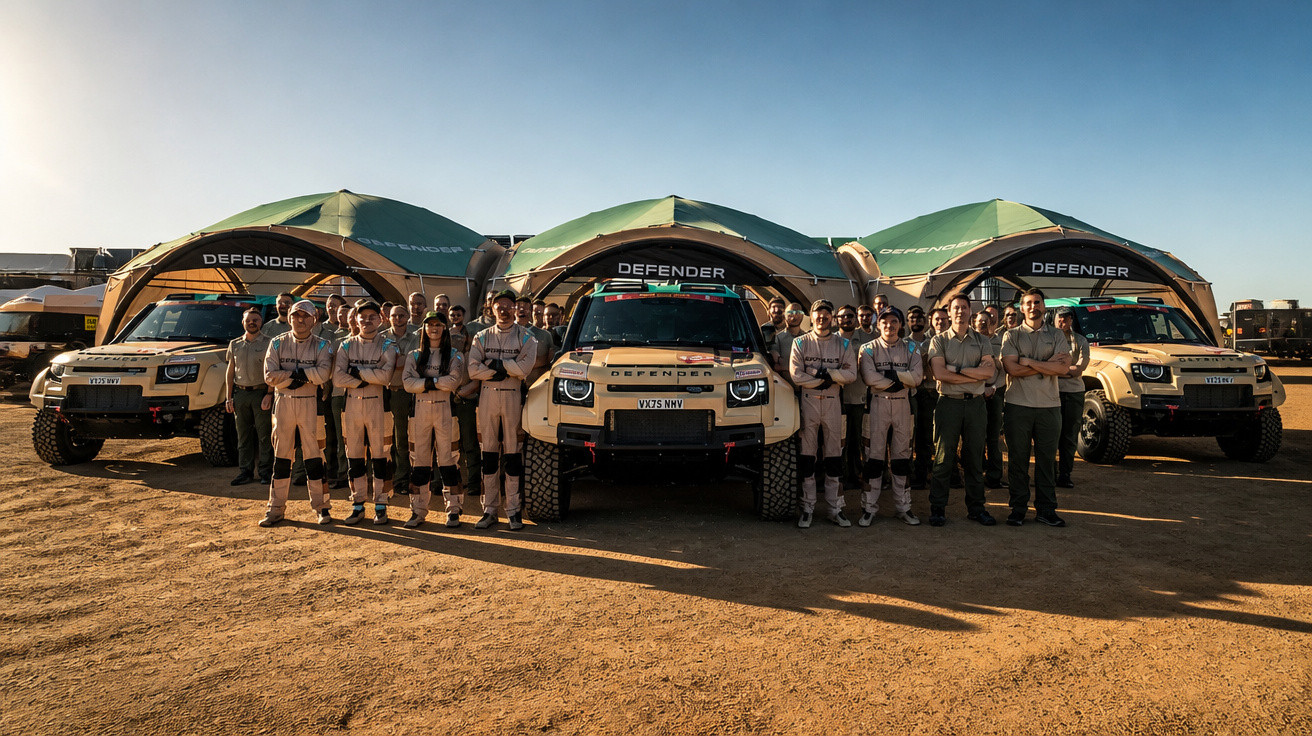
Defender’s commanding 2026 Dakar Rally campaign will be remembered for three defining moments: the marque won its class on its first attempt, young driver Rokas Baciuška announced himself on the global stage, and the Stock car category came to prominence.
For a brand so closely linked with 4x4s that can go anywhere, it seems remarkable that this year was Defender’s official first appearance in the famous two-week off-road endurance event. Indeed, entering the 48th Dakar represented its first-ever factory motorsport programme. It was certainly a baptism of fire.
Making the Dakar appear straightforward is not something any team can do simply by arriving. Yet Defender came remarkably close. Across Saudi Arabia, from 3 to 17 January, the team won every leg - the Prologue qualifying run and all 13 stages - to claim the Stock class title for production-based vehicles. There were also no fewer than 10 all-Defender podiums. The extraordinary effort was spearheaded by 26-year-old Baciuška, who led the cumulative standings from Stage 1 all the way to the finish, winning by an immense four hours. Team-mate Sara Price made the result even stronger by securing second place.
“To see the three Defenders come over the line together, it's the culmination of an incredible team effort,” summed up Defender Managing Director Mark Cameron. “To see us win it in our first race has made history, and to also come second in such style. The team spirit has just been incredible. They're just so proud.”
Defender Dakar D7X-R and the Stock class
Well before reaching the start line in Yanbu, on the Red Sea coast, Defender had to determine the shape of its first Dakar challenge. It could have entered the T1+ class, rally-raid’s equivalent of Formula One. That category is populated by purpose-built prototype silhouette racers based around spaceframe chassis, with very little shared with road-legal vehicles.
Instead, Defender chose the new Stock division, which is for showroom-based vehicles that customers can genuinely buy. The Defender Dakar D7X-R takes its gearbox, drivelines, chassis and bodywork directly from the production line in Nitra, Slovakia. Its 4.4-litre twin-turbo V8 is also taken straight from the Defender OCTA. Rally-raid modifications are largely limited to widened wheel arches, additional cooling, long-range fuel tanks, strengthened suspension and mandatory safety equipment.
As a Dakar newcomer, Defender’s 2026 objective was simple: reach the finish line 8,000 kilometres later. Beating the competing Toyota Land Cruisers and Nissan Patrols was not initially the priority. That aim remained unchanged when Extreme E race winner Price set the fastest time in the brief Prologue on the opening day. The American and co-driver Sean Berriman topped the 23-kilometre run in Yanbu, earning the right to select their starting position for the first full stage 24 hours later. Peterhansel and Baciuška reinforced the encouraging opening by taking second and third.
A challenging opening week for Defender
The following day showed why Defender had set a restrained target. Dakar’s punishing nature struck after Price’s early pace, handing her a broken rear suspension arm on Stage 1. She lost two hours waiting for a support truck to arrive and assist with the repair. Peterhansel also had to work hard, as a power-steering fault created an unexpected upper-body workout. Baciuška, however, had a less difficult day. He won the 305-kilometre stage to take the overnight Stock class lead - a position nobody then realised he would never relinquish.
Price demonstrated the real Dakar spirit on the next day. The X-Games medallist immediately responded by winning Stage 2 as the route travelled inland towards ancient AlUla. Her pace across the 400-kilometre timed section delivered a Defender 1-2-3. With Baciuška and Price each having taken a stage victory, it was then Peterhansel’s opportunity to join them.
Considering everything Peterhansel has achieved during his illustrious career, it is striking that he can still reach new milestones. The 60-year-old has earned the ‘Mr Dakar’ moniker through 14 event victories, the first six of which came on a motorbike. He has competed in the Dakar 36 times and had already accumulated around 83 stage wins before the 2026 event began. Nevertheless, on Tuesday 6 January, he achieved a first by claiming his maiden Stock class victory. Alongside navigator Michaël Metge, he finished Stage 3 more than a minute clear of Baciuška, while Price completed another all-Defender podium in third.
Celebrations had to be put on hold, as the first of two 48-hour Marathon Stages followed. Returning after a two-year absence, this aspect of the Dakar format was back due to popular demand. Rather than joining their wider team at an extensive base camp, where mechanics would inspect the cars, competitors were left to manage alone. Therefore, after Peterhansel was fastest on Stage 4 - despite putting the D7X-R onto its side - crews needed to complete any repairs themselves, pitch a tent, eat military rations and depart again early the next morning.
Baciuška and co-driver Oriol Vidal spent a late evening replacing a right-rear knuckle. Their skilled work with the tools proved worthwhile, as they won the second leg of week one’s Marathon Stage on the way to Ha’il. Although the Defender crew had earned the comfort of a shower, the Dakar organiser, ASO, was never likely to make life too easy. The longest day of the entire event was naturally next.
Stage 6 carried the convoy through the Qassim region, in the centre of the country, towards the capital, Riyadh. A 331-kilometre competitive section was surrounded by an enormous 589 kilometres of road sections, producing a draining 920-kilometre total. In the last competition before a well-earned rest day, Price led throughout to complete the first part of Defender’s outstanding campaign. Baciuška and Peterhansel ensured a fifth podium clean sweep.
At halfway, Baciuška’s two wins, three second places and one P3 finish had built a 45-minute lead in the overall Stock class standings. Peterhansel was second, while Price, after her Stage 1 delay, stood fourth behind Ronald Basso’s leading Toyota. As the drivers and navigators took their break, mechanics worked against the clock to dismantle, inspect and rebuild all three Defenders before the remaining seven stages and 4,000 kilometres.
Baciuška secures the 2026 Dakar Rally victory
Any concern that the rest day would halt the team’s momentum quickly disappeared. Peterhansel overcame a wrong turn to edge Baciuška by 21 seconds for victory on Stage 7. Price shrugged off a heavy front impact and a wing mirror knocked off by a tree to complete the newest 1-2-3. The route then headed straight into the Wadi ad-Dawasir valley area, which returned to the demanding Dakar itinerary for the first time since 2022.
From here, Baciuška made clear that he no longer wished to be considered rally-raid’s emerging talent. He was now an established star. Alongside Vidal, he moved from leading the overall Stock standings to controlling them. Stage 8 began a run of four consecutive victories for the Lithuanian, turning his 45-minute margin into a vast four-hour advantage.
Naturally, Defender’s Dakar was not without further difficulties. Early in week two, Peterhansel’s hopes of a class podium were ended. With 200 kilometres of Stage 8’s 483 kilometres remaining, a broken alternator belt forced him to stop. Recovery took 12 hours, and the setback was compounded by a 24-hour penalty for retiring from the stage, dropping him to fourth overall. Price provided some consolation, rising to P2 in the standings after two podium finishes in two days, leaving her Stage 1 problems far behind.
Baciuška’s remarkable run included wins on Stages 9 and 10, the second demanding Marathon Stage. He beat Price by half an hour on the first part of the overnight test, then by 22 minutes across day two’s soft sandy dunes. Recovering Peterhansel took P3, delivering another Defender podium lockout. Baciuška then completed an impressive Connect 4 by adding Stage 11 to his tally. The Bisha-to-Al Henakiyah route was much tighter, however, with Peterhansel only 49 seconds behind.
On the penultimate day, the convoy returned to Yanbu. The sight of the bivouac base camp, where the rally had begun, was not a desert illusion: the finish was genuinely close. Yet before anyone could consider placing a coveted Dakar trophy in their collection, Stage 12 presented a 311-kilometre timed section combined with a 409-kilometre road section.
Mindful of the original ambition merely to complete the rally, Defender’s three drivers chose to run in formation. They remained together on the course, while Peterhansel carried spare parts should either team-mate face a late issue. Following several changes at the front, Price emerged victorious from a close battle with Peterhansel, with Baciuška taking third.
Only Stage 13 remained. Unlucky for some? Not Defender. The short 105-kilometre timed stage was far from an easy final formality. It wound through rocky valleys and soft lagoons before ending literally at the base of the event podium. Baciuška could hardly have been criticised for driving cautiously and avoiding every obstacle that might threaten his chance of Stock class honours.
He did nothing of the sort. Just 56 minutes after beginning the stage, he had sealed his seventh stage victory. Greeted by the cheers of the whole Defender camp at the finish, Baciuška accomplished the unimaginable. He preserved the brand’s 100% winning record and confirmed Stock class victory - an excellent way to begin the year.
“Dreams come true!” he said. “Full credit goes to the Defender team. For the first year, it’s amazing. The mechanics did a great job. Without them, we would not have made it to the finish. What they do is unbelievable work. They work until 3AM trying to prepare the car for the next stage. Thanks to them and the engineers – all the team. It’s great.”
Across two and four wheels, Peterhansel has now contested the Dakar with nine manufacturers. His 2026 Defender campaign will remain memorable even though it did not produce a top-three finish. He added: “It was a Dakar with all the emotions. Sometimes it was up, sometimes down. But at the end, we won the Stock category. Rokas finished first, Sara second. For us, it was a little bit more complicated. But what I keep in my mind is that it was a nice adventure with a super good team, super good team spirit.
“All the members of the team – the mechanics, the staff, the crews, the drivers, the co-drivers – we were really close together. Not exactly the result I expect for me but, at the end, I’m super happy to do it because it was a really nice Dakar.”
Baciuška’s seven stage wins, Price’s three and Peterhansel’s three mean Defender’s Dakar debut has unquestionably earned its place in the history books. Retaining the title will be even harder, though. The Stock class itself proved successful, so many more marques are likely to arrive next year with road-based racers aiming to take the prize.
Before that, Defender can begin to absorb the achievement. Before boarding the flight home, Defender Team Principal Ian James said: “Honestly, I couldn’t be more proud of the entire team. Not only the fact that we've won Dakar in the way that we have, but the manner in which everybody's pulled together and worked so hard throughout has been simply outstanding.
“A huge congratulations, of course, to Rokas and Oriol in particular, but to every member of the team. A huge thank you for the efforts in getting us to this point, and long may it continue.”
That continuation will arrive soon: at the end of March in Portugal. Defender will contest the remainder of the 2026 World Rally-Raid Championship season as part of a three-year programme. It is useful, then, that the campaign has started so strongly.
Defender OCTA | Master of Extreme Performance, Everywhere
Comments
No comments yet. Be the first to comment!
Leave a Comment