
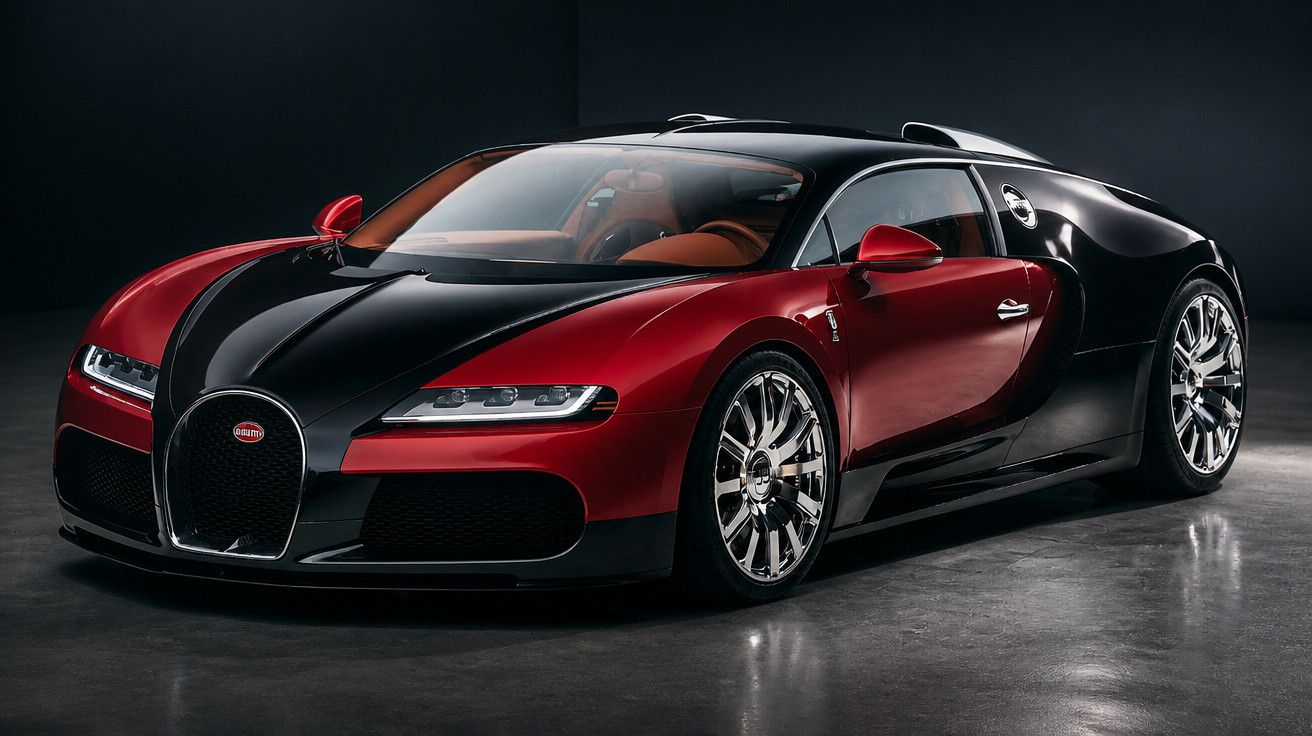
Ever heard of a faithful reimagining of the Bugatti Veyron - the Noughties hypercar built to defy physics - using the foundations of its successor, the Chiron? It is rather like Lamborghini creating an Aventador homage on the Revuelto’s platform. Retrofication has gone completely wild.
Bugatti F.K.P. Hommage: a Veyron reborn
Known as the F.K.P. Hommage, it is named for Ferdinand Karl Piëch, the celebrated VW Group chairman responsible for masterminding the Veyron and Many Other Things. The car commemorates the Veyron’s 20th anniversary. Although it appeared first as a concept at the 1999 Tokyo show and was formally revealed in 2005, Top Gear did not drive the Veyron until 2006 - the internationally accepted benchmark for when a car truly begins.
This is the second creation from Bugatti’s new Solitaire programme, after the Brouillard revealed in 2025. Solitaires are individual customer commissions that retain established engine and chassis architecture while gaining coachbuilt bodywork and extensively bespoke cabins. Production is restricted to two projects annually. Unsurprisingly, its price has not been disclosed, as it would probably trigger a rash of aneurysms… let’s say it sits somewhere around £15m to £20m.
Josef Kaban’s initial design had always been eccentric, defined by a dropping beltline, a rearward-leaning posture and vast, squared-off planes meeting like tectonic plates. This time, however, the ungainly elements have been smoothed away. It has a focused squint, appears lower and wider, and carries more visual muscle. Larger wheels lend it a marginally stronger stance, while every surface has gained extra three-dimensional definition: a genuine glow-up. It is not an exact replica, but a restrained development that suggests how a refreshed Veyron might have looked, both inside and out.
Mistral foundations and W16 power
The Mistral serves as the donor car, for good reason. Notice the flat section at the upper rear corner of the Veyron’s side glass: on the Chiron, the immense C-shaped air intake begins at the roofline and ends at the sill. That makes it a structural element of the roof and prevents it being reshaped in this fashion. With the roofless Mistral, there is no such issue. Its engine is equally useful.
Rather than the original Veyron’s modest 987bhp 8.0-litre quad-turbo W16, the F.K.P. Hommage uses the ultimate 1,578bhp version of Piëch’s generously cylindered engine, first fitted to the Super Sport. It brings larger turbochargers, improved cooling, a strengthened gearbox and all the other changes accompanying the 600bhp increase.
The black-and-red finish references the specification of chassis 001, the first customer Veyron, delivered late in 2005. Examine it closely and the black is not actually black: it is exposed carbon fibre beneath a black-tinted clear coat. Likewise, the red sits over silver, with a red-tinted transparent layer providing maximum depth, contrast and conspicuousness. The Veyron’s futuristic revised face comes courtesy of slim headlights, whose L-shaped running lights align neatly with the creases above the front wheelarches. The horseshoe grille is wider and deeper too, now projecting forwards.
Veyron-inspired details inside and out
The original Veyron’s tyres were famously bonded to their rims, with a complete replacement set costing about £30,000. Here, Michelin Pilot Sport Cup 2 tyres are conventionally fitted to 508 mm front and 533.4 mm rear wheels; the Veyron used 472.44 mm front wheels and 508 mm rear wheels. The rims themselves reinterpret the iconic Machiavelli design with greater dimensionality. Roof-mounted ram intakes are fractionally enlarged to satisfy the engine’s increased demand for air. At the back, meanwhile, it is almost an exact match, apart from a broader exhaust outlet, a wider diffuser and delicate circular LED rear lights with a tunnel effect.
Within, Chiron hard points combine with familiar Veyron styling cues. Consider the steering wheel: its satellite drive-mode controller and starter button, thumb pads and small paddles are clearly Chiron-derived, yet the rim is perfectly round like the Veyron’s, rather than moulded and flattened as in the Chiron. The centre console retains the Chiron’s vertical arrangement of four protruding dials with inset screens. In that car, they are mounted on a slim spine with empty space beneath; here, the dashboard expands into a wide, substantial shield-shaped mass. As in the Veyron, a split in the stitched leather atop the fascia exposes aluminium running from the windscreen base down to the centre console and transmission tunnel - machined from one billet.
The shield’s ‘engine-turned’ surface treatment was used on the Veyron, but originally appeared on the cylinder heads of Ettore Bugatti’s early straight-eight engines. The seats even use something called… fabric? Yes, much as in an entry-level Dacia Sandero, though this is rather different material: "custom couture fabrics woven exclusively in Paris" says Bugatti. Should you somehow forget the bazillion-pound unicorn’s inspiration, Piëch’s signature is stitched into the headrests, while his initials and date of birth are embossed into the leather beside your right knee.
Finally, there is a small finishing flourish mounted above everything else: a collaboration between the owner and Swiss watch experts Audemars Piguet. A 43mm Royal Oak Tourbillon rests in a small scallop - or ‘gondola’ - and looks extremely nickable. Happily, it rotates and retracts when the vehicle is switched off, while periodically turning in a display of magnificent miniature theatre to keep its mechanism running.
The F.K.P. Hommage is an extraordinary flex. It makes Veyrons, Chirons and even highly limited models such as the Divo and Centodieci appear commonplace. It tackles the challenge of refining a modern icon and succeeds without making anything seem or feel uncomfortable. This is the tribute nobody anticipated, yet it now feels entirely logical.
35 minutes 47 seconds

Comments
No comments yet. Be the first to comment!
Leave a Comment