
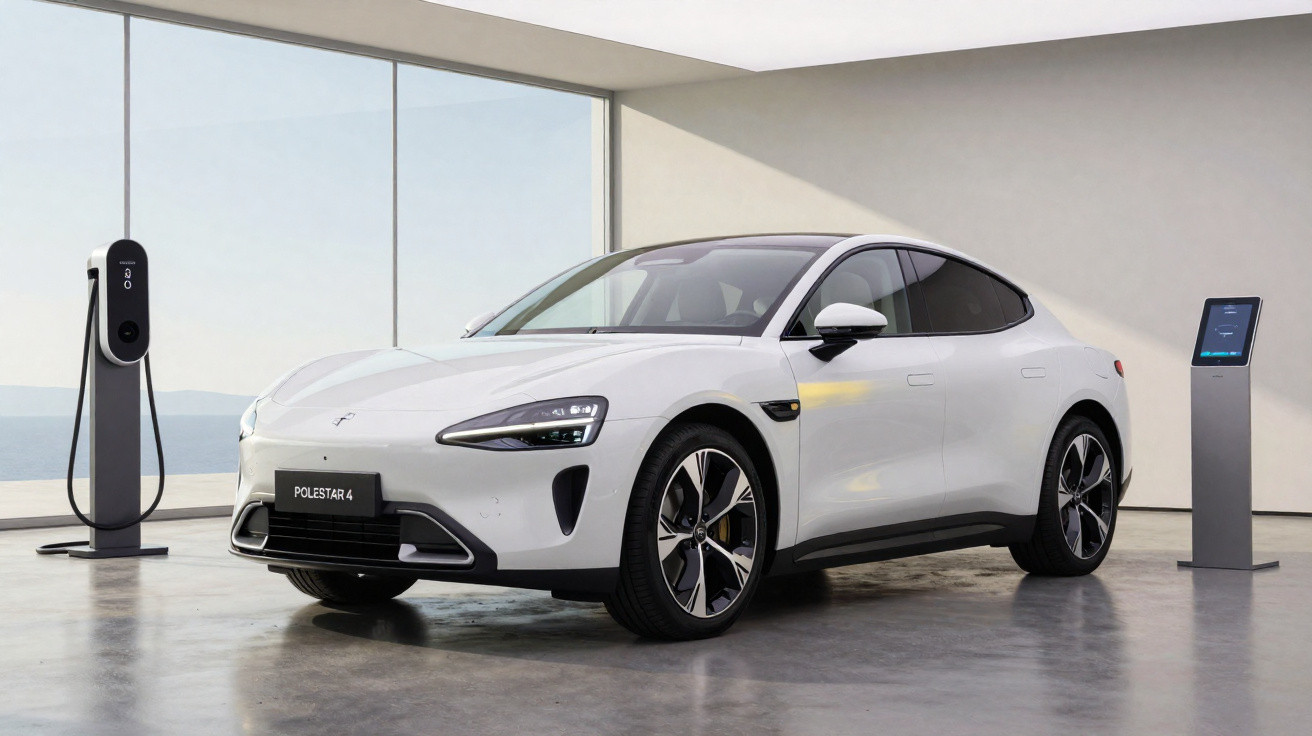
Polestar is enjoying the strongest period of its still-young history, and the Polestar 4 is one of the key reasons, having already become the Swedish brand’s best-selling model.
To build on that momentum, Polestar has now introduced a second version of the model. It is called the Polestar 4 SUV and, while it shares much with the 4 Coupé, it brings major changes in the area that is most noticeable: the rear.
It has lost the feature that was both its most distinctive and most controversial. For me, though, that is welcome news. Seeing it in person for the first time was enough to know which of the two I would take home. Take a look:
A success story
Polestar recorded its best-ever year in Europe in 2025, selling 47,579 cars - an increase of 55.76% over the previous year. The Polestar 4 was chiefly responsible for that growth, accounting for 26,316 units on its own, or more than half of the brand’s total sales.
Riding this growth, the Swedish company is preparing the biggest product offensive in its history, with four new models due by 2028. First comes the Polestar 5, which we have already driven, followed by this Polestar 4 SUV.
The second-generation Polestar 2 will be unveiled in 2027, while the Polestar 7 is scheduled to arrive in 2028. It will become the brand’s new entry-level model and is set to rival cars such as the BMW iX1, Mercedes-Benz GLA and Audi Q4 e-tron.
For now, however, it is this derivative of the Polestar 4 that takes centre stage. With its more conventional body style, it is aiming to appeal to an even wider group of customers - and it has every chance of doing so.
The Polestar 4 SUV is not merely a styling exercise
Viewed from the front, it is difficult to tell that this is a different version of the Polestar 4 we already know - and there is good reason for that. From the B-pillar backwards, the two versions are virtually identical.
Step back and take in the full side profile, however, and the differences become much clearer. While the Polestar 4 Coupé has a low, sportier roofline and no rear window, this SUV takes the opposite approach, following the design language of a more traditional SUV. Even so, it also displays details more commonly associated with estate cars.
I admit I was concerned that removing the blanked-off rear window of the Coupé version would leave this SUV lacking character. After all, that is the detail which most clearly sets the Polestar 4 apart, as well as the one that divides opinion most. But seeing it in the metal quickly proved me wrong.
The SUV has a more robust presence, looks better balanced and gains additional luggage space. Honestly, I think it is the more successful design.
Thanks to its less steeply sloping roofline and an extra 22 mm in height, the Polestar 4 SUV’s boot is 30 litres larger, at 530 litres in total. With the rear seats folded, capacity rises to 1,665 litres.
What is the interior like?
Changes inside are less immediately apparent, as the cabin is almost a direct carry-over from the Polestar 4 Coupé. That is not necessarily a drawback, as it conveys the values championed by the Swedish brand rather well. Unlike in the Polestar 5, I also feel the minimalist approach works better here.
The cabin feels spacious, combining sustainable materials with very restrained colours. Its most disruptive feature is perhaps the huge 15.4-inch central infotainment display, which now has a fixed panel on the right containing shortcuts to the most frequently used functions.
Also worth highlighting are the smart rear-view mirror, which is optional on this SUV version, and the panoramic roof. It features an electrochromic layer that can darken all or part of the glass, regulating the light - and heat - entering the cabin.
There are differences from the Polestar 4 we know in the rear seats, too. They are not so much about legroom, but rather the slightly greater headroom available. At 1.83 metres tall, I can sit comfortably in the back even with the driver’s seat set for my height, as you can see in the video featured in this article.
Up to 630 km of range
As expected, the Polestar 4 SUV retains almost all of the Coupé’s technical underpinnings. It remains available with rear-wheel drive (Rear Motor) or four-wheel drive (Dual Motor), always paired with the same 100 kWh battery. It supports DC charging at up to 200 kW and, optionally, AC charging at up to 22 kW.
Rear-wheel-drive models use an electric motor producing 200 kW (272 hp) and 343 Nm of torque, delivering 0–100 km/h in 7.3 seconds and an electronically limited top speed of 200 km/h. Depending on the equipment level - and wheel size - the claimed range can reach 630 kilometres on the combined WLTP cycle.
Dual Motor variants, meanwhile, use two electric motors delivering a maximum 400 kW (544 hp) and 686 Nm of torque, enabling the 0–100 km/h sprint in 3.9 seconds. Top speed nevertheless remains capped at 200 km/h. In this case, range drops to 590 kilometres in the Dual Motor Performance Prime version.
How much will it cost?
The new Polestar 4 SUV is already available to order, with the first cars due to arrive in Portugal later this year. Prices start at €55,600 and rise to €67,400 for the highest equipment level, which combines the Prime Pack and Performance Pack.
As is customary for Performance Pack versions, they are identified by 22-inch forged wheels and gold Brembo brake callipers. The cabin also gains gold seat belts and a volume control with a specific finish.
From a dynamic perspective, the pack also adds active ZF dampers and a more sportily tuned chassis, two elements intended to improve this SUV’s road behaviour. We will return to that subject in a few weeks, when we drive the Polestar 4 SUV for the first time.
Until then, you can watch - or rewatch - the video we made behind the wheel of the most powerful Polestar ever:
Comments
No comments yet. Be the first to comment!
Leave a Comment