
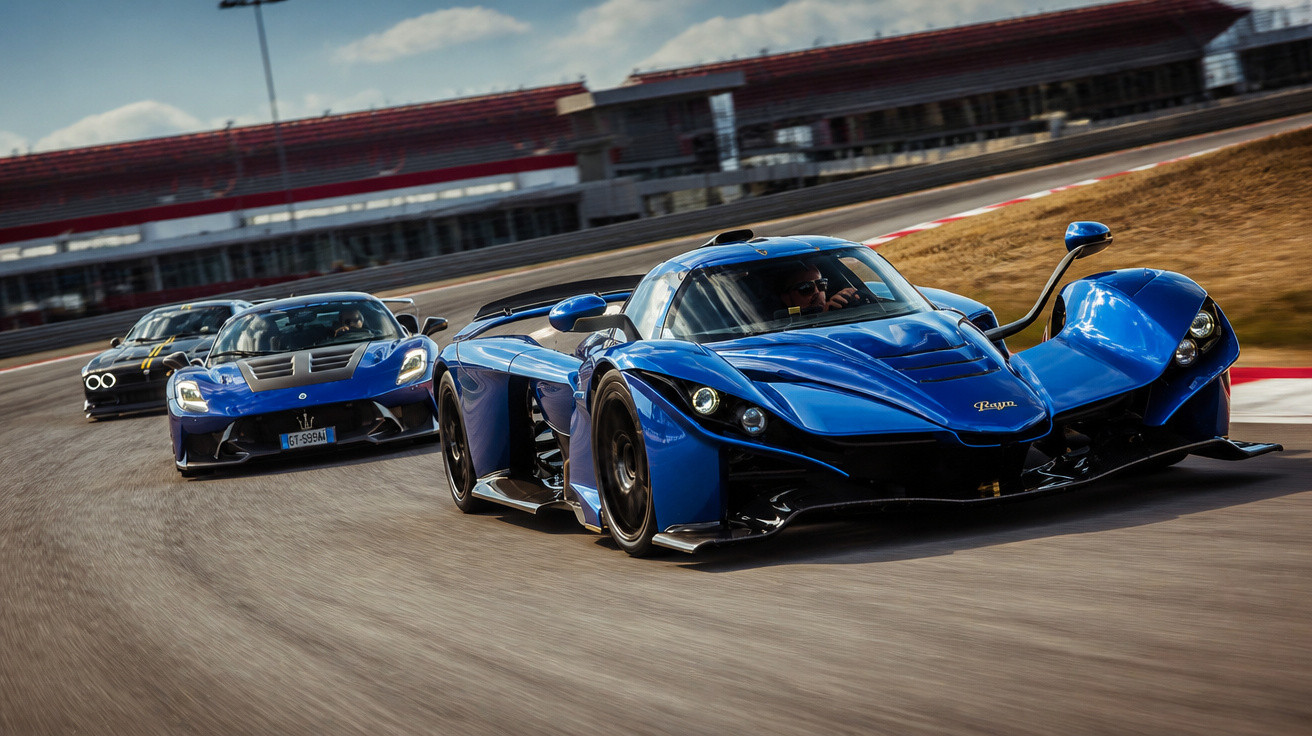
These are the outsiders. The alternatives. For that reason alone, I am already fond of them. Existing on the fringes of car enthusiasm is fascinating, intensely niche and apparently in the grip of a collective obsession unlike anything seen before. It is also hugely varied and full of surprises. Among every car in our line-up, the appeal of the Maserati GT2 Stradale, Kimera EVO37 and Praga Bohema is the most difficult to call. The next few days could bring glory or catastrophe. Or, perhaps more bleakly, a shrugging verdict of ‘yeah, not bad’.
It could even deliver all three outcomes. Before a single car has taken to the circuit, a walk past the pit garages gives a clear impression of each contender’s star power. The Maserati rather disappears. Positioned only a few metres from Manthey’s frighteningly single-minded interpretation of the GT3 RS, it looks slightly undercommitted. Nearly timid.
The Bohema combines aggression, elegance and aerodynamic effectiveness with real artistry, but there is something mildly daunting about its purity. It attracts people, then swiftly sends them away again.
The Kimera is another matter altogether. It is beautiful, compact and endlessly, absurdly cool. Once its booming four-cylinder supercharged-and-turbocharged engine bursts into life, the Ferrari mechanics looking after the 12Cilindri in the neighbouring garage applaud before, quite literally, embracing each other. Italians, eh?
Photography: Mark Riccioni
Yet the Manthey team want to inspect it too, their eyes wide and faces beaming. So do Aston Martin’s people. And the M-Sport crew supporting the Raptor T1+. Everyone, in fact, gathers around the EVO37, laughing, gasping and nodding in sincere appreciation for a full 10 minutes. Kimera’s homage to Lancia’s Group B icon may be small, but its presence is enormous.
Even so, the Praga Bohema is an extraordinary sight once you begin to absorb its contoured bodywork, flicks, strakes and voids. It is genuinely attractive, too, with an exceptionally high-quality finish. Comparisons with the Aston Valkyrie are unavoidable, and the Bohema has no need to be embarrassed by them. If anything, its carbon-fibre, titanium and Inconel detailing moves a step beyond Newey’s vision, despite costing little more than half as much at ‘just’ £1.32m.
The Bohema is substantially lighter as well. Praga quotes a dry weight of 982kg, giving it an advantage of almost 300kg. It is, however, down a full six cylinders. Rather than a bespoke, high-revving V12, it uses the less exotic 3.8-litre twin-turbocharged V6 from the Nissan GT-R, though fitted with a dry-sump system and tuned by UK-based specialist Litchfield to produce an exceptionally dependable 700bhp. Pair that with 900kg of downforce at 155mph, pushrod-operated suspension, adjustable Öhlins dampers, carbon-ceramic brakes, Michelin Cup 2 R tyres and a sequential Hewland gearbox, and it ought to feel entirely at home here.
Its driver may be less immediately comfortable after opening the small butterfly door and awkwardly lowering themselves into the seat. There is no issue with comfort inside, yet the feet-up driving position and the extreme cabin environment feel unfamiliar and intimidating. For some, that Le Mans prototype atmosphere will form a major part of the Praga’s charm. Others will find it simply too extreme.
It rewards perseverance. To begin with, the outward view is spectacular. The windscreen curves around you like a visor, while engineering drama is visible in every direction. Its near-open-wheeler arrangement is superb, and the wheel covers frame the circuit perfectly as it arrives beneath you. It is a closely fitted, race-car-style cockpit, but its materials and design imagination are worlds removed from unfiltered competition machinery.
The steering wheel is exceptionally pleasing to hold. That may sound odd, but the placement of the padding and its exact degree of give are noticeably different. And spot on. Switch on the ignition - mounted on the roof, where a conventional car might have sunroof controls - then press the adjacent starter button and it is ready to go.
Road mode engages the clutch automatically, while Sport, Race and Race+ demand the use of a hand clutch to pull away. I choose Road until the Bohema is rolling, then turn the left thumbwheel to select Race as the pit lane opens onto the circuit.
The engine has an all-business note and lacks the recognisable, tortured howl of a GT-R, although the familiar V6’s mighty torque and outstanding throttle response soon feel like assets, not compromises. Brake-pedal feel is excellent. Its travel is perhaps a little longer than expected, but the unassisted system delivers masses of information as well as formidable stopping force.
Stopping distances are remarkably short. More striking still is the way the Bohema transforms the nature of the track itself. Where other cars demand a firm press of the brakes, the Bohema can tolerate flat acceleration and an upshift. Its low weight, grippy tyres and downforce create an experience that is almost overpowering.
Its balance is outstanding. Find the courage to explore Praga’s spaceship at its limit and you discover that it is, ultimately, still a car. It initially understeers gently, before the rear gradually starts to move outward. The electronics are a major ally here: Race mode’s calibration seldom interrupts momentum on corner exit, yet permits you to use a small yaw angle through the middle of a corner. The Bohema may be a downforce monster, but it never feels as though it wants to bite your head off.
13 minutes 34 seconds
The negatives? There are not many. The gearbox is quick and generally smooth - comparable with the Valkyrie, for instance. It is not, however, as brutally quick and thrilling as the finest dual-clutch transmissions. The engine is muscular and enjoyably industrial in sound, but it does not quite possess the deranged, all-conquering sensation I have encountered from tuned GT-R engines before.
I reckon its character needs turning up a notch. Perhaps it needs a dose of Group C madness. The steering is also rapid and precise, but as speed rises it does not seem to be anchored by the aerodynamics and become more positive. Instead, it starts to feel slightly more detached, making high-speed corners an exercise in faith rather than instinctive confidence.
Against it, Maserati’s GT2 Stradale may look restrained, but it is the car that tantalises me. The MC20 beneath it divides opinion, yet I adore the contrast between its gruff, boost-heavy twin-turbocharged V6 and compliant, wonderfully fluid chassis. It occupies a rare space: a slightly mad overall package that suits Maserati’s operatic heritage perfectly. A tougher, quicker iteration risks becoming too familiar and charging into direct competition with cars such as McLaren’s 750S and Ferrari’s 296 GTB, but it could equally uncover something special.
The recipe is broadly predictable. There is a little extra power, rising to 631bhp; firmer, more aggressive springs and dampers; heavily reworked aerodynamics including a pass-through-style bonnet, vented front wings, a far larger diffuser and a fixed rear wing; together with recalibrated stability control, quicker shifts and larger brakes. Weight has come down too, while the cabin feels both stripped back and bespoke. This example lacks the carbon-fibre bucket seats, which feels like a strange omission, but otherwise the GT2 projects precisely the right degree of road-racer attitude.
One lap is enough to reveal that the Maser possesses exceptional dynamic talents - along with a few baffling errors. Its handling balance is superb. The GT2 is sharp yet natural, offering immense grip and traction while transferring the MC20’s smooth, fluid road behaviour straight to the circuit. The fundamental sensation remains unchanged, merely enhanced by greater control and g-forces. It is intensely alert without ever seeming hurried or twitchy, and it instils enormous confidence in its driver.
The engine is a snorting beast of a thing that spews flames and malevolence
‘Natural’ is the crucial word. Why, then, is there a manufactured thud on upshifts? It is a strange decision for a car that appears inherently excellent and needs no such synthesised ‘character’. A second lap exposes its extraordinary composure and the GT2’s almost eerie resistance to wheelspin. In Corsa mode, you can choose from four preset stability-control programmes, but it soon becomes clear that on a dry track no assistance is necessary. The GT2 simply finds grip, and if either the front or rear begins to slide, the angles remain modest and develop progressively.
By lap three, however, temperatures are rapidly approaching the red. The brakes - oddly unresponsive even while operating within their comfort zone - start to fade, compromising the chassis’s impeccable balance. The GT2 Stradale is an exceptionally cool and highly capable machine. Still, it needs better endurance, greater consistency and every dynamic component to reach the standard set by its clean, precise chassis. Until that happens, it will remain a case of what might have been.
That leads us neatly to the £750,000 Kimera EVO37. The thinking behind this car is straightforward yet inspired. Its looks and configuration are pure Lancia 037: the mid-engined Group B marvel developed and built by Abarth with Pininfarina and Dallara, which somehow won Lancia the 1983 WRC constructors’ title against the incoming Audi Quattro onslaught. It was the final rear-wheel-drive car to achieve that feat.
What a foundation, then. Yet this is not a slavish recreation. Kimera instead considered how the 037 could have developed had Lancia not chosen the four-wheel-drive Delta S4 route for its next WRC contender. The EVO37 therefore takes technical answers from the Delta S4 - alongside craftsmanship so astonishing it feels entirely unlike 1980s Lancia - and installs them in the diminutive, lightweight sports-car platform adored by drivers such as Walter Röhrl.
Like the original, the EVO37’s central tub comes from a Lancia Montecarlo. Everything else is pure competition: double-wishbone suspension, twin dampers at each rear corner and utterly breathtaking carbon-fibre bodywork. Its engine is the headline act. The 037 used a 2.1-litre supercharged engine in 1983, but Kimera has adopted the S4’s ‘twin charge’ approach.
That means four cylinders, a supercharger for low-rev response and a large turbocharger for top-end fireworks. An electric clutch decouples the supercharger from the engine at 4,200rpm to eliminate its parasitic losses. There are three engine maps, delivering 300bhp, 400bhp or 505bhp. Naturally, we select map three.
Where do you start? The Kimera EVO37 has rally roots, so its body roll, pitch and dive go far beyond those of, say, the GT2 Stradale. Yet its compact dimensions and low weight keep those movements controlled, generating immense feel. Very few cars have this degree of fluidity. Fewer again combine expressive freedom with composure and the ability to keep absorbing punishment. The 037’s remarkable stage agility - its talent for swallowing up relentless direction changes, yumps and broken surfaces - survives in the EVO37. The Kimera just flows.
It is not all serenity, though. The engine is a snarling animal, spitting flames and menace. It is so furious, ugly and beautiful. There is no melody to it, but you want its sound to shake your organs and overwhelm every sense. It helps that it is paired with the excellent six-speed manual gearbox from the Audi R8. The shift action is mechanical and sweet, with enough grit to feel genuine. Every dynamic element fits seamlessly with the next.
The EVO37 comes from a small team with limited means, yet its depth of finish embarrasses many OEM efforts. You can sense the passion invested in the project, along with the inherent understanding that this deeply evolved 037 is not an ornament to be polished and displayed. Its detailing is beautiful, certainly. But the real magic appears only when you roll up your sleeves and commit to driving it properly. Kimera founder Luca Betti is a former WRC driver. You can tell he has driven this thing flat out for thousands of miles.
This is not a restomod. It’s the living, fire breathing embodiment of everything we love about cars
Then it broke down. That is what you are expecting, isn’t it? Sorry to disappoint, but the Kimera did not even hint at trouble. I would guess it completed more laps than any contender other than the GT3 RS MR. It was driven sideways and hammered over kerbs. It met the rev limiter countless times. Still, the EVO37 took it all in its stride.
Following three hard days of lapping, the brakes - now equipped with ABS and supported by a traction-control system - felt thoroughly worked but neither vibrated nor lost any stopping power. Weak points? We found none. This thing is legitimate. In every sense.
From its lovely, light, calm steering to its exquisite balance and the raw exuberance of its wild engine, Kimera has created a world-class, unforgettable and irrepressible machine. This is not a restomod. It’s the living, fire breathing embodiment of everything we love about cars.
The Lancia 037 overcame the Audi Quattro in 1983 against all expectations. Who is to say the Kimera EVO37 cannot beat Ferrari, Porsche, BMW, Aston Martin and Lamborghini in 2025? It reaches the final five. Easily.
Kimera EVO37
A Lancia Montecarlo provides the central chassis, while the rest belongs in a fantasy garage: a carbon-fibre body, twin dampers at every corner and a racing stripe surely worth at least 25bhp.
Kimera chief Lucca Betti is a former WRC driver... and it shows: the set-up is all oversteer, with no understeer.
The 2.1-litre four-cylinder engine uses supercharging for low-down response and turbocharging for power higher in the rev range. It produces an orchestra of booms, whistles and whines.
Praga Bohema
Its pushrod suspension must deal with 900kg of downforce at 155mph. Adjustable Öhlins dampers, carbon-ceramic brakes and Michelin Cup 2 R tyres... this is the genuine article.
V12? V10? No... it is the Nissan GT-R’s 3.8-litre twin-turbo V6, tuned by Litchfield for 700bhp. That will do.
Maserati GT2 Stradale
The 3.0-litre twin-turbo Nettuno V6 now produces 431bhp... it may not sound like much, but it still hits like Rocky Balboa in his prime.

Comments
No comments yet. Be the first to comment!
Leave a Comment