
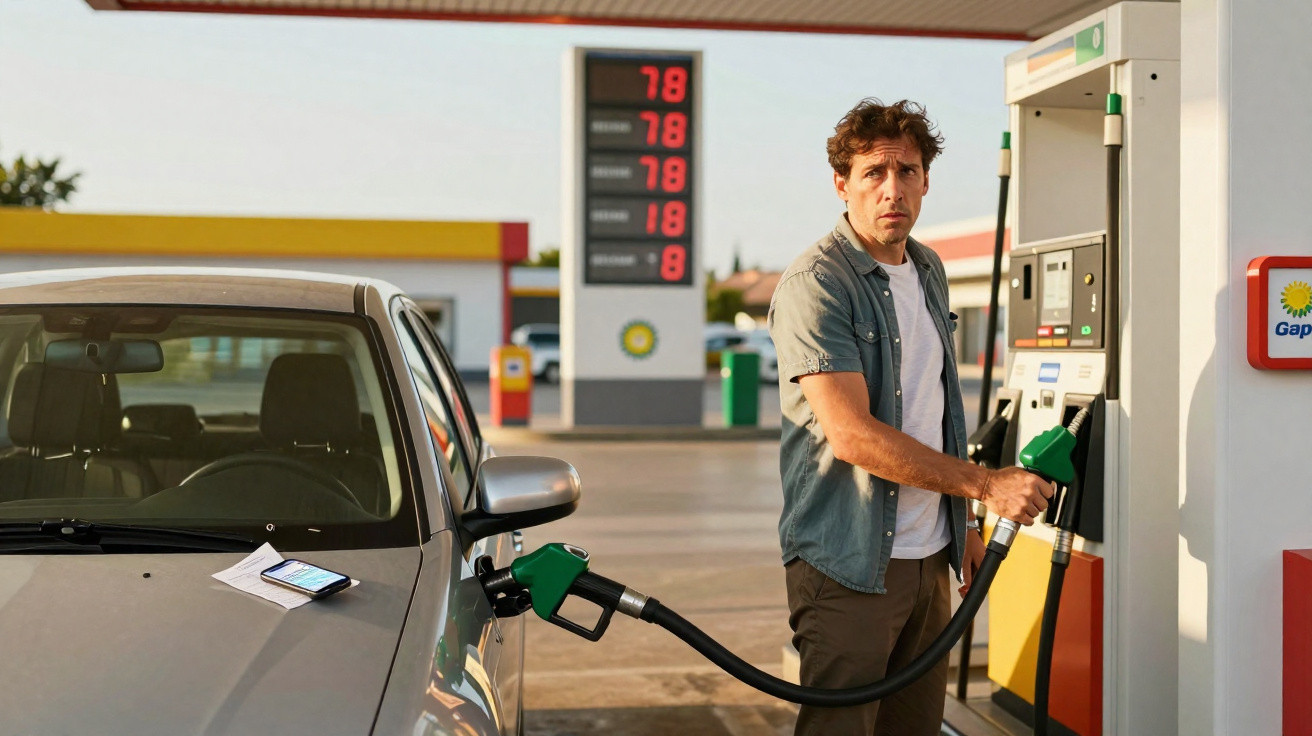
As forecast at the end of last week, Monday 27 July brought another sharp increase in diesel prices.
A review of prices charged by the leading fuel retailers shows that diesel rose markedly by 6–7 cents per litre. Petrol increased by less, by around 1.5–2 cents.
BP recorded the largest rises, increasing regular diesel by seven cents per litre and regular petrol by two cents. Repsol and Galp raised regular diesel prices by 6.5 and 6.4 cents per litre respectively. For regular petrol, Repsol added two cents per litre, while Galp increased its price by 1.6 cents.
Taking these increases into account, which are expected to be reflected across all fuel retailers, the average price of regular diesel will once again exceed the €2-per-litre threshold this week - something that has not happened since 10 May.
Moreover, the substantial rise in diesel prices will place it above the average price of regular 95 petrol, which is expected to stand at around €1.99 per litre.
As usual, the basis for calculating fuel prices is the data released by the Directorate-General for Energy and Geology (DGEG), in this instance relating to last Friday, 24 July.
The figures published by the DGEG already include discounts offered by fuel retailers, as well as the Government measures currently in force. However, they are average, indicative values and may differ from prices displayed at filling stations.
What is driving this sharp increase?
The rise in fuel prices is directly linked to the end of the ceasefire between the US and Iran. Brent crude, Europe’s benchmark, climbed sharply again last week.
After hovering around $70 following the ceasefire announcement, it rose above $90 last week and at one point exceeded $100. With the announcement that attacks had been suspended, on Monday 27 July the barrel price fell more significantly to $85–86.
For comparison, before the conflict the average price of regular diesel was €1.635 per litre, while regular petrol stood at €1.705 per litre.
Reduction in the ISP discount
Given fuel-price developments, the Government announced a further adjustment to the exceptional discount on ISP excise duty, which has been in place since early March.
Under Order No. 314-B/2026/1 of 24 July, the discount applied to regular diesel changed from 6.01 cents per litre to 7.52 cents per litre. The amount applicable to regular petrol changed from 4.64 cents per litre to 5.50 cents per litre.
This exceptional measure had initially been due to remain in force until the end of June. However, the Minister for Environment and Energy, Maria da Graça Carvalho, assured the public that the support would remain while current market conditions persist, although she said the discount would be withdrawn gradually once the situation stabilises.
“We will continue increasing the discount to save the Portuguese people money and prevent the State from profiting,” said António Leitão Amaro, Minister of the Presidency, at the end of last week.
This exceptional reduction in ISP excise duty is cumulative with the one in place since 2022, introduced to ease the impact of higher fuel prices after Russia’s invasion of Ukraine. The mechanism partially reduces the tax charged on petrol and diesel, and has been progressively adjusted in line with price movements.
What is at stake?
The increase in fuel prices in Portugal and across Europe is directly connected to escalating tensions in the Middle East, which led to the closure of the Strait of Hormuz, one of the principal routes used to transport oil from the Persian Gulf. Around 20% of global crude trade passes through this waterway.






Comments
No comments yet. Be the first to comment!
Leave a Comment