
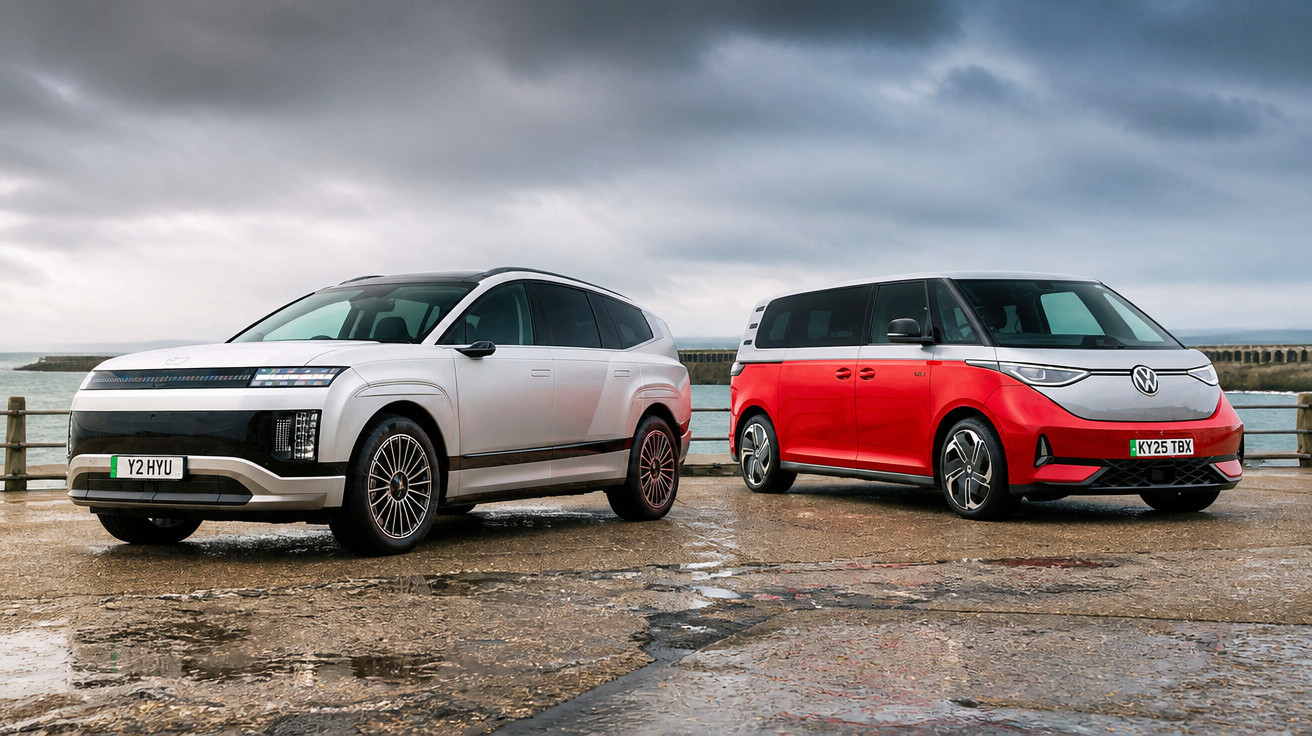
Both of these are exceptionally costly family cars; there is simply no avoiding that. Seen here, each wears its range-topping trim and most powerful powertrain. On a three-year PCP agreement, after an already substantial £10,000 deposit and with a 10,000-mile yearly allowance, a six-seat Hyundai Ioniq 9 Calligraphy would set you back a little over £1,000 every month.
Volkswagen’s long-wheelbase ID. Buzz GTX, offering the same passenger capacity, is not dramatically cheaper: it requires 36 monthly instalments of £825. Yet these are not meant to be mere people carriers. They are intended to be desirable, even cool. That may sound far-fetched, but the Ioniq 5 has already shown that Hyundai is capable of pulling it off.
Hyundai Ioniq 9 and Volkswagen ID. Buzz GTX design
For the Ioniq 9, Hyundai again uses its retro-futuristic ‘parametric pixels’ in the front and rear lighting. Its swept-back windscreen and abruptly cut-off, estate-like tail are designed to cut drag. The company says much of the streamlining knowledge came from the Ioniq 6 saloon, and Hyundai has somehow achieved a notably slippery 0.26 drag coefficient for this enormous relative.
Photography: Jonny Fleetwood
When I first encountered the Ioniq 9 in the US, I was taken by its appearance. In that market, it provided a point of difference from the domestic, boxy, truck-based SUVs. Now that it has arrived in the UK, though, I am less convinced. Perhaps it is the excessive pixel detailing, the eyebrow-like wheelarch trims, or the £1,200 Gravity Gold matt paint. Then again, it may just be its vast scale. It is 8mm longer than a Range Rover, and it somehow makes even this elongated ID. Buzz appear tidy and compact.
Before Volkswagen eventually revived the Bulli in 2022, the Scirocco was arguably the last genuinely cool VW (RIP). This, however, is a convincing example of retro design. Its electric platform enables a level floor, while the lack of substantial cooling requirements allows a short, blunt nose. We did not see the long-wheelbase ID. Buzz until mid-2023, and the more powerful GTX first appeared the following March, but neither development has compromised the looks. Indeed, I rather like the GTX’s fresh, slightly smirking front bumper.
The extended wheelbase also turns it into a considerably more versatile family car. Instead of the standard car’s five seats and large boot, buyers can select six or seven seats. Extensive glazing floods the cabin with daylight, while the GTX includes a huge panoramic roof as standard, with ‘smart glass’ that can be switched from opaque to transparent at the press of a button.
It is a small disappointment that the performance model cannot be ordered with white paint for a traditional two-tone finish, although this £2,791 Mono Silver/Cherry Red combination remains very striking. The cabin is upholstered in black cloth, enlivened somewhat by red stitching and a sporty-looking steering wheel.
The haptic controls attached to that wheel remain just as irritating to operate, but the 12.9in central infotainment display has improved significantly. It starts up rapidly, reacts promptly to commands, and has permanent climate-control functions plus a quick route into the driver-assistance menu. There are illuminated sliders below it as well.
Family space and cabin practicality
Although the Buzz’s rear doors and windows open electronically, its rear seats are manually operated and wonderfully straightforward to fold, tip and slide. In the six-seat configuration, there are two captain’s chairs in the middle row and two slightly smaller chairs at the back. Even so, a 6ft adult has ample space in the third row. The compromise is a fairly modest boot: with the final row occupied, there are just 306 litres available. Even an ID.3 can easily better that figure.
The Ioniq 9 employs an equivalent arrangement while preserving a little more luggage room with every seat in use, though it cannot rival the van-shaped Buzz once seats begin to fold. It also has a 2-2-2 seating layout, but giving third-row adults reasonable legroom means those in the centre row cannot spread out.
It too has a flat floor, though its seats sit lower, leaving occupants with their knees uncomfortably high. This range-topping Calligraphy version also uses an odd assortment of seat-adjustment methods: the rearmost row folds electrically, but the middle row is manual and quite fiddly. It is confusing.
The centre console, by contrast, glides smoothly. Hyundai refers to it as the “Universal Island 2.0”; essentially, it is a huge storage compartment that slides between the first and second rows. It contains cupholders, a wireless charging pad and all of the rear-seat climate controls. Volkswagen sells a comparable feature in the Multivan, but not in the ID. Buzz.
The driving position is pure van but it handles more like a passenger car
Hyundai deserves considerable credit for retaining physical controls. A broad curved display containing two 12in screens sits ahead of the driver, but there are separate climate and media-control panels, along with genuine buttons and rocker switches on the steering wheel. Press and hold the volume control to silence the speed-limit warning bong; repeat the process with the small steering-wheel symbol to disable the overzealous lane assist. Simple.
Regrettably, I did not find the Ioniq 9’s driving position especially comfortable. Its front seats are clad in Nappa leather, heated, ventilated and fitted with massage functions, but the headrest is too bulky. The steering wheel also lacks sufficient reach adjustment, leaving you stretching towards it while your legs are cramped against the pedals.
We also need to discuss the camera units pretending to be mirrors. They undoubtedly help achieve that low drag coefficient, but they undermine the usability gained from fitting conventional mirrors. Their screens are positioned naturally, and you would presumably adapt, but parallel-parking a 5m-long car using cameras alone is not something I would want to do daily. Even assessing distances during an apparently straightforward lane change proves difficult. Hyundai has added a guide to the screen, although relying on it entirely would demand real faith in technology.
Performance, comfort and charging
Thankfully, if you are joining the outside lane on an unrestricted stretch of autobahn, there is more than enough thrust to reach speed quickly. The Performance AWD setup places a motor on each axle, producing a combined 421bhp and delivering a 0–62mph time that slips beneath five seconds.
Its power arrives cleanly and calmly, and the car feels far better controlled than the prototype I drove last year. It pitches less under braking, and for such a weighty SUV it stays impressively level through bends, with steering that gains weight pleasingly as pace increases. Paddles behind the steering wheel even allow the driver to alter the regenerative-braking level.
However, comfort has not been sacrificed in pursuit of performance. Laminated glazing, active noise-cancelling technology and foam-filled tyres work together to limit road and wind noise, making the Ioniq 9’s interior a peaceful place to be. Its suspension is a comparatively straightforward combination of multi-link rear and MacPherson front setups, and benefits from that simplicity. There is no air suspension. It copes effectively with rough and uneven surfaces, although an enormous pothole will occasionally make its considerable mass very apparent with a heavy impact.
The ID. Buzz cannot equal the Hyundai’s refinement. Its upright, slab-sided body and low-profile tyres allow more sound into the cabin, though it remains light years ahead of the diesel-powered, van-based VW buses of old. It also sends 335bhp to all four wheels, making it properly quick.
Even in Normal mode, its nose gives a slight upnod when accelerating. With a low centre of gravity, it turns into corners with genuine enthusiasm. The seating position is unmistakably van-like, yet its handling is closer to that of a passenger car, and there is even a degree of steering feedback. Together, these qualities make it enormous fun.
As expected, the VW is also much simpler to manoeuvre. Elsewhere in the world, the Ioniq 9 can be specified with four-wheel steering, but in the UK the front wheels must handle everything for reasons unknown. Consequently, its turning circle resembles that of a cross-Channel ferry. The ID. Buzz may be heavier on paper, but it feels nimbler and is much easier to park. That matters when the children have been asking whether you are nearly there for the last hour and a half.
The ID. Buzz is a car that gets under your skin and makes you smile. It’s the one I’d really want to own
Once parked and connected to a charger, there is little separating their charging capability. The Hyundai reaches 233kW, whereas the Volkswagen manages 200kW. Both can also function as enormous powerbanks, supplying electricity in the opposite direction. Naturally, the Ioniq 9 has a much bigger battery, claiming 372 miles of range against the Buzz’s 282 miles.
During our test, though, their efficiency was almost identical: the Hyundai achieved 3.1 miles per kWh and the VW 3.0. For a family bus, the GTX’s range feels generous, and the added motor and extra power reduce its claimed range by only five miles compared with the rear-wheel-drive version.
For frequent long-distance journeys, the Hyundai is probably the better choice. It is the more accomplished long-distance cruiser and feels more refined while moving, although I have reservations about the driving position and certainly would not choose the £1,000 digital side mirrors.
Truthfully, if I were picking between them, I probably would not even reach Hyundai’s configurator. The ID. Buzz is a car that gets under your skin and makes you smile. It’s the one I’d really want to own, and when you are spending this much money on an electric family car, that counts for a great deal. Otherwise, you could simply spend £30k on a seven-seat Vauxhall Combo Life.
Volkswagen made the regular Buzz much more practical by adding a long-wheelbase model, then made it more enjoyable by fitting a sporty front bumper and an additional motor. It is now genuinely fun for the entire family.


Comments
No comments yet. Be the first to comment!
Leave a Comment