
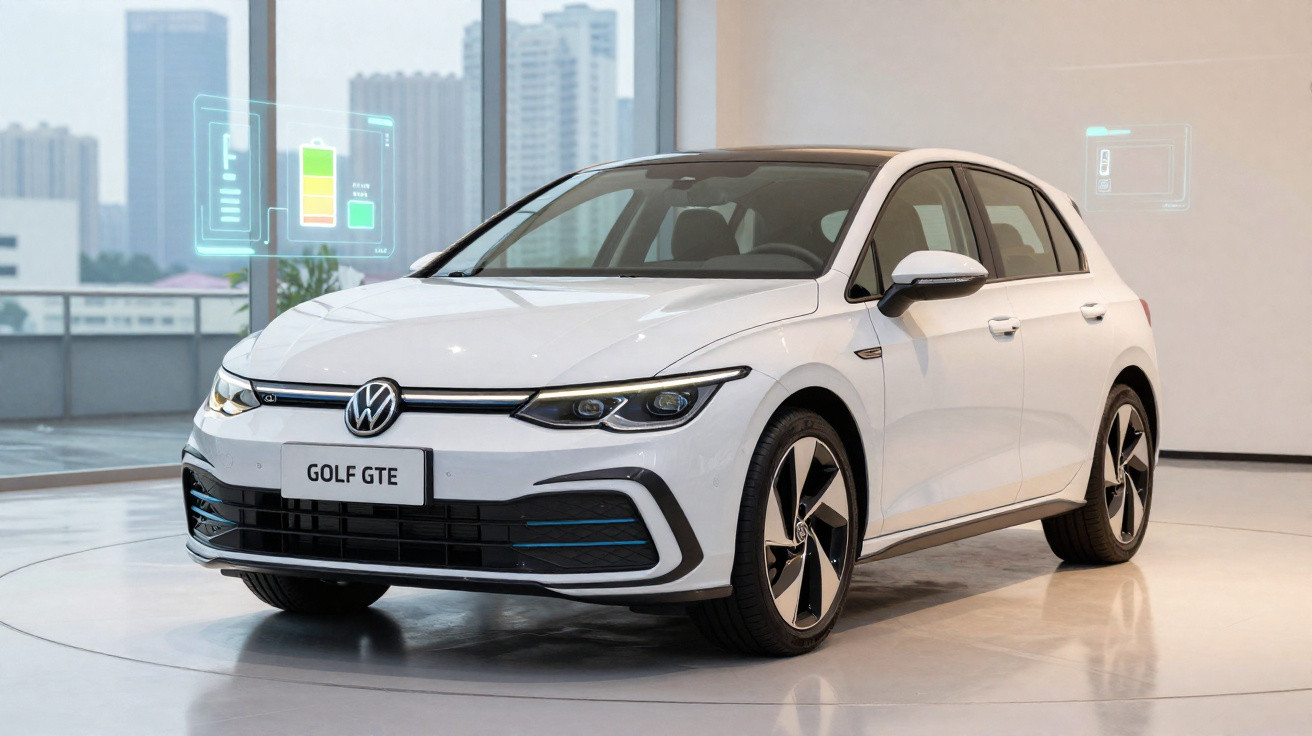
Volkswagen are to blame. After all, they are the ones who have raised the new Golf GTE to the level of the iconic GTI, not only visually - there are very few differences - but also in power and even in chassis terms. The message could hardly be clearer.
My expectations were therefore fairly high when I first took the wheel of the new Volkswagen Golf GTE.
Could it live up to them? More importantly, does this new electrified take on the hot hatch have the legs to go the distance?
First, what is the Golf GTE?
Picture a Golf GTI, but rather than relying solely on an internal-combustion engine - in this case, a more modest 1.4 TSI producing 150 PS - it also has an electric motor with 109 PS. As a result, the GTE matches the GTI on the headline figures: both deliver 245 PS of maximum power, although the GTE exceeds it by 30 Nm for peak torque, reaching 400 Nm.
The electric motor naturally requires a battery to power it - now a 13 kWh unit, 50% larger than that of its predecessor. It is housed beneath the rear seat, forcing the fuel tank underneath the boot and “stealing” more than 100 litres of its capacity. The combined power and torque still go to the front axle through a six-speed dual-clutch gearbox.
An additional motor, battery and associated hardware increase kerb weight from the 1463 kg (EU) of a DSG-equipped GTI to the Golf GTE's 1624 kg: an extra 160 kg.
The GTE's electric drive does, however, allow for things the GTI can only dream of, including the ability to cover up to 64 km officially “without guilt”, using the electric motor alone. There is considerable potential for fuel savings, provided the battery is charged regularly for everyday journeys.
Is it a good hot hatch recipe?
For now, the short answer leans towards no - though perhaps future iterations will change that. Several factors work against the Golf GTE, preventing it from reaching the same level as its Golf GTI sibling and, consequently, leaving something to be desired as a hot hatch.
That said, before examining its hot hatch credentials more closely, the new Volkswagen Golf GTE impresses with its effectiveness and competence. As a plug-in hybrid, its priorities become obvious as soon as you set off.
With sufficient charge available, it defaults to Electric mode. Although I never achieved the official 64 km with a fully charged battery, nor did I make a particular effort to do so, I managed almost 50 km of electric driving per charge.
It is noticeably firmer than other Golfs, even in Comfort mode. Our test car was a GTE+ with standard adaptive suspension - an essential option, as will become clear - offering a broad and clearly perceptible range of damper firmness. It is far from uncomfortable, but road imperfections are more apparent.
Everything else feels like a… Golf. The controls are on the light side, it is easy to drive, and at ordinary speeds in this more civilised setting, the automatic transmission manages the exchange between the combustion engine and electric motor smoothly and seamlessly in Hybrid mode.
At higher speeds, however, particularly on dual carriageways and motorways, it appears less well insulated than its more conventional siblings. This contrasts with the distant hum of its smooth, linear powertrain - if you ignore the all-too-obvious artificial sound. Road noise is more pronounced, helped by the GTE+'s 18-inch wheels rather than 17-inch items, and wind passing around the car is more noticeable than it was, for instance, in the Golf TDI I tested some time ago.
Unleashing the beast
Put those considerations aside: a sequence of bends is approaching. Goodbye Comfort mode, hello Sport. The suspension stiffens, the steering gains weight and… the artificial engine note becomes louder and more aggressive.
Pressing harder on the accelerator, the 245 PS created by the mix of octane and electrons propels you forwards decisively - none of it feels missing. I brake lightly for a reasonably quick left-hander, followed by a tighter right that closes into an almost chicane-like right-left, before opening onto a short straight ending in a fairly pronounced right-hand bend. It is enough to wake anyone up…
A number of things become clear very quickly. First, the Golf GTE can corner extremely quickly; grip is plentiful and its chassis effectiveness is beyond doubt.
Sport mode disappoints, though, especially the steering, which becomes excessively heavy. Despite the accuracy and immediate response from the front axle, the extra effort needed to turn the wheel bears no relation to what you are asking it to do, nor does it improve communication with the front tyres.
The transmission, too, which had so far acted with assured, smooth and decisive logic, seems slightly “lost” in Sport mode. It sometimes downshifts on the exit of corners when there is no need, or holds the engine at high revs when selecting the next gear would be better.
Thankfully, there is an Individual mode. For the first time, it allows adjustment beyond the preset modes when it comes to damper firmness. While Sport felt quite firm, and best suited to smoother tarmac than the road I was on, Individual can make it firmer still - or softer than Comfort. There are 15 damping settings to choose from.
The following minutes were spent like in a racing simulator, trying to find a more satisfying configuration. After several attempts, I found a “set-up”, like a racing driver would, in which the new Golf GTE finally began to make more sense from behind the wheel.
“My” Golf GTE
Starting with Sport mode, I used Individual to reduce damper firmness slightly, making it more forgiving - two settings below Sport - and returned the steering to its lighter Comfort setting. As for the gearbox, I chose to shift myself, despite the tiny paddles behind the steering wheel and, worse still, the fact that they turn with it when changing gear. It is time for others to copy Alfa Romeo's excellent paddles…
Happiness! At last, I began to get along with the Golf GTE. Its cornering effectiveness is now complemented by greater, more enjoyable fluidity over rippled tarmac, while the steering's response and weight become much more natural. Even with the impractical small paddles, the gearbox promptly follows my intentions, although it occasionally decides to shift down or up itself, depending heavily on the revs.
What remains unchanged is its attitude. Is it quick and effective? Undoubtedly. You can tackle any twisting road at very high speeds and the Golf GTE will not break a sweat. Yet the rear axle feels static… It simply obediently follows the path set by the front wheels, with the rear refusing even a slight rotation to help point the nose where you want it, or to make the experience more engaging. Is the extra ballast, almost all of it positioned over the rear axle, what makes it so planted?
The brakes also deserve a mention. Pedal feel and modulation leave something to be desired, even though the stopping power is there when needed. This is a fairly common trait among hybrid vehicles that combine regenerative and mechanical braking.
Is this the right hot hatch for me?
The plug-in hybrid Golf GTE is almost certain to become the standard recipe for the hot hatch of the decade now beginning. Not because it is the best formula, but because it will very likely be the only viable one in the face of increasingly demanding regulations.
The battle to reduce emissions continues and, despite all the recent controversy surrounding them, plug-in hybrids are an effective means of achieving that while retaining access to high-performance models with lower fuel consumption.
When the battery charge is low - it never fully discharges - spirited driving produces consumption figures no different from those possible in the Golf GTI, easily rising above eight litres. The GTE's advantage emerges during more restrained driving, where it can return around 5.0 l/100 km, or in town, by taking advantage of its ability to run solely in Electric mode. Neither the GTI nor any other purely combustion-powered hot hatch can compete at this level.
However, despite its added rationality, it cannot provide the same level of driving emotion as its GTI brother or as one expects from a hot hatch. And while the Golf GTI is undeniably very good, it has never been the market's most exuberant or exciting hot hatch… The recipe for a finely honed driver's car involves more than the numbers on a specification sheet.
Portugal's absurd tax system favours the plug-in hybrid Golf GTE. Whether considering the GTE or the more expensive GTE+, its price is always below that of the Golf GTI - by €4,100 and €2,400 respectively - and buyers will discover a car that is almost as fast as the GTI while being highly competent dynamically. It also brings desirable tax benefits when purchased by a company.
Yet if the Golf GTI is unquestionably a hot hatch - it defined the formula in 1976 - its electrified Golf GTE sibling is more warm than hot. That may be enough for many, but I hope future iterations can raise this new breed of compact performance car to at least the same level as the others.



Comments
No comments yet. Be the first to comment!
Leave a Comment