
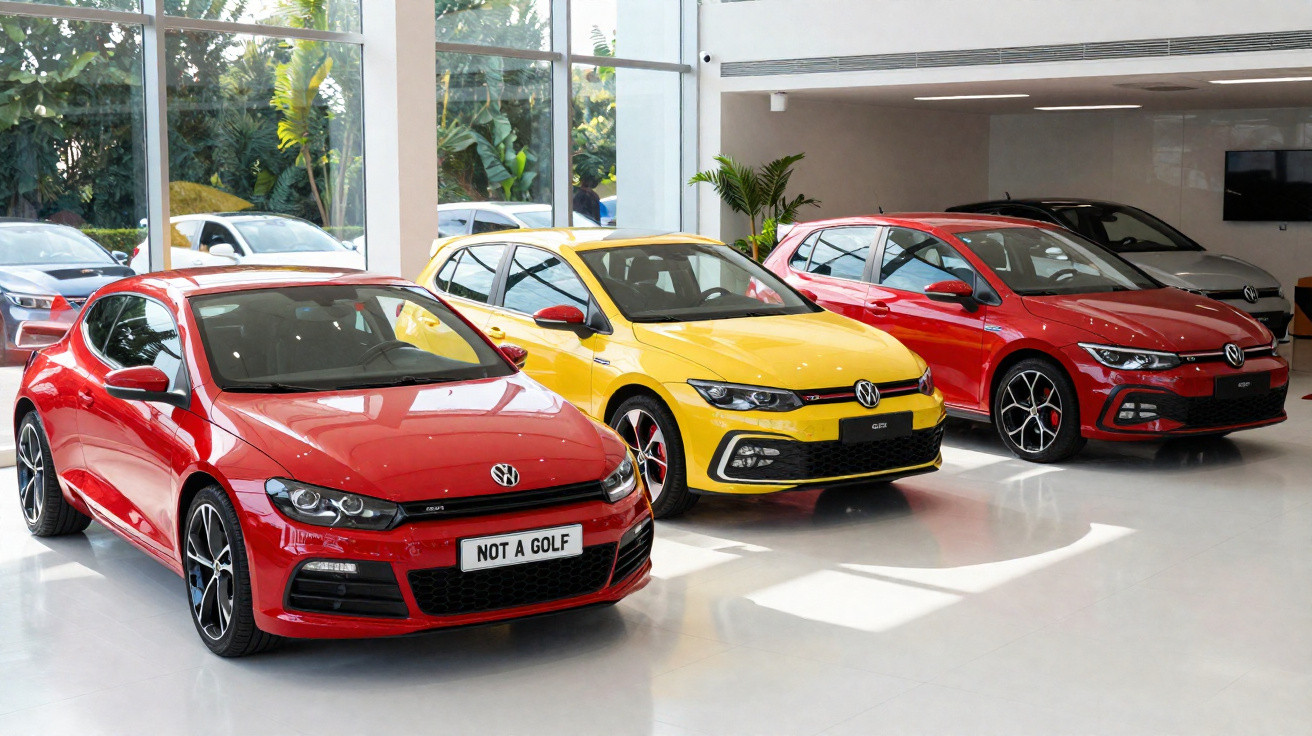
Speaking of the GTI badge inevitably brings the Volkswagen Golf GTI to mind. After all, it was this car that, in 1976, effectively defined what we now recognise as the hot hatch: a formula that paired the everyday practicality of a small family car with performance previously reserved for sportier and… more expensive machines.
Short for Gran Turismo Injection (the wording may differ by language), the badge combined the initials already associated with performance, GT, with the letter “i”, denoting electronic fuel injection at a time when most engines still relied on carburettors. The initials ultimately grew beyond their original technical meaning to represent far more than a particular solution.
They went on to define an entire class of cars and appeared on sporting models from other manufacturers, yet the strongest association remains with the Golf specifically and Volkswagen more broadly. It is hardly surprising that, for many people, “Golf” and “GTI” are virtually synonymous…
However, the success of the first Golf GTI - which we have already driven - prompted Volkswagen to apply the initials to further models. Some are well known, while others have been almost forgotten. The GTI-badged Volkswagens that were not Golfs are the focus of the following pages.
Scirocco GTI (1976)
The Scirocco GTI was among Volkswagen’s first models to wear the badge, arriving at almost exactly the same time as the Golf. Its three-door coupé body set it apart, although everything beneath the surface was identical.
It used the same platform and the 1.6-litre engine producing 110 hp and 140 Nm of torque. Even so, it never attained the Golf’s status, although a second generation was also offered with the same engine. It later gained the second-generation Golf GTI’s 1.8-litre, 139 hp unit. In certain markets, it was known as the Scirocco GTX.
Volkswagen Polo GTI
While the Scirocco received the GTI badge straight after the Golf, the Polo had to wait considerably longer. Volkswagen’s German supermini did not wear these initials for the first time until the late 1990s. Before then, the sporting Polo role was filled by the legendary, popular and even infamous Polo G40 - discover it in greater detail.
Since then, the Polo GTI has been a regular fixture in what many consider one of the most entertaining types of car to drive: the pocket rocket. The concept is no different from that of a hot hatch, only on a smaller scale. The Mini Cooper S (1963) is widely regarded as the car that established this category, predating even the hot hatch.
The gallery below features every generation of the Volkswagen Polo GTI:
Volkswagen Lupo GTI
The first Polo GTI (1998) soon faced serious in-house competition, as Volkswagen unveiled the Lupo GTI in 2000.
It had the same 1.6-litre, 125 hp engine, but was more compact and several dozen kilograms lighter at 975 kg. That translated into a 0.5-second advantage in the 0–100 km/h sprint, while matching its 205 km/h top speed - and it was also more enjoyable to drive.
Little wonder it was praised as the enthusiast’s choice and the genuine successor to the first… Golf GTI.
Volkswagen up! GTI
Decades after the Lupo, Volkswagen applied the same philosophy to its successor. Revealed in 2017, the Volkswagen up! GTI revived the notion of a light, straightforward and enjoyable pocket rocket - effectively a modern tribute to the original first-generation Golf GTI concept.
Powered by a 1.0 TSI engine with 115 hp and weighing only just over one tonne, the up! GTI claimed 8.8 seconds from 0 to 100 km/h and a top speed of 196 km/h. When it arrived in Portugal, Razão Automóvel drove it at the Palmela Kart Circuit, a track well suited to its dimensions - revisit that moment.
More GTI models that were not the Golf
The Volkswagen GTI models above made it to Europe, but they were not the only ones. Across prototypes and cars sold in other regions of the world, several more models ended up displaying the GTI badge.
One of the most intriguing examples is the first-generation Volkswagen Passat GTI prototype, created to assess whether the Golf GTI formula could be applied to a larger family car. The German manufacturer ultimately decided against it, having found no viable business case for a Passat GTI.
Among production cars, other Volkswagens wore the GTI initials outside Europe. Perhaps the best-known is Brazil’s Gol GTI - Gol, not Golf.
Introduced in 1988, it differed from the Golf by using a longitudinally mounted 2.0-litre, 120 hp engine rather than a transverse installation, although it retained front-wheel drive. It spanned two generations and several versions, with the most powerful reaching 153 hp. Like the Golf GTI, it is also a brand icon in Brazil.
Remaining in Brazil, the Volkswagen Pointer GTI was probably one of the badge’s most unlikely interpretations. Sold in selected Latin American markets during the 1990s, it resulted from an industrial partnership between Volkswagen and Ford, known as Autolatina, and was simply a fifth-generation Ford Escort restyled to resemble a Volkswagen. It used a 2.0-litre engine producing around 115 hp.
Finally, there is the North American Jetta GLI, which inherits virtually everything from the Golf GTI apart from the initials. Across several generations - from the 1980s to the present day - the Jetta GLI has received the same chassis and suspension modifications, as well as the same mechanical upgrades, some adapted for the North American market. In essence, it is a three-box Golf GTI.

Comments
No comments yet. Be the first to comment!
Leave a Comment