
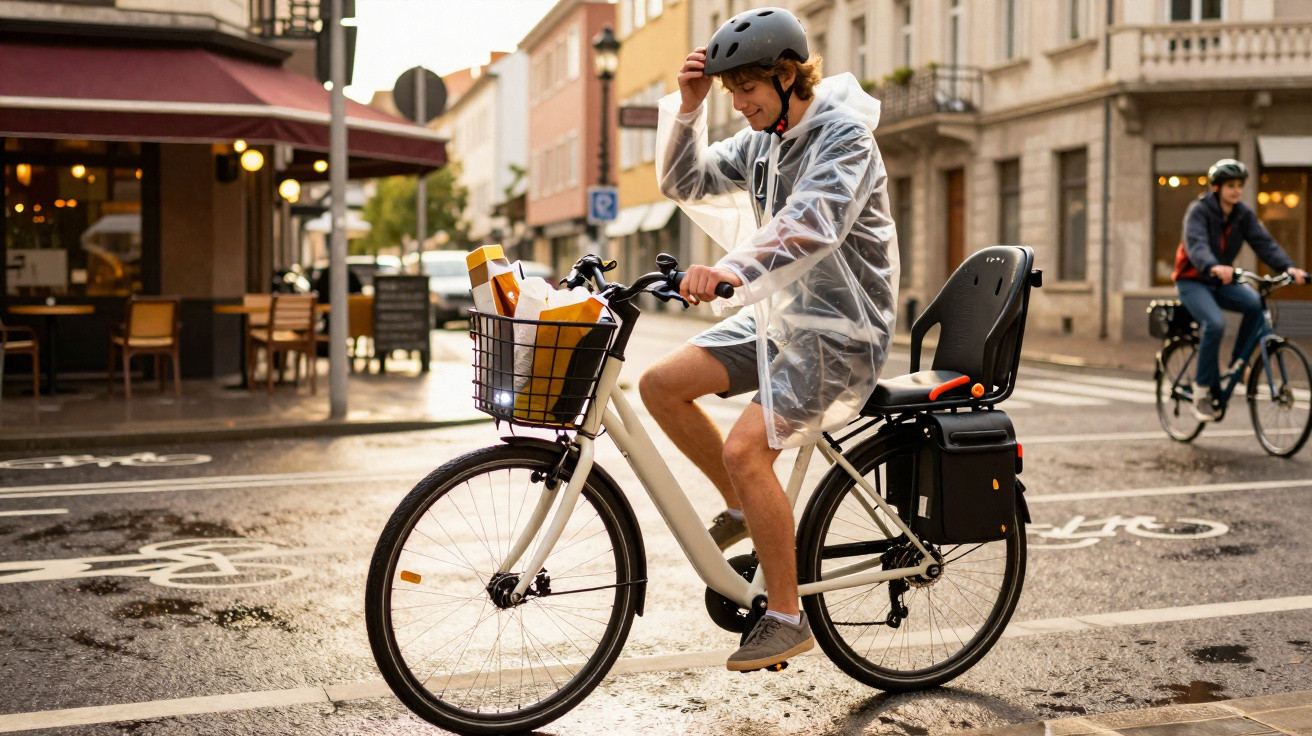
The first time I properly took notice of e-bikes was at a traffic light on a Monday morning. Around me, people on ordinary bikes seemed only half awake, with rounded shoulders and their gaze fixed downwards. Then a woman arrived on a smart electric bike: a basket at the front, a child seated behind her, and headphones tucked beneath her helmet. She looked entirely at ease. As the lights changed, she moved off smoothly, with no visible effort, sweat, fuss or wobble.
I found myself watching her.
What caught my attention was not really the motor or battery. It was all the small additions fitted around them: the phone holder on the handlebars, the broad rear rack loaded with bags, and those unusually wide tyres.
Then I understood it: an electric bike’s real magic lies as much in its accessories as in the bike itself. That realisation changes the whole picture.
Why the right accessories determine whether you actually use your e-bike
Most buyers fixate on wattage, battery range and brand names. They purchase a gleaming electric bike, use it for a fortnight, then gradually leave it gathering dust in the hallway. The problem is rarely the bike itself. It is that the bike does not properly slot into the untidy reality of everyday life.
An e-bike without suitable accessories is much like a smartphone without apps: capable in theory, but underused in practice. Naturally, you can still ride it, yet you never quite reach that point where you think, “I’ll take the bike for everything”. That shift comes down to practical details: where you put your bag, what you do when rain starts, and whether you feel secure cycling home after dark.
Speak with people who commute by e-bike and the same story appears so often that it is almost funny. Someone buys a basic model with no rack, mudguards or worthwhile lights. They enjoy three days of sunshine, then face their first large grocery shop, unexpected downpour or evening trip along a poorly lit road.
One rider in Paris told me he fitted a rear rack and panniers after nearly dropping his laptop while trying to cycle one-handed. A woman in Berlin said she doubled her weekly distance as soon as she added a genuinely bright headlight and reflective side stickers. The motor had not changed; what changed was the sense of safety and ease in everyday use.
Once you notice this, it becomes impossible to ignore. Accessories are not simply decorative. They can tip the balance between a “nice idea” and a “default mode of transport”.
A front basket can turn a brief ride into a useful errand trip. A robust lock determines whether you are willing to leave the bike outside the supermarket. Mudguards decide if you arrive at work with a clean back or a stripe of mud. This is the understated reality: the items many people label as “extras” often decide whether an e-bike becomes a routine or remains an expensive toy.
The motor gets all the credit, but the accessories do most of the work.
The four e-bike accessory setups that genuinely transform daily life
Before you even select a motor size, ask yourself one straightforward question: “What do I really want this bike to do for me, every week?” Let that answer shape your accessory choices before you think about top speed.
Four familiar configurations appear again and again: the commuter build, the cargo-hauler, the family taxi and the weekend explorer. Each has its own essential kit. For commuters, dependable lights and a good lock matter more than an elaborate display. For cargo riders, a rear rack and panniers are more important than integrated GPS. Identify the task first, then equip the bike to handle it.
Consider the commuter arrangement: a 15 km daily round trip through urban streets in unpredictable weather. The ideal is uncomplicated: take the bike, set off, arrive, lock it and continue your day. No second thoughts.
One London office worker I spoke to insisted that full-length mudguards and a chain guard made more difference than a battery upgrade. “I stopped needing backup clothes at work,” she said. After fitting a sturdy folding lock to the frame and a phone mount for navigation, her e-bike began beating the Underground on every wet day. The bike didn’t just ride better. Her whole routine softened.
At the other end are cargo and family configurations. Parents who fit a child seat to a standard e-bike often assume that solves everything. Then everyday life intervenes: where should the backpack go, the shopping, or the scooter their child refuses to ride home?
This is where broad rear racks, side panniers, footrests and even small handlebar grips for the child turn anxiety into confidence. A rider in Amsterdam told me that he only felt truly relaxed once he added a front basket to balance the load and a double kickstand to keep the bike completely stable during loading. Accessories literally redistribute weight, stress, and attention. Without them, the motor feels like nothing more than a strong arm attempting to carry too many plastic bags at once.
Small details that shape comfort, safety and enjoyment
Before buying an e-bike, follow one simple practical rule: test it with a load, rather than empty. Take your backpack with you. Ask the shop whether you can borrow panniers. If they have a front basket available, fit that too. Ride the same route twice: once “naked”, then once “dressed”.
You will spot oddly specific differences. A front bag can make the steering feel heavier. A rear pannier prevents an irritating strap from catching your pedal. Your posture alters when you are no longer carrying everything on your shoulders. This is how you identify what you genuinely require: perhaps a straightforward rear rack and two panniers serve you better than an Instagram-perfect wooden crate at the front.
Comfort is another area that people commonly learn about the hard way. A suspension seatpost and a slightly wider saddle may determine whether you cycle three times each week or every day. Powerful front and rear lights can dramatically increase your confidence at night. A bell loud enough to be heard on busy cycle paths can save you from uncomfortable last-minute swerves.
We have all had that moment when we vow to “fix that small annoyance later”, only to tolerate it for months. In truth, nobody adjusts their saddle height every day. Set it correctly once, fit suitable ergonomic grips or bar-ends, and your hands may stop tingling after 20 minutes. This is not a luxury; it is what stops the bike feeling like a chore.
Eventually, every discussion returns to security. It may not be glamorous, but it is crucial.
“People spend €2,000 on a bike and €25 on a lock,” a Brussels bike mechanic told me. “Three weeks later, they come back on foot.”
- Lock and anti-theft system
A frame-mounted U-lock or heavy chain, alongside a secondary café lock. - Carrying solutions
Rear rack, panniers, front basket or cargo crate suited to the load you actually carry. - Weather and comfort
Mudguards, a decent saddle, possibly a suspension seatpost and good gloves. - Visibility and signals
Strong lights, reflectors, reflective stickers and a loud bell. - Control and protection
A quality helmet, a phone holder for navigation and perhaps a mirror for busy roads.
Living with an e-bike is an evolving story, not a one-off purchase
What shops rarely explain is that your ideal e-bike arrangement will not be perfect on the first day. You uncover your needs as you get to know a new city: turn by turn and ride by ride.
After a month, you may find that your inexpensive lights are ineffective on unlit roads. Three months later, after a friend’s bike is stolen, a second lock may suddenly feel sensible. Six months on, a new job with a longer commute could lead you to add a more comfortable saddle or a larger battery bag. Every adjustment brings the bike a little closer to “I can use this for everything”.
For that reason, the best question before purchase is not “What’s the best e-bike?” but “Which accessories will make this thing feel like it was built for my life?” A modest motor paired with an excellent rack, strong lock, proper lights and useful bags can outperform a premium motor on a bare, showroom-clean frame.
The bike industry is fond of speed and statistics. Yet you do not cycle statistics. You ride to collect your child, to get through a Tuesday thunderstorm, and to carry a week’s shopping without dreading the journey. Accessories are the quiet element of the story, but also the most truthful.
An e-bike that genuinely works for you is usually the one that accounts for the dull little details everyone else overlooks.
| Key point | Detail | Value for the reader |
|---|---|---|
| Accessories shape daily usability | Racks, mudguards, lights and locks determine how often you ride | Helps you avoid purchasing an expensive bike that you hardly use |
| Match setup to real life | Commuter, cargo, family and weekend builds require different equipment | Directs you towards a configuration that genuinely suits your routine |
| Think long-term, not showroom | Plan for comfort, safety and security from the outset | Makes your e-bike a dependable everyday tool rather than a short-lived gadget |
FAQ:
- Question 1 Which accessories should I prioritise if my budget is tight?
- Question 2 Do I really need special e-bike lights or are normal ones enough?
- Question 3 Is a rear rack better than a front basket for commuting?
- Question 4 How many locks does an electric bike actually need?
- Question 5 Can I add these accessories later or should I choose them when I buy the bike?

Comments
No comments yet. Be the first to comment!
Leave a Comment