
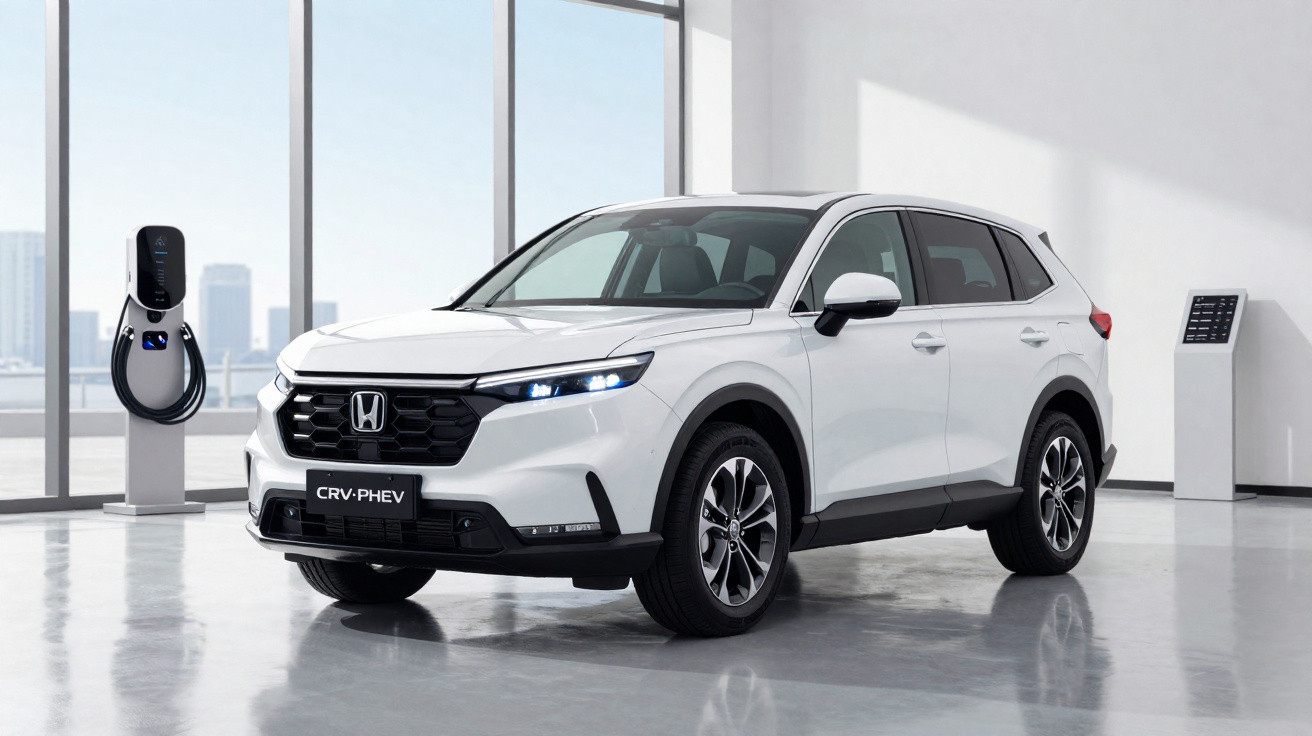
The new Honda CR-V introduces a plug-in hybrid system that can cover more than 80 km in fully electric mode. We have already driven it.
The new Honda CR-V will arrive in Portugal later this year, although it is already on sale in China, where it is built and which is one of its most important markets for commercial success. That focus explains features such as the enormous front grille and the body’s enlarged proportions.
As well as being the Japanese brand’s largest SUV, the sixth-generation Honda CR-V is also its first model to feature a plug-in hybrid system (e:PHEV).
It combines a 2.0-litre four-cylinder petrol engine producing 148 hp with a 184 hp electric motor. The latter draws power from a 17.7 kWh battery, with a claimed maximum all-electric range of 81 km.
Honda chose the Porto and Douro region for the dynamic presentation of the new Honda CR-V. Front-wheel-drive and all-wheel-drive hybrid versions were available, alongside the plug-in hybrid, which brings the main technical innovation.
Practicality and added space
Given the larger body, the increase in cabin room comes as no surprise. Indeed, it is now among the most spacious SUVs in its class in this respect.
In the second row, NBA players can now travel without having to squeeze themselves in. Legroom can be adjusted through the seats’ asymmetrical 19 cm longitudinal adjustment.
The seats are not only spacious but also highly comfortable, with eight backrest settings. The absence of an intrusive transmission tunnel in the floor also gives rear passengers greater freedom of movement.
For easier access, the doors open to an angle close to 90 degrees, making it much simpler to get in and out or fit and remove child seats.
Boot capacity has increased by 99 litres compared with the previous CR-V, reaching a total of 587 litres. The PHEV version offers an even greater benefit, thanks to a 72-litre underfloor compartment for small items, such as battery charging cables.
It is unusual - if not unprecedented - for the plug-in version to have the larger boot. This is possible because the battery and other components are positioned closer to the front of the vehicle.
“Copied” from the Honda ZR-V
Up front are the familiar features that define the dashboard of Honda’s latest models: a horizontal layout, solid assembly, materials that feel good to the touch, and a transverse hexagonal mesh housing the air vents.
There is also a 9-inch central infotainment display and a 10.2-inch digital instrument cluster. Both are easy enough to read, but their appearance already feels dated, owing to the graphics and the predominance of monochrome shades. The “old-fashioned” controls on the central screen are also a nod to the 1990s.
Better-equipped versions already feature a head-up display projected onto the windscreen, a more sophisticated solution than the panel mounted above the instruments.
Compared with the Honda ZR-V, one of the most obvious differences is the wider centre console. However, it retains the same automatic gearbox controls, driving-mode selector and a separate control for the hybrid system’s operating modes.
Approved driving manners
Ride quality is geared more towards comfort, and there is little noticeable distinction between the driving modes. The plug-in hybrid version already has variable electronic dampers, so ride comfort ranges from extremely good to very satisfactory - again, without major differences between settings.
Performance from the Honda CR-V plug-in hybrid is acceptable, as the instantly delivered electric power means it never struggles greatly when building speed, even though 0-100 km/h takes 9.4 seconds.
Its plug-in hybrid system is heavier because of the larger battery, which affects performance in certain situations. On the other hand, fitting the battery centrally in the vehicle floor gives the Honda CR-V greater stability and even makes the steering feel more “communicative”.
e:PHEV system driving modes
There are no selectable driving modes in the hybrid (e:HEV), as the system makes those decisions itself. In the e:PHEV, however, the driver can choose EV (pure electric), Auto (hybrid), Save (which maintains the battery charge at the same level) and Charge (activated by holding the driving-mode control for a few seconds, using the petrol engine to charge the battery).
EV mode is unavailable when Sport mode is engaged, and it disengages under full-throttle acceleration in the interests of preserving electric range. Its use is also restricted when battery charge is too low.
There are also paddles behind the steering wheel to adjust the level of energy recuperation during deceleration, with four settings available. Alternatively, pressing the “B” button on the gearbox selector produces a stronger effect. In any case, the CR-V never offers one-pedal driving: it will not come to a complete stop unless the brake pedal is pressed.
One of the biggest advances in the latest generations of hybrid powertrains can be found in continuously variable transmissions, which now provide a closer relationship between engine noise and the vehicle’s overall response.
That improvement is clear in the hybrid CR-V, although in the plug-in it is compromised by the synthesised acceleration sound selected in Sport mode.
Not only is the sound rather “basic”, but the synthesised electric acceleration noise blends with the petrol engine’s sound under full-throttle acceleration, when it comes under load to assist. The result is a disconcerting and far from harmonious “racket”.
Consumption and range
A 40 km route in the Honda CR-V e:HEV (hybrid), consisting almost entirely of A-roads, returned an average of 7.7 l/100 km, well above Honda’s stated 5.9 l/100 km.
Nevertheless, it was an acceptable result considering this was a test drive, including several harder accelerations and generally faster driving than would be typical in everyday use.
Around 120 km were covered in the plug-in hybrid version, with 80 km completed while the battery still had charge, validating Honda’s claimed 81 km electric range. However, the more demanding conditions of a test drive increased the final recorded average still further, to 3.4 l/100 km, against the official 0.9 l/100 km.
When the battery’s “juice” ran out, the average stood at 2.9 l/100 km. This means the final 40 km of the route raised average consumption by only half a litre. In other words, this result supports Honda engineers’ “promise” of average consumption of 6.2 l/100 km when the Honda CR-V has no battery charge remaining.
Brands such as Honda and Toyota have long been hybrid-system specialists, though not in plug-in hybrids, and charging is proof of that. For example, DC charging is not yet available; only AC charging is supported. In the Honda CR-V’s case, the onboard charger reaches only 6.8 kW, meaning a full charge of the 17.7 kWh battery takes around 2.5 hours.
Orders now open
The new-generation Honda CR-V will reach the market later this year, but ordering is already open. In Portugal, the plug-in hybrid version will be the main focus, despite its €61,500 starting price.
Alternatively, Honda will also offer the CR-V with a conventional hybrid system, although its final price has not yet been fully confirmed. Its entry price is nevertheless expected to be around €52,000.
An all-wheel-drive hybrid version will follow later, although the brand does not expect it to account for a significant share of the Portuguese market.


Comments
No comments yet. Be the first to comment!
Leave a Comment