
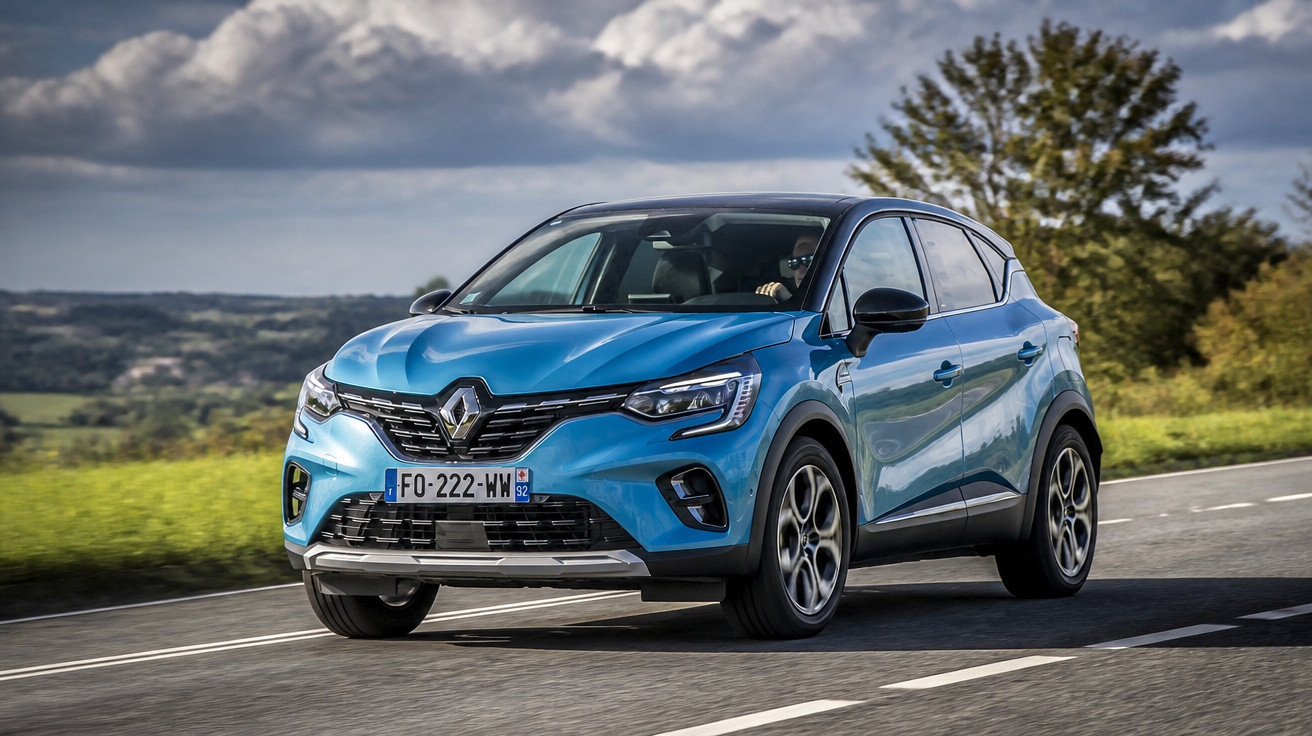
So, what exactly is this?
Before your eyes start to glaze over, it is worth pointing out that this is not merely an ordinary second-generation Renault Captur. Thankfully.
Visually, almost nothing distinguishes it from the rest of the range, apart from a fuel flap on each rear quarter. This is, in fact, the plug-in hybrid Renault Captur E-Tech.
Renault Captur E-Tech hybrid system
E-Tech sounds familiar, doesn’t it?
It should do. E-Tech is Renault’s Formula 1-inspired hybrid arrangement, combining two electric motors with a 1.6-litre four-cylinder petrol engine and a six-speed automatic transmission.
That gearbox is particularly fascinating. It is a clutchless, multi-mode dog-type transmission, akin to the units found in F1 cars. The smaller electric motor synchronises engine revs with road speed to make gear changes smooth. It also starts the combustion engine whenever required, although only while the car is already moving: switch the Captur on and it will always pull away in EV mode. It is an exceptionally clever set-up.
Interesting. What else should I know?
The larger electric motor sends power to the front wheels. It can operate independently for 48 km at speeds of up to 134 km/h, or work with the petrol engine according to the selected drive mode.
Renault says the powertrain’s highly intelligent control unit can select from as many as 15 combinations of gear ratio and power source. There is no reverse gear in the sophisticated transmission, either, as reversing is handled entirely by electric power. Its 9.8kWh battery needs between three and four hours to recharge fully, with charging limited to 3.6kW.
Despite its complexity, Renault insists that the system represents good value. However, at £30,495, the S Edition E-Tech PHEV costs roughly £5,000 more than a similarly equipped 95kW 1.3-litre petrol Captur. Ouch.
How the Renault Captur E-Tech drives
What is it like on the road?
First, the E-Tech is now the most powerful Captur offered to UK customers. Together, the hybrid components develop 118kW and 348Nm of torque, delivering a 172km/h top speed and a 0-100km/h time of 10.1 seconds.
Perhaps those figures are not the most relevant ones here, although selecting Sport mode brings up an image of the Captur on a racing circuit on the central display. Optimistic.
Sport releases the full forward performance of the powertrain. Most drivers will instead choose the automatic MySense mode, which retains fairly progressive acceleration while avoiding much of the elasticated noise associated with CVT-equipped hybrids. Pure is Renault’s term for fully electric running, while E-Save uses the rather coarse engine by itself and preserves at least 40 per cent of the battery charge for urban use later on.
The entire system feels carefully considered, and the Captur’s ride and handling mirror that approach. It is a crossover, so excitement is not its forte, but this second-generation model is sufficiently refined and entirely capable in everyday use.
Economy, charging and cabin
What economy does Renault claim?
An extremely sensible question. Renault quotes 188.3mpg and 34g/km under WLTP testing, although that is an extremely unhelpful answer for a PHEV. In everyday conditions, the result will hinge on how often your journeys exceed 48 km. A BP Chargemaster wallbox is included free of charge, at least.
And the interior?
As with the exterior, the E-Tech’s cabin differs little from that of the petrol-powered Capturs. Every E-Tech receives the frustratingly sluggish 9.3-inch portrait-format central touchscreen, along with a 10-inch digital instrument display and a wireless phone charger set into the dashboard.
At 379 litres, the boot is marginally smaller than in the internal-combustion Captur models.
Verdict on the Renault Captur E-Tech
So, the final verdict?
This is not a poor plug-in hybrid effort from Renault, but it remains difficult to escape the sense that the E-Tech powertrain suits the smaller, non-PHEV Clio better. The absence of rapid-charging capability is disappointing as well, before even considering the price. The regular second-generation Captur earns a TG rating of 6/10, making this version a distinctly middle-of-the-road…
5/10
Comments
No comments yet. Be the first to comment!
Leave a Comment