
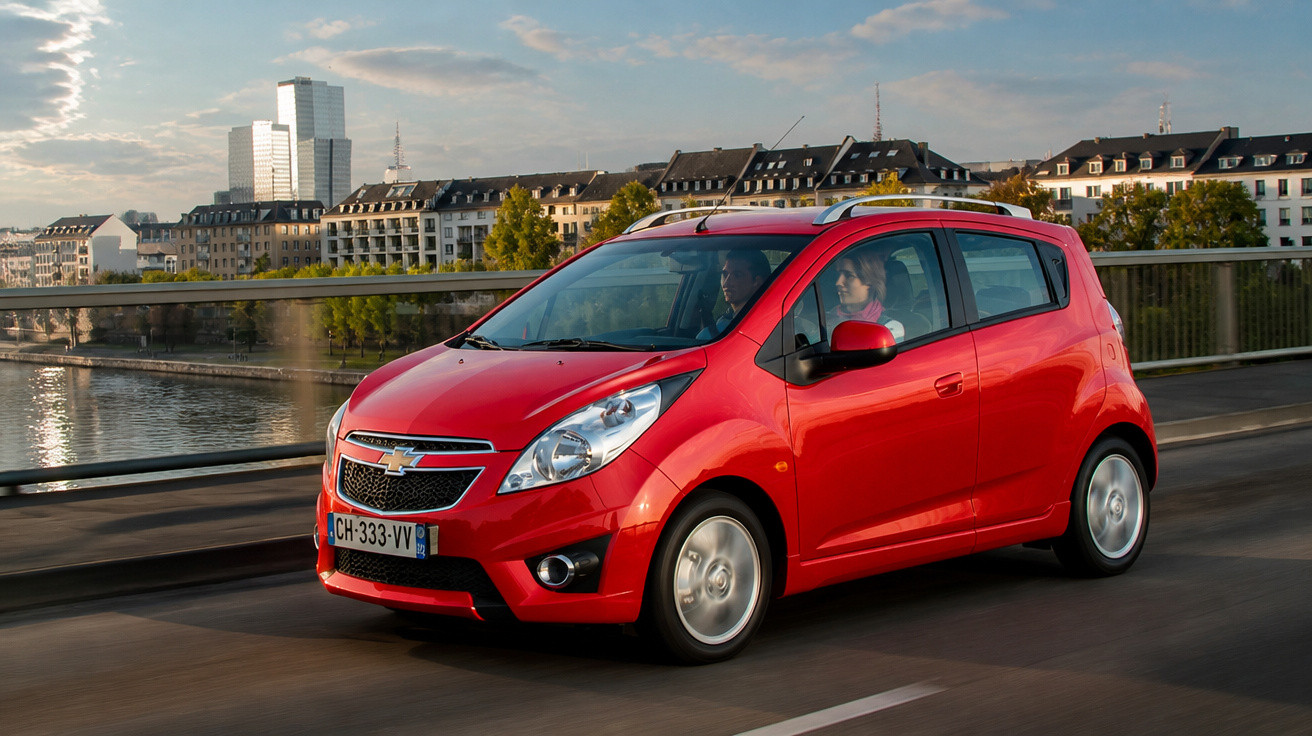
For most buyers, a second-hand car presents no problem at all. For others, however, only a new vehicle will do: they would be no more inclined to drive something previously owned than they would be to wear somebody else’s old trousers. Chevrolet built the Spark for that latter group.
Chevrolet Spark pricing and equipment
This is a proper five-door hatchback with a starting price below £7,000. I have not looked through the Spark brochure, but I suspect the entry-level version will not be the one appearing in its publicity shots. Admirably, it comes with six airbags, yet it also makes do with manual windows, wheels resembling sofa castors, an empty gap in the dashboard where a radio should sit, and central locking only in the sense that, if you sat in the middle of the car - presumably on the handbrake - you could reach each of the four lock buttons.
Spend a little over £8,000 and those omissions are sorted, with air conditioning included as well. Continue up the range and Chevrolet gives the top-specification LT equipment that makes it look rather appealing among minicars, which is precisely why these are the versions Chevy put in front of the camera. It gets larger wheels, chrome highlights, plus silver and body-coloured dashboard trim. Those visual touches must cost pennies to add, but because the LT brings other equipment too, you must spend thousands extra to have them. The price is close to £10,000.
At that figure, you could certainly buy a better car, provided you were happy to metaphorically pull on pre-owned underwear. A low-mileage, full-sized supermini with plenty of warranty remaining, for example. That is what I would choose. Even if you insist on the scent of a brand-new car, the £9,000-£10,000 bracket becomes seriously competitive, bringing Fiat 500s, Kas and Twingos into play. They are all three-door cars, though. So the conclusion is simple: if a low-cost new car with five doors and five seat belts is an absolute requirement, consider the Spark.
Chevrolet Spark design and cabin
Viewed in those terms, it is a decent car. It is interesting to look at, first and foremost, and unusually aggressive in character for such a small machine: its lights are angular and glittery, its detailing deliberately exaggerated, and its bodywork is carved into a sequence of switchblade-like cuts. The rear door handles are concealed in the pillars, while the cabin is narrower than the track. Even so, there is no fully hiding the unavoidable tall, stubby shape. Look at it from just behind a perfect side-on view and it appears as though someone has kicked it in the face. Nevertheless, it is a welcome break from convention, which insists that little cars must wear an overly cute expression, like a line of Hallmark birthday-card rabbits with pink bows at their necks.
Imagine the instrument cluster mounted on a scooter’s handlebars, then place it on a steering column: that is the Spark cabin’s standout feature. The speedometer is a conventional dial, with every other piece of information displayed on an LCD screen. Absurdly, although that LCD is the same size, basic models do not even receive a clock. Producing two different versions surely costs Chevrolet money, so this is simply another tactic to steer buyers towards a higher specification.
Five people can fit, as long as the larger ones take the front seats. Rear-seat legroom and headroom are acceptable, but the space is as narrow as you would predict from looking at the car outside. It is not a Tardis, although The Doctor would not find more room elsewhere in this class either.
Ride, engines and handling
It is a comfortable little car, particularly when pottering around town. Its body feels rigid and does not tremble over bumps, while the springs absorb those bumps remarkably well anyway. The dampers do a good job too. Overall, it feels as though it has been engineered with a reasonable amount of money behind it. Turn the radio down, however, and the budget-saving becomes unmistakable. Road noise is dreadful. I did not realise Lidl sold own-brand suspension bushes.
The engine is not especially quiet, either. The first 1.2-litre example I drove sounded like a cement mixer and had a notchy gearchange to match. The second was substantially better in both respects. They were pre-production cars, so I would expect the one you buy to resemble the latter rather than the former.
The nicest engine of all was actually the basic unit, a modest 1.0 litre. Work it hard and it responds willingly enough, while 68bhp is respectable output for the price.
You will need the larger 1.2-litre Spark, though, if reaching 62mph in less than 15.5 seconds matters. The same applies if you ever need the outside lane, or if you travel uphill carrying more than just yourself. The 1.2 produces 81bhp, and those additional 13 horses make a huge difference at this end of the market. Its official fuel economy figure is identical, too.
The best small cars are those you can fling through corners within an inch of their lives while still feeling that they are working with you. The Spark is one of them. It feels light-footed. The front wheels follow steering inputs faithfully, while feedback from the tyres travels back through the wheel to your fingertips. With the throttle, you can coax the rear tyres into shifting about slightly. It is not wild, but it creates a mischievous grin. Because all this occurs at such modest speeds, even in suburbia, you can feel like a hooligan without actually behaving like one.
Chevrolet remains a name that suggests cumbersome American barges. Yet it is a cleaner badge than Daewoo, the former name of this GM division. The Spark is no Corvette, but it demonstrates that Chevy is heading in the right direction. And doing so at a fair pace.

Comments
No comments yet. Be the first to comment!
Leave a Comment