
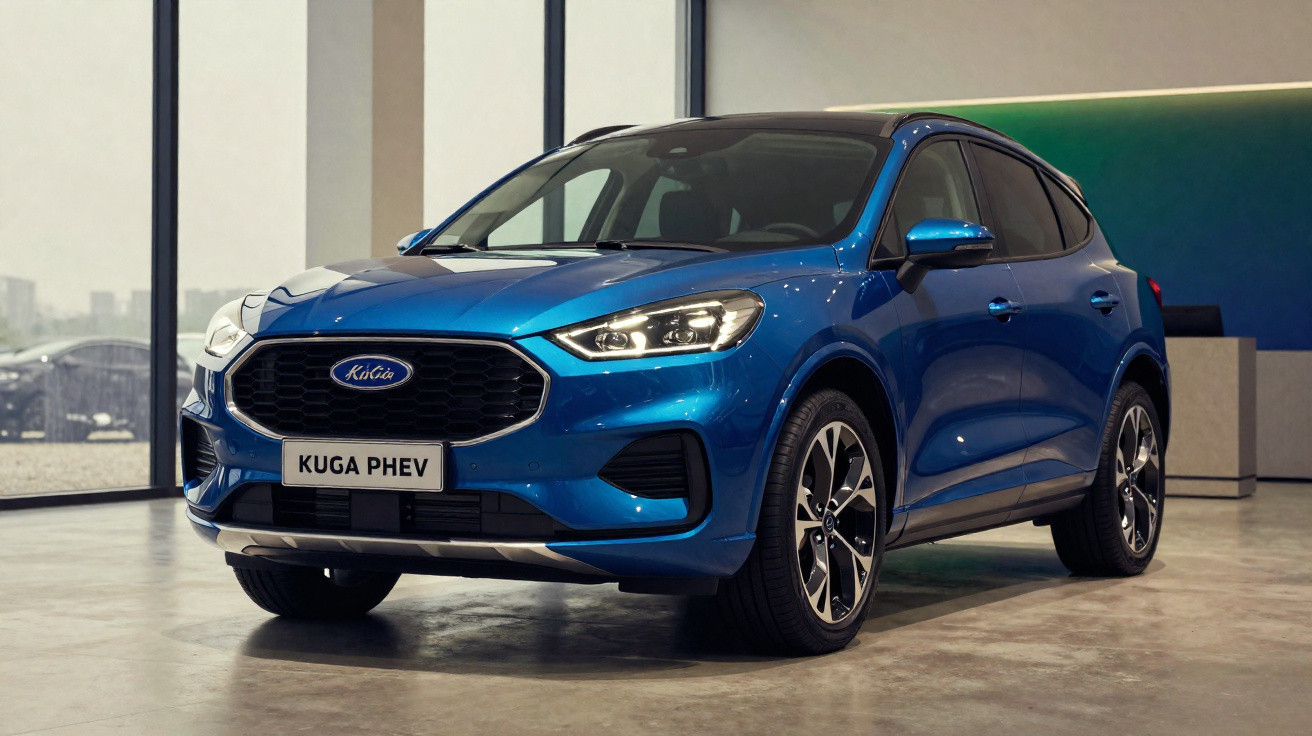
The Ford Kuga PHEV covered more miles in fully electric mode than I had anticipated.
The Ford Kuga plug-in hybrid (PHEV) has been among the best-selling vehicles in the European market fitted with this type of powertrain. It actually topped the sales charts for three consecutive years, while this year it has been competing with the BMW X1 and Volvo XC60.
To keep the model appealing and sustain interest, Ford has refreshed its styling and expanded its technology offering. At the front, there are new light clusters and a revised visual signature, with the blue oval badge, for instance, now positioned in the middle of the grille. At the rear, the overall design remains unchanged.
One of the key additions in this updated Ford Kuga range is the Active version, which adopts a more adventurous appearance. It features plastic wheel-arch cladding, bumpers with more substantial lower protection and matching lower side protection. The 20” wheels complete the look, although they are only available as an option.
A stronger focus on technology
Inside the Ford Kuga, most things look much as they did before this update. Even the instrument cluster, which was already fully digital, has only gained slightly revised and customisable graphics.
The major change is the new central touchscreen, which has grown by more than 50%, increasing from 8” to 13.2”. The SYNC 4 system also improves connectivity, both for devices inside the car through Apple CarPlay or Android Auto, and externally thanks to a 5G modem and over-the-air (OTA) updates.
The user interface has also been refined. It is easier to use and offers a modest level of customisation, allowing drivers to tailor it more closely to their preferences.
Cabin space is unchanged. The driving position remains very good, while rear-seat accommodation is generous. The rear seats can still be moved fore and aft, with 15 cm of adjustment available. This allows occupants to choose between greater rear legroom or more boot space, which can reach 536 litres.
An even more efficient hybrid system
The Ford Kuga plug-in hybrid system combines a 2.5-litre four-cylinder petrol engine, operating on the more efficient Atkinson cycle, with an electric motor. Together, they deliver a maximum combined output of 243 hp. That is 19 hp more than before, a gain attributed to improvements to the automatic CVT transmission.
Drive is sent to the front wheels and, according to Ford, the 14.4 kWh battery provides an all-electric range of 69 km, just 1 km short of 70 km.
On paper, these figures may not sound especially exciting, but in real-world use the Kuga’s plug-in hybrid system makes a great deal of sense. With access to a charger at home or at work, it is very easy to forget that there is a combustion engine under the bonnet.
Although the test lasted only a few days rather than weeks covering a wide range of routes, achieving a maximum all-electric range of 67 km was not difficult, even with several motorway miles included.
Reaching this result did not involve going without air conditioning whenever it was needed. There was some care taken to make the most of regenerative braking and, naturally, to avoid overusing the accelerator. The final figure was very close to the range claimed by the manufacturer.
Effective even with no charge remaining
Without straightforward access to a charger, the plug-in hybrid system becomes less compelling - in that case, the other Kuga hybrid, the FHEV or Full Hybrid Electric Vehicle, which does not need charging, may be the better choice.
Even so, once the Kuga PHEV battery has been fully depleted, the system still “rolls up its sleeves” and does all it can, recovering as much energy as possible during every braking event or period of deceleration.
Even when the instruments indicate 0 km of electric range, the Ford Kuga often travels - and for a considerable period - with its combustion engine switched off. In addition, parking manoeuvres are rarely anything other than silent and fully electric.
As a result, unlike with some similar systems, petrol consumption never rises to astronomical levels.
By the end of the test, after more than 375 km, almost 230 km had been completed with the combustion engine switched off. Average consumption was just 3.8 l/100 km, an exceptionally good result for a 2.5-litre petrol engine with nearly 250 hp in a vehicle weighing two tonnes.
With charge in the battery, I recorded just 1.6 l/100 km in urban driving with heavy traffic. That was over 23 km, of which 19.4 km were covered in electric mode.
Ford Kuga Active on a higher plane
The effectiveness and efficiency of the plug-in hybrid system were impressive, and the Kuga also surprised dynamically. The 243 hp combined output is a positive, whereas the continuously variable automatic transmission is less so. Nevertheless, it is neither intrusive nor unpleasant in terms of noise.
The chassis and steering perform at the level expected of Ford. Even as an Active model with increased ground clearance - 10 mm at the front and 5 mm at the rear - the Kuga continues to inspire considerable confidence behind the wheel. Its body movements are highly predictable and easy to manage, making this SUV enjoyable to drive.
The price of efficiency
While electric cars remain expensive, plug-in hybrids are not far behind. In Portugal, they are also disadvantaged by the way ISV is calculated, as it penalises larger engine capacities - and the Kuga’s 2.5 litres do not help. There is, however, some relief: plug-in hybrids pay only 25% of the total ISV amount.
The Ford Kuga PHEV starts at €49,726 in ST-Line trim. In Active X specification - the version tested and the highest of the four equipment levels available - the price rises to €53,753. The Bursting Green body colour fitted to the test car is included as standard, so it carries no additional cost.
The Kuga tested also featured several optional items. Highlights include the 20” alloy wheels, panoramic opening roof, and the Winter and Safety packs. The latter includes dynamic LED headlamps, a head-up display and an alarm.
Once all the figures are added up, the Ford Kuga Active X 2.5 Duratec PHEV tested here costs €57,208. To make the figure less “painful”, Ford stated that, at the time this test was published, it had an offer in place reducing the price to around €48,500.
The price is high, but it is in line with other comparable offerings in the segment.

Comments
No comments yet. Be the first to comment!
Leave a Comment