
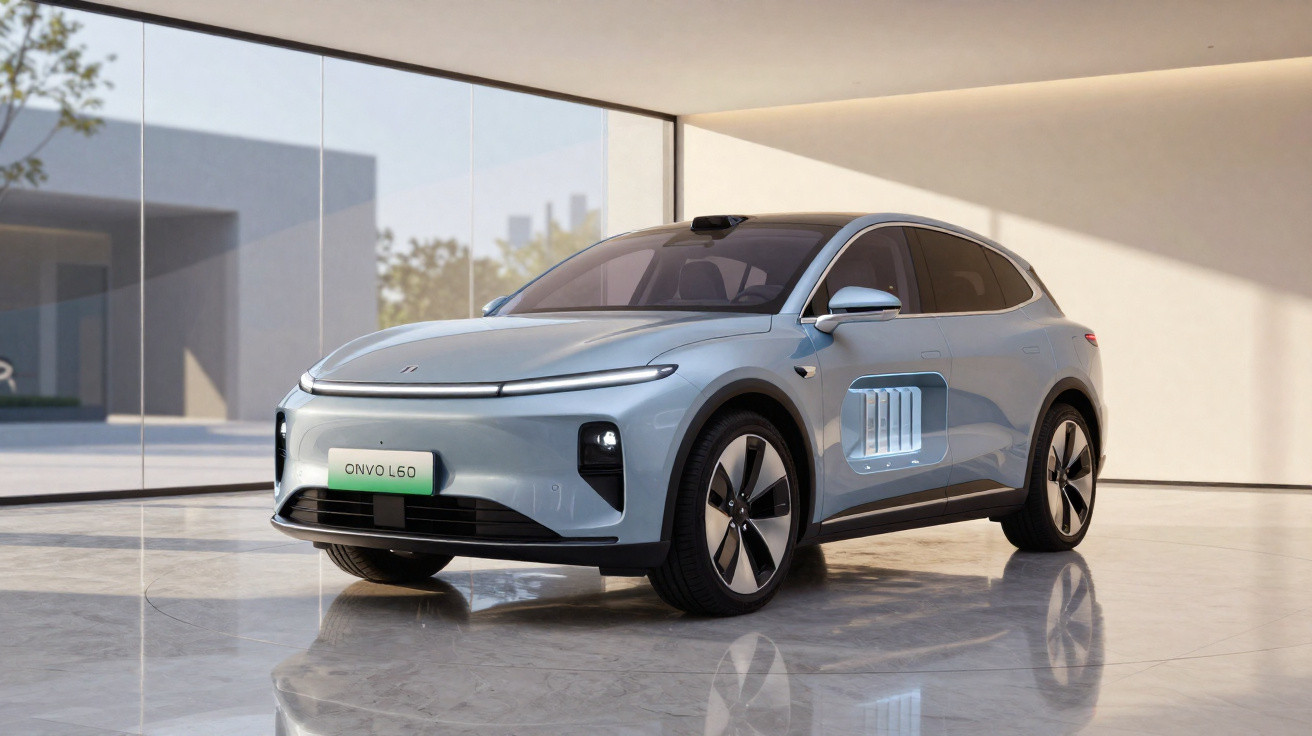
It may not have the most inspired name, but remember it: Onvo L60. A model whose battery swapping capability is one of its main highlights.
When launching a new brand, recognition is among the most important steps. In this respect, Onvo - owned by China’s NIO - has done an excellent job with the L60, whose exterior design immediately creates an emotional connection.
Even so, there are certain Tesla-like cues when viewed from the side, while the boomerang-shaped front lights bring Polestar to mind. The comparisons could continue: the overall rear-end layout recalls the BMW X4.
Déjà vu
There may also be a sense of déjà vu inside - something increasingly common among the minimalist dashboards of the digital era. There is a flattened steering wheel, with just two rotary controls on either side. “Where have we seen that before…”
Having to control everything through the screen is less practical and less safe than using direct physical controls, but if there were a Tesla badge somewhere in here, it could easily pass for one.
The Onvo L60’s central infotainment display measures 17.2 inches. A 13-inch head-up display comes as standard, as does the impressive Dolby Atmos 7.1.4 sound system with 18 speakers and 1000 W of output. Combined with a 16-million-colour ambient lighting system, it creates a distinctive onboard entertainment environment in the Onvo L60.
Convincing quality and space
The perceived quality is close to NIO standards - which are very high - particularly those of the new ET9, which is especially impressive in this area. There are still plenty of soft-touch, highly pleasant materials, while the assembly appears solid; in any case, it is better than what we know from the Tesla Model Y cabin.
Moreover, with a 2.95 m wheelbase and an overall length of 4.82 m, the L60 offers generous space in the front and, especially, across its three-seat second row, even for occupants taller than 1.80 m. In return, its 495-litre boot makes it one of the smallest in its class.
The interior is also designed to be quickly converted into a range of immersive, customisable spaces, something that particularly appeals to Asian customers. At the press of a button, the cabin adjusts according to the Naps, Oasis, Camping, Comfort and Pet programmes. The second row also has a central 8-inch screen.
The necessary distinction between the Onvo L60 and NIO models is equally apparent in the driver-assistance systems. The L60 is fitted with 30 sensors, including a 4D imaging radar, allowing high-definition detection, mapping and tracking of several moving objects at the same time.
It remains a respectable technological arsenal, though it is less advanced than the costly LiDAR systems fitted to NIO models, which can identify obstacles from further away and even in poor lighting conditions.
For that reason, its Level 2++ autopilot function is unlikely to operate as accurately in rain or low-visibility driving as it does in a NIO. However, as the day in Guangzhou, China - where we drove it - was very sunny, conditions were ideal and the challenge was not particularly demanding.
On-road driving
Like all electric cars, the L60 is swift in mid-range acceleration, but it is also quick from rest, completing 0-100 km/h in only 4.6s. Its 203 km/h top speed is unlikely to draw complaints, even from German customers accustomed to the speed freedom of many motorway sections in their country.
In the heavily congested traffic of the Guangzhou metropolis, the electric crossover’s instant torque helps it escape the local chaos with ease. Even so, we spent most of the time in Comfort mode, without calling upon the final kW of power available in Sport mode.
Drivers with a lighter right foot and/or less urgency may prefer the energy-saving mode, which provides up to 80 km of additional range without requiring the air conditioning to be switched off. Alternatively, they can set their own preferences in the “Individual” programme.
The suspension deals with the well-maintained roads we travelled on in a highly comfortable manner. Perhaps even more so than the average European driver might appreciate, and a slightly sportier, firmer set-up may be needed from NIO’s UK R&D department in the interests of stability. If that happens, it would also be a good opportunity to give the steering a little more directness and weight.
With the regeneration level set to its weakest position - there are three driver-selectable settings, but no one-pedal driving function - and after a substantial motorway section, the final consumption shown by the trip computer was 17.9 kWh/100 km. That is an acceptable average, but well above the claimed 14.8 kWh/100 km.
Onvo L60 battery options
At this early stage of its life, the Onvo L60 is available with two battery sizes: 60 kWh and 85 kWh. A 100 kWh battery will join the range later, promising more than 1000 km of range on a full charge under the CLTC cycle. Under the more realistic WLTP cycle, however, this should be between 750-800 km.
Our Onvo had the 60 kWh LFP battery pack, supplied by FinDreams, a BYD subsidiary, and 340 kW (462 cv) of power: 100 kW (136 cv) at the front and 240 kW (326 cv) at the rear. It therefore had four-wheel drive.
At the beginning of our test, the system showed a battery charge level of 86% and 451 km of range, not far from the claimed 555 km range on a fully charged battery.
The smaller battery delivers respectable charging performance at 150 kW, but nothing more than that. It can raise its charge from 10% to 80% in 25 minutes. More had been expected given that the L60 uses a 900 V electrical system.
Its charging performance in sub-zero temperatures is worth highlighting, something the Chinese are particularly proud of. They claim that the Onvo L60 battery can go from 10% to 80% in 52 minutes, almost half the 95 minutes required by the Tesla Model Y for the same result.
A heat pump is also standard equipment, along with bidirectional charging functionality, allowing the Onvo to power external devices at up to 3.3 kW.
Alternatively, Chinese users can drive to one of NIO’s fourth-generation battery-swapping stations and receive a fully charged battery in just three minutes, as we had the opportunity to experience. The car drives autonomously into the swapping station, and the procedure is fast and straightforward.
Prices and impact on the European market
The L60 starts at roughly €27,000 (206,900 yuan) in China, or close to €20,000 if the customer chooses to rent the battery instead of buying it.
For the four-wheel-drive version we tested, the base price increases by around 20,000 yuan, taking the total to marginally below €30,000.
With the 85 kWh battery, the price rises by another 29,000 yuan - approximately €3,900, to around €33,500 - but Onvo offers a discount of almost €7,500 if the buyer rents the battery. This results in a monthly charge of €79.
Its impact in the domestic market has been significant, with more than 20,000 Onvo L60 units sold during its first 100 days on sale.
In Europe, however - where Onvo is not expected to arrive until 2026 - tariffs imposed on Chinese car manufacturers will push prices above €35,000 even for the most affordable L60 versions. The tested vehicle would cost around €39,000, with the battery included.
The battery-rental solution may still have limited relevance in the European market. There are only around fifty battery-swapping stations across the European countries where NIO is already present.


Comments
No comments yet. Be the first to comment!
Leave a Comment