
Test mules - or development prototypes, if the term is translated literally - are used for new-model programmes at a point when the vehicle may not even have a final form.
They also operate as test beds for fresh technological or mechanical solutions. As a result, most are built around existing models, or components taken from existing models.
That is why, when spy photographers catch them on camera, they resemble a familiar production car yet look sufficiently odd to reveal that something entirely different lies beneath the bodywork.
Over the years, we have seen virtually everything. Following a quick editorial brainstorming session, we selected some of the most fascinating examples. Many are destroyed once testing has ended, while others become collectors’ items, but there is certainly no shortage of stories behind them.
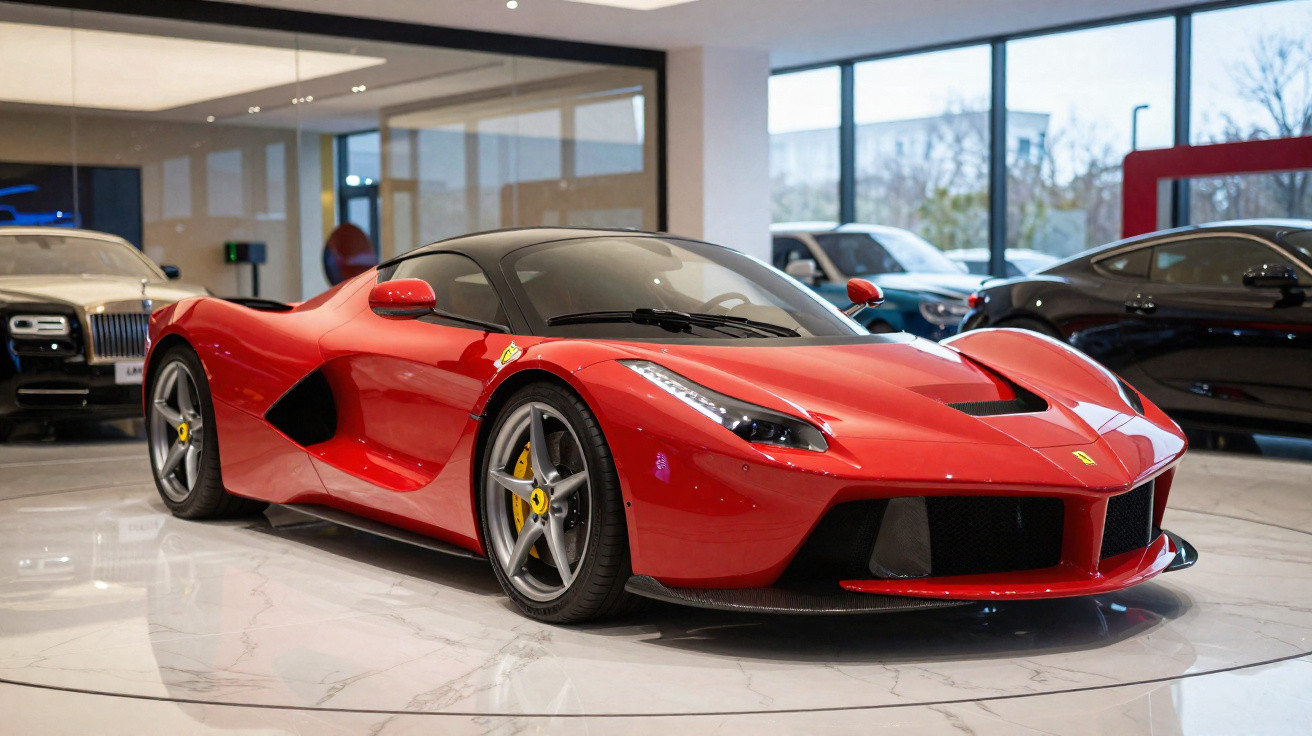
Ferrari LaFerrari
The first Maranello supercar to feature a hybrid system initially appeared wearing the body of a Ferrari 458 Italia.
The LaFerrari programme was then known as F150, and one of its prototypes, the “M6”, was this black Ferrari 458. This test mule was used to evaluate the hybrid powertrain intended for the future LaFerrari.
Its key difference lay beneath the engine cover. Rather than the V8 fitted to the 458 Italia, the compartment had been extensively reworked to accommodate the larger V12, along with the hybrid system, battery and all the necessary wiring.
The huge roof-mounted air intake made its additional cooling requirements clear, although the camouflage designed to surround the 458 did everything possible to conceal the fact that it was linked to a model of major importance to the marque.
Ferrari sold this test mule to a customer in 2016. The owner attempted to sell it at auction in 2022, but without success. Take a closer look at it:
Rolls-Royce Cullinan
The aristocratic Goodwood marque took a long time to accept that its refined model range needed an SUV. Once it chose to go down that route, it had nothing even remotely suitable to use as a test mule.
Perhaps for that reason, it turned to the largest car in its line-up: the imposing Phantom. The result was a shorter Phantom - note the abbreviated rear doors - but its towering ground clearance and somewhat ridiculous rear wing were impossible to miss.
The eventual outcome was the Cullinan, now Rolls-Royce’s best-selling model.
Chevrolet Corvette Stingray
The eighth generation of the legendary Corvette represented the biggest break with tradition in its history. After decades of deliberation, the decision was made to move the engine from a longitudinal front-mounted position to a longitudinal mid-rear layout, directly behind the two occupants.
Needless to say, General Motors had nothing comparable that could serve as a test mule. Unless it looked to Australia.
The answer could hardly have been more inventive. In this island continent - which GM would ultimately leave - utes, or pick-up versions derived from passenger cars, are particularly popular, especially with V8 engines.
The silhouette of a ute could provide the ideal test mule for the radical new Corvette, and that is exactly what Chevrolet created.
Known as “Blackjack”, it featured unusually wide tracks. It had the complete cabin of a Corvette C7, while its raised load bed, fitted with a huge rear spoiler, was designed to house - yes, you guessed it - the V8 engine being developed for the next Stingray.
Jaguar XJ220
The use of a pick-up to develop a supercar, as with the Corvette, brings to mind another test mule. This one is genuinely epic and even became a television star.
In an episode of the essential Top Gear, a Holden ute raced against a white 1989 Ford Transit, just as one would expect.
To everyone’s surprise, the Ford Transit left the powerful ute behind with remarkable ease. The reason was that this Transit had been used as a test mule for the Jaguar XJ220 supercar.
It was not so much for the supercar itself, but for its aluminium twin-turbo V6 engine. That unit was used in the Jaguar XJR-10 IMSA championship car, and in turn traced its origins to the MG Metro 6R4 from the former Group B World Rally Championship.
Could there have been a better way to disguise the new engine? We do not think so. From the outside, it still looked like countless other vans, but a closer inspection of the XJ220 wheels and the generously wide tyres offered a clue that this was no ordinary Ford Transit.
Land Rover Freelander
In the mid-1990s, Land Rover wanted to broaden its customer base and began developing a new entry-level model: the Freelander.
For the first stage of dynamic testing, it needed a test mule, which took the form of a commercial Austin Maestro with its “trousers rolled up”. A total of 25 were built.
Only three have survived, as the remainder were destroyed. Two belong to the Dunsfold Collection in the United Kingdom, established in 1968 as a “simple” private collection but with the admirable aim of preserving Land Rover history.
Among its extensive selection of the marque’s most unusual and historic vehicles, these strange Austin Maestro Vans with raised suspension are impossible to overlook.


Comments
No comments yet. Be the first to comment!
Leave a Comment