
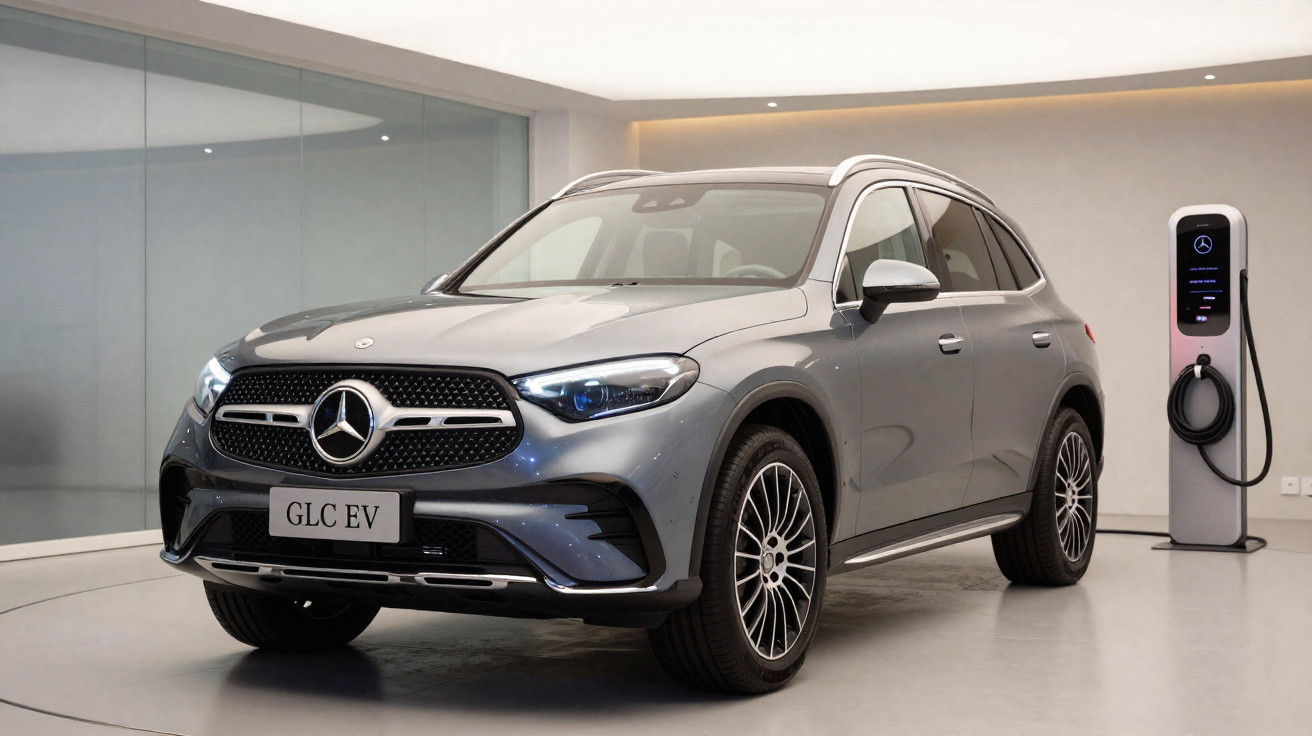
The new electric Mercedes-Benz GLC will not have an easy time: it must take on its long-standing German rivals, and now there is a Swedish challenger too.
While the new CLA has laid the foundations for Mercedes-Benz’s forthcoming electric cars, the new GLC has the task of cementing the entire strategy. After all, it is the brand’s best-selling car worldwide.
That is no small undertaking. This is one of those models that simply cannot go wrong for Mercedes-Benz, particularly as it enters a segment in which BMW, Volvo and Audi rivals are making a strong case for themselves.
We drove it on public roads in the Algarve region to uncover the secrets of one of Mercedes-Benz’s most significant launches in recent years. Here is what we found:
A play of light
The Mercedes-Benz GLC introduces an entirely fresh look, led by a front end which the German designers describe as an “illuminated work of art”.
As it is an electric vehicle, its grille is completely sealed and therefore serves no practical purpose. It does, however, carry considerable visual importance, transforming the model’s face completely.
The front light clusters - making their debut on this GLC - also play a part in the GLC’s new visual signature. Here, though, their purpose is clearly functional: Mercedes-Benz says they reach the equivalent of six football pitches, or around 630 metres.
The dimensions are another noticeable change over the previous-generation GLC, as this new model has grown in every direction: 13 cm longer (4.85 m), 2.3 cm wider (1.91 m) and half a centimetre taller (1.64 m), while its wheelbase has increased by 8.4 cm to 2.97 m.
Digitalisation taken to the extreme
If you are still taking in the exterior light display, brace yourself: opening the GLC’s door reveals the largest screen Mercedes-Benz has ever fitted to one of its cars. The new Hyperscreen measures 39.1” and is 99.3 cm wide, extending across the entire dashboard.
Despite its highly digital cabin, the GLC retains physical controls for essential functions. That is a positive feature and makes driving safer. Its main drawback may be the steering wheel, which needs more straightforward controls for tasks as basic as “changing the music track”.
The overall cabin quality is also particularly impressive, with careful construction and well-chosen materials. Buyers can choose between vegan or genuine leather, as well as brushed aluminium or wood trim.
Another detail that cannot be overlooked is the SUV’s panoramic roof, whose opacity can be adjusted. Alternatively, it can recreate a starry-sky effect with 162 points of light.
More space than ever in the Mercedes-Benz GLC
It is in the rear seats that the benefit of the additional 8.4 cm in wheelbase becomes clear: there is ample legroom and headroom. We can confidently say this is the roomiest GLC ever.
The same applies to luggage capacity, although the picture here is less straightforward. In the version we tested, which uses two electric motors, the GLC has a 570-litre boot - 100 litres more than the PHEV versions, but 30 litres less than current combustion-powered variants.
Add the 128 litres provided by the frunk and total capacity rises to almost 700 litres, making this the GLC with the greatest load capacity you can buy.
Up to 713 km of range
Its exterior styling may not appeal to everyone, and the cabin may feel overly technological, but a look at the technical package offered by this model makes it impossible not to acknowledge the work Mercedes-Benz has put in.
First, there is the new 800 V MB.EA platform, which enables DC charging speeds of up to 330 kW - allowing up to 305 km of range to be added in only 10 minutes. The GLC’s electrical system can also operate at 400 V and up to 100 kW at compatible charging points.
For AC charging, it comes as standard with 11 kW capability, while a 22 kW on-board charger is available as a €700 option.
At this stage, the electric Mercedes-Benz GLC is available only with a 94 kWh battery. That gives the 400 4MATIC version - the only one announced so far - a claimed WLTP combined range of up to 666 km, rising to 713 km with the €2950 Long Range package.
This optional package does not increase battery capacity, but adds more aerodynamically designed wheels, air suspension and rear-wheel steering.
Intelligent suspension
As for the electric powertrain, the GLC 400 4MATIC uses two electric motors, one on each axle, producing a combined 360 kW (489 hp) and 800 Nm of maximum torque. That is sufficient to launch it from 0 to 100 km/h in 4.3 seconds, despite its 2.5-tonne weight. Top speed is limited to 210 km/h.
As in the CLA, the rear electric motor is paired with a two-speed gearbox. This improves acceleration response from a standstill and lowers energy consumption at higher speeds. Anyone who drives on the autobahn every day will appreciate it.
During this first drive in the Algarve, which combined secondary roads, motorways and urban driving, I recorded consumption between 14 kWh/100 km and 15 kWh/100 km. That is a very interesting figure when considering this SUV’s “athletic stature”, and it proves markedly better on the road than the previous generation.
Even as an electric vehicle, the Mercedes-Benz GLC remains the accomplished long-distance car it has always been. Yet it is now more pleasant to drive, more agile - with rear-wheel steering helping here - and more comfortable than before. Unlike many electric vehicles, it also puts everything its motors can deliver onto the tarmac effectively.
It would be unfair to credit this result to one component alone, since its road performance relies on several systems and technologies. If one had to be singled out, though, it would be the intelligent air suspension, which can anticipate imperfections in the road surface.
Thanks to the Car-to-X function, which allows 16 million cars to communicate with one another, the GLC’s brain can electronically adjust the dampers before the car encounters potholes or uneven surfaces. At the same time, it uses Google Maps data to keep the car as low as possible for as long as possible. This reduces the drag coefficient (Cx) to just 0.26 - a remarkable figure for an SUV.
Braking is another area in which there has been a substantial improvement. The GLC now uses a centralised system that determines whether to employ regenerative braking through the electric motors or the hydraulic braking system.
How much does it cost?
Due to arrive during the first half of this year, the new electric Mercedes-Benz GLC will start at €78,000, including VAT, for the GLC 400 4MATIC. That is less than the current GLC 400 plug-in hybrid.
Technical details and pricing for the entry-level, rear-wheel-drive GLC 250 will be announced in the summer, ahead of its market arrival in September. Two further variants are also planned, although their details have not yet been revealed.
Compared with equivalent versions of the Audi Q6, BMW iX3 and Volvo EX60, Volvo’s electric model is the one promising the most for the least. It claims greater range, is the quickest and is the cheapest.
Nevertheless, following this first drive, the electric GLC earns high marks. It sits at the top of the segment for its electric powertrain and range, is highly capable dynamically and comfortable, and represents a step forward in this model’s career overall.
On paper, it has everything needed to succeed. In the electric SUV segment, it replaces the EQC, launched in 2019, which was derived from the combustion-engined GLC and consequently involved compromises in space, practicality and efficiency. There is no other way to put it: these two models are so far apart that comparing them barely makes sense.
Even so, despite the faith it has placed in this new generation, Mercedes-Benz has already confirmed that the combustion-engined GLC will remain on sale for several more years.
Comments
No comments yet. Be the first to comment!
Leave a Comment