
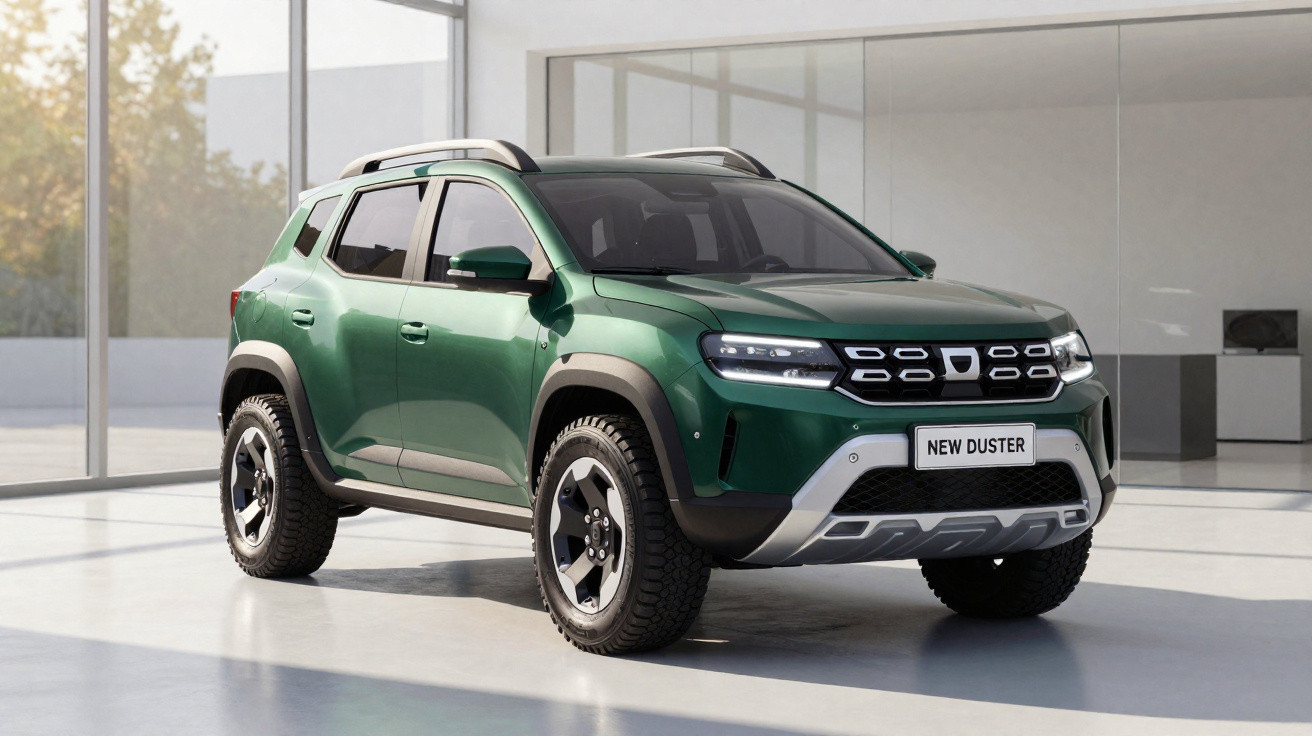
The Duster has become the best Dacia ever. And that could prove to be a problem… for its Renault Captur “cousin”.
Introduced in 2010, the Dacia Duster swiftly established itself as a major sales success, with more than 2.4 million examples sold so far.
For all that success, the outgoing generation, launched in 2017, was beginning to show its age, so it was only a matter of time before Dacia updated its best-selling model.
Now in its third generation, the Duster brings fresh styling, an all-new cabin and even a new platform, opening the door to electrification. Yet, despite all this progress, does it remain the “people’s champion” it has always been? The answer is in the video:
Everything has changed
Updating a model as successful as the Duster always requires some care: its achievements must be maintained, or ideally improved upon. Dacia, however, has chosen to change virtually everything from top to bottom, abandoning the more conservative approach normally seen in such cases.
Its dimensions may have remained almost unchanged, but the design is entirely new and closely follows that of the Dacia Bigster, the concept car previewing Dacia’s largest model yet.
Almost unrecognisable
Although the Duster looks very different on the outside, the most substantial changes have taken place inside, where it represents a major step forward over the model we knew before.
Harder plastics are still present, certainly, but the build quality feels robust and the layout is now far more appealing. The redesigned dashboard makes a major contribution, with strongly horizontal lines that recall off-roaders of the past. I like that.
It is also impossible to overlook the new technology offering: a fully digital 7-inch instrument display and a 10.1-inch multimedia screen, angled slightly towards the driver.
This first encounter was admittedly brief, but the infotainment system seemed very smooth, responsive and straightforward to use, thanks to graphics that are attractive and easy to read.
More room on board
Because it uses a new platform, Dacia promised greater interior space in the new Duster, despite its dimensions barely changing. That is noticeable, particularly in the second row, where the available room is clearly convincing.
The boot has grown as well: the versions with the largest load volume offer 474 litres of luggage capacity, in addition to the extra space beneath the floor.
A “bed” on wheels
If versatility is what you want from this Duster, it is available with the Sleep Pack already seen in the Jogger, which turns the cabin into a double bed and can be stowed in a wooden box in just two minutes.
As well as modular roof bars, which can be repositioned according to your needs, the new Duster introduces a roof rack capable of carrying up to 80 kg, something that will undoubtedly be valuable for more adventurous families.
New platform, new possibilities
One of the biggest constraints of the second-generation Dacia Duster was its platform. It used an evolution of an older Clio platform in order to keep costs under control. That has now changed.
The Duster now uses the same CMF-B platform found beneath the Sandero and Jogger, as well as the Renault Captur and Arkana. This has given it access to a host of important developments, starting with hybrid versions, although diesel engines have been dropped.
It is now a hybrid too
The Duster range starts with bi-fuel petrol/LPG versions, an area in which Dacia continues to invest and which has been attracting ever more buyers in the domestic market, including business customers.
Called the ECO-G 100, it uses a turbocharged 1.0-litre three-cylinder engine producing 100 hp, while claiming a 1,300 km range thanks to its two tanks: 50 litres for petrol and 50 litres for LPG.
Above this sits the TCe 130, powered by a 1.2-litre turbocharged three-cylinder engine paired with a 48 V mild-hybrid system, comprising a small electric motor/generator and a 0.8 kWh battery, for a maximum output of 130 hp.
This was the powertrain I drove during this first test, and it is available only with a six-speed manual gearbox. It strikes me as the choice that makes most sense in the majority of situations, as it proved consistently well balanced and returned relatively restrained consumption of around 6 l/100 km, and sometimes less, even with plenty of motorway driving included.
At the top of the line-up is the HYBRID 140, already familiar from the Jogger. It combines a four-cylinder petrol engine, with 1.6 litres of displacement and 94 hp, with two electric motors - one for propulsion and another serving as a starter/generator - plus a 1.2 kWh battery, delivering a combined 140 hp.
Managing this system is the familiar Renault Group clutchless multi-mode gearbox, with four ratios for the combustion engine and two for the traction motor, combined across 15 different operating modes.
This version can be driven in fully electric mode for much of the time in urban areas, which has a very positive effect on consumption: combined figures below 5 l/100 km are possible.
What about off-road?
The Duster has always taken pride in being one of the most capable off-road models in its segment. Those credentials have been further strengthened in this third generation.
During this first test in the Spanish region of Málaga, we had the opportunity to drive it off road over a route featuring several obstacles, and the Duster’s progress was clear to see.
We tested the Duster TCe 130, the only version available in both 4×2 and 4×4 configurations. The latter has the greatest ground clearance in the segment, at 21.7 cm - 1 cm more than the 4×2 - along with improved approach and departure angles of 31º and 36º respectively.
At least as important is the infotainment system’s dedicated off-road information, displaying in real time the vehicle’s lateral inclination - we exceeded 20º, as you can see in the featured video - its uphill and downhill inclination, and torque distribution between the two axles.
The multiview camera is equally useful, allowing us to see every scenario ahead in real time. I would say it is an essential aid when placing the wheels over the trickiest obstacles. As it is a €400 option, included in the Parking Pack, it is, in my view, almost indispensable.
Impressively sure-footed
The electrified powertrains give it fresh strengths - low consumption will certainly help win over customers - while its all-terrain ability puts to shame other proposals with more serious off-road ambitions. Nevertheless, what impressed me most about this new Duster was its on-road poise: it always feels very solid and firmly planted.
Everything feels quite robust, the controls have the right amount of weight, and ride comfort is highly satisfactory.
If I had to point out flaws in this Duster, there are two areas that could be improved. First, the seats, which offer excellent support but are somewhat firm; second, the aerodynamic noise on the motorway, which is easily noticeable.
However, I am fully aware of the price Dacia is asking for this Duster, which completely excuses these two points, neither of which ever becomes a real problem.
It is hard to imagine a better deal
A large part of the Duster’s success has always been down to its price, and that appears unlikely to change with this generation. The difference is that its price-to-quality ratio is now even more compelling.
That is because the Duster has improved substantially in every area, from its appearance to its technology, without overlooking comfort, safety - it has gained plenty of safety and driver-assistance equipment - and dynamic behaviour. Prices still start below €20,000 - find out all the prices for the new Duster.
The ECO-G 100 in Essential trim starts at €19,150, rising to €24,050 for the TCe 130 4×2 and reaching €29,000 for the HYBRID 140. Despite being the most expensive Duster you can buy, it remains very competitively priced against its rivals.
The TCe 130, priced at €24,050 and available only in the two highest trim levels, Journey - focused more on comfort and technology - and Extreme - with a more adventurous character - seems to me the most balanced and appealing option in the range. It is a very good price. A more affordable version of this engine will arrive later, at €22,250.
At this price, it is difficult to think of a better deal.
Orders for the new Dacia Duster are already open, with the first units due to arrive in Portugal between the end of May and the beginning of June.
Comments
No comments yet. Be the first to comment!
Leave a Comment