
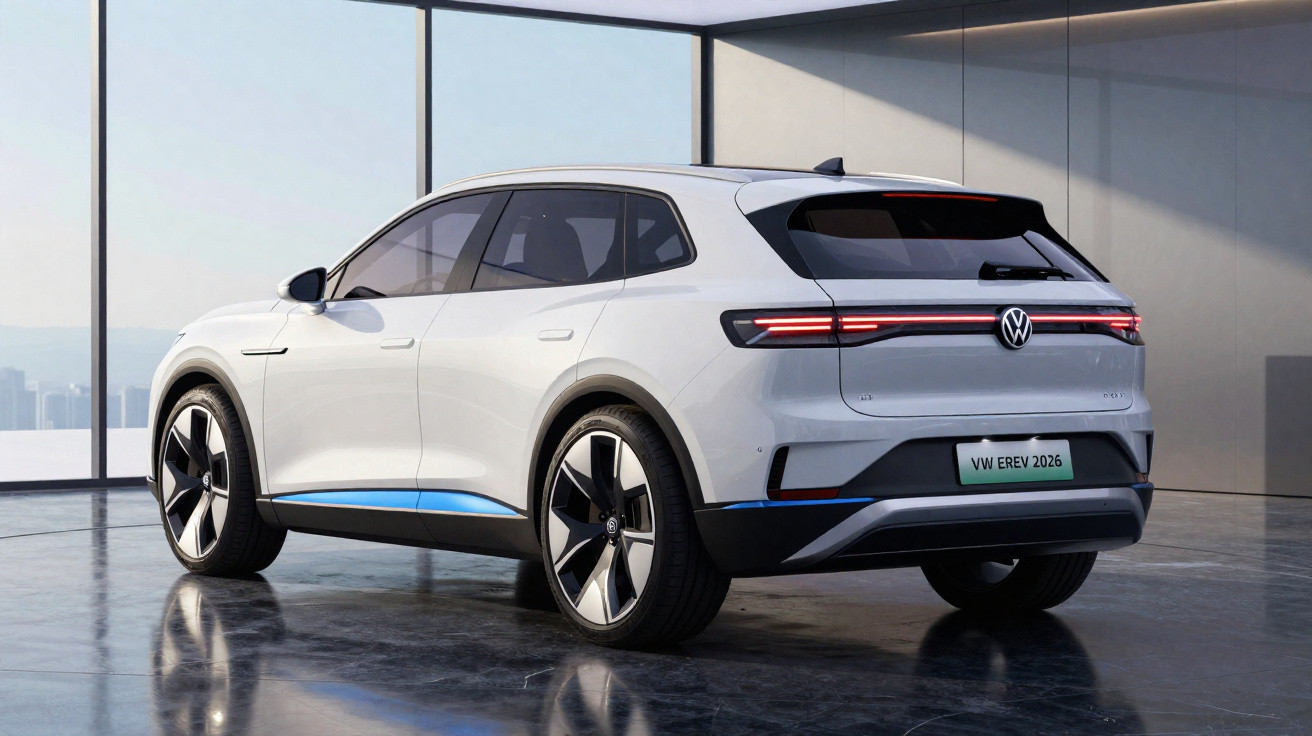
Two automotive industry leaders offer radically opposing views on the future of the car. This time, however, the discussion is not about Akio Toyoda, Toyota’s chairman, or Carlos Tavares, the former CEO of the Stellantis Group, both of whom have become known for taking positions that differ sharply from the industry’s status quo.
Instead, the focus is on Oliver Blume, chief executive of the Volkswagen Group, who considers extended-range electric vehicles (EREVs) to be an important bridge towards electrification with worldwide scaling potential, and Mu Feng of Great Wall Motors (GWM), who describes the technology as a technological aberration.
The two executives made their comments during the latest Shanghai Motor Show. They may have been prompted by Oliver Blume’s remarks in an interview with German publication NOZ, in which he also considered the future of electrification:
“In China, we see great potential in range extenders as a transitional technology, and we will launch the first Volkswagen with this solution as early as 2026.”
Oliver Blume, CEO of the Volkswagen Group, speaking to NOZ newspaper
As will become clear, GWM’s stance on this technology could hardly be further from that of the Volkswagen Group. These are two entirely different approaches and strategies from two of the world’s largest automotive groups.
EREV technology is growing as Volkswagen holds an ace
Sales of fully electric vehicles have yet to meet the political and industrial ambitions expected by the sector. As a result, every manufacturer is looking for an alternative that can keep electrification moving forward without losing market momentum.
In Western markets - the United States and Europe - plug-in hybrids (PHEVs) have been the more common choice. Volkswagen, however, is increasingly looking towards a solution gaining popularity in China: EREVs, or extended-range electric vehicles.
So, what are extended-range electric vehicles? They are essentially battery-electric cars fitted with a small combustion engine that has no connection to the wheels. Its sole function is to produce electricity, recharge the battery and extend the vehicle’s range. Oliver Blume sees more than just potential in EREVs.
The Volkswagen Group already has a specific plan under way. Its first Volkswagen using this technology will arrive in 2026, starting in China, a market that is already well established for this type of vehicle.
More interestingly, Blume has not ruled out bringing the technology to Europe: “EREVs may also be an option for Europe, under the right technical conditions,” he told German publication NOZ, referring to the emissions calculation method applied to this technology.
To pursue a technology that the Volkswagen Group CEO himself sees as transitional, the German group has an important asset within its own organisation: Scout. The American brand acquired by the Volkswagen Group already has this technology in its portfolio.
The brand says it has already received thousands of pre-orders for the first electric models from the revived Scout marque, and “the majority of customers want the range-extender version”, Blume confirmed.
“We would rather die”, says China’s GWM
On the other side of the divide is Mu Feng, vice-president of Great Wall Motors, who could not have been more unequivocal: “It is preferable to die than manufacture extended-range vehicles.” The statement was reported by CarNewsChina, also during the Shanghai Motor Show.
Despite being one of China’s largest automotive groups - in a country where EREVs are proliferating - GWM refuses to follow that path. It will continue to focus exclusively on conventional hybrids and battery-electric vehicles. This decision contrasts with other Chinese brands which, in an effort to win over the domestic market, have launched EREV models as a compromise between cost, versatility and range.
What divides Volkswagen and GWM?
For Blume, EREVs offer a way to strike a mobility compromise until all the limitations holding back full electrification have been overcome. For Mu Feng, meanwhile, EREVs are a distraction in an increasingly fragmented global market.
At the centre of this stand-off is the European market, where policies and environmental targets continue to show some uncertainty. The review of the timetable for applying emissions fines and the ban on combustion-engined cars by 2035 are just two examples.
Comments
No comments yet. Be the first to comment!
Leave a Comment