
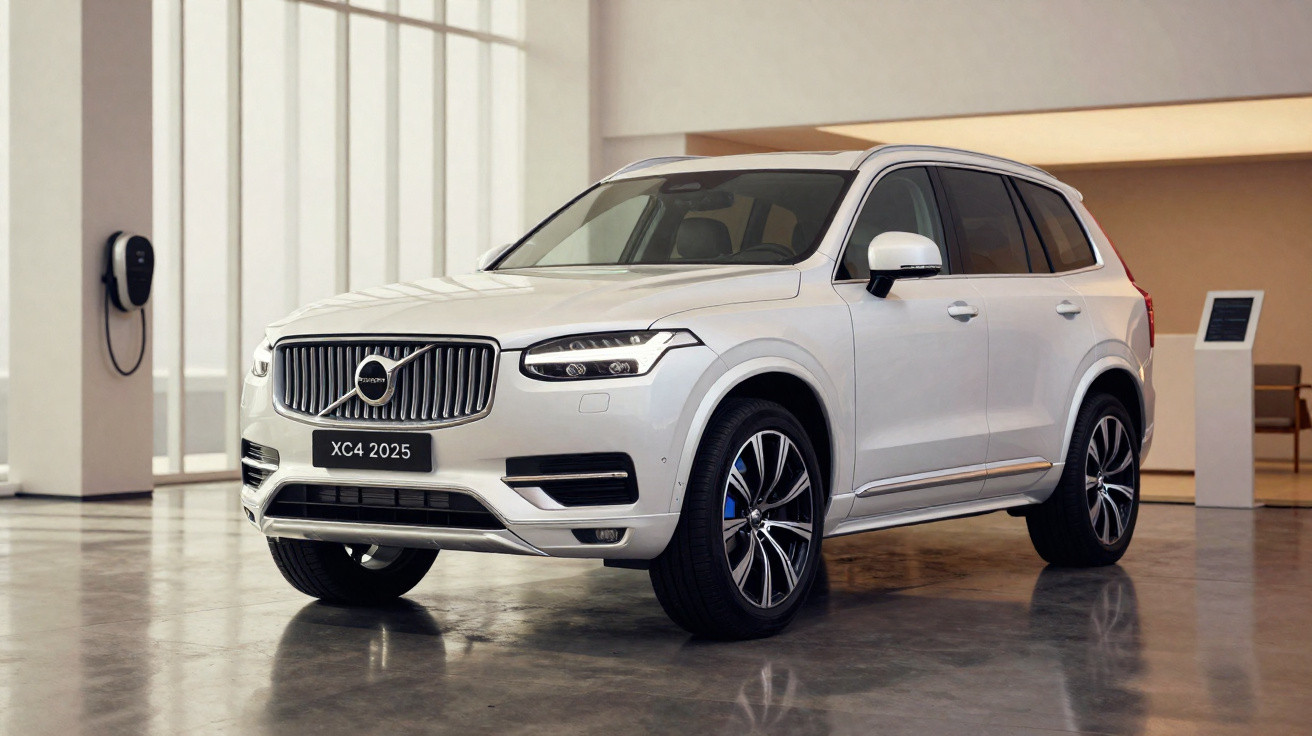
Has the 2025 Volvo XC90 discovered the fountain of youth? It certainly seems so, and it is ready to carry on.
As with almost everything in life, improving an existing product is not the same as creating one from scratch. For Volvo, that principle applies to the XC90, its flagship SUV. It was not expected to receive a successor - its role was, in fact, supposed to be taken over by the all-new, fully electric EX90 - but slowing electric-car sales made extending this model’s life the sensible choice.
What is more, the market remains “in love” with this model - as the sales figures demonstrate - and its strengths simply required updating. That is where the 2025 Volvo XC90 comes in.
Here, we look at what has changed: refreshed styling, more in-car technology, a longer all-electric range, improved comfort and a driving experience that has moved in the right direction.
What has changed visually?
This is therefore a facelift of the second generation, originally launched in 2015. It is now offered without any diesel engines - they had already been dropped at the start of 2024 - and its exterior design has been brought into line with the Scandinavian brand’s latest models.
The Volvo XC90 remains based on the same SP1 platform and retains its dimensions: 4.95 m long, 1.92 m wide and 1.77 m high. That also means interior room and boot capacity are unchanged.
Unchanged space
Welcome to the welcoming cabin of the 2025 Volvo XC90. There are no radical changes, although the significant updates begin with the infotainment system. First, though, one of this model’s key strengths deserves attention: its space and practicality.
The front seats feature heating and ventilation, while massage functions and electrically adjustable side bolsters can also be specified. On the second row, the outer seats may also be heated, and there are ventilation outlets in the centre and on the door pillars.
This area of the cabin has three individual seats, each with 11 cm of fore-and-aft adjustment. This makes it possible to surrender some room to passengers in the third row, where the recommended maximum height is 1.70 m. Otherwise, these seats are really best reserved for children, not least because access is restricted by the limited space behind the second-row seats when getting to and from the rearmost positions.
The middle seat in this row has no ISOFIX anchorages and cannot accommodate a child seat. Occupants in the centre also have to contend with a prominent tunnel between their feet, as it houses the prop shaft and exhaust system in mild-hybrid versions, which are not sold in Portugal, as well as the T8 PHEV battery.
With five seats in use, the boot continues to offer 640 litres of capacity; using all seven seats reduces this to 262 litres.
Refreshed appearance
The seats can be trimmed in two types of upholstery, both synthetic leather, and are reasonably comfortable. The front seats can provide greater side support in the most powerful version in the range. More textured and recycled materials can be seen on the door panels and dashboard.
On the dashboard, the vertical infotainment display has made way for a larger new unit, measuring 11.2 inches rather than 9 inches, with improved resolution and faster responses. It is nevertheless odd that it now sits on top of the dashboard rather than being integrated into it, as it was previously.
There are USB-C ports in the first two rows, while a new front centre console incorporates a wireless mobile-phone charging pad. The familiar built-in Google infotainment system is retained, alongside wireless Apple CarPlay connectivity, as expected from a luxury SUV.
Other infotainment upgrades include a new 360-degree camera, offering sharper images and the option to split the display to show more than one angle around the vehicle.
The instrument display has also grown to 12.3 inches and gained improved graphics, although its content-customisation options remain rather limited.
Plug-in hybrid is the only version in Portugal
For this first dynamic drive of the updated Volvo XC90, I chose the T8 plug-in hybrid, the sole version sold in Portugal. Its previous 9.2 kWh battery has been replaced with an 18.8 kWh unit, of which 14.7 kWh is usable, increasing electric range from just over 40 km to around 70 km.
That is worthwhile progress, but it still falls well short of the 100 km of odour-free, emissions-free driving that some rivals can already deliver.
Likewise, AC charging power has risen from 3.7 kW to 6.4 kW, thanks to a two-phase on-board charger. This remains below what is available elsewhere in the market, and there is no DC charging capability. Once again, these are limitations imposed by an ageing technical base.
The petrol combustion engine is unchanged in configuration - a 1,969 cm³ four-cylinder - but it now produces 310 hp, 10 hp more than before, and drives the front wheels. It is supplemented by a far more powerful electric motor, acting on the rear wheels, with 145 hp rather than 88 hp. This raises the T8 powertrain’s maximum output from 408 hp to 455 hp.
Oddly, neither the central screen nor the instrument display includes an animation showing the hybrid powertrain’s energy flows.
The Volvo XC90 cannot be fitted with rear-wheel steering - another constraint of the older platform - despite this being useful for manoeuvring and urban driving in a vehicle that is nearly five metres long and two metres wide.
Updated suspension
The suspension keeps its independent arrangement, with double wishbones at the front and an independent rear set-up with an integral link and transverse leaf spring on versions with passive suspension, “so that it takes up less boot space than conventional vertical coil springs”, according to Volvo’s Swedish engineers.
The new feature is frequency-selective damping (FSD), now increasingly widespread, for the passive suspension. It uses one valve to control compression and another to manage rebound. Better-equipped versions can have electronically controlled dampers, while air suspension is also available.
This allows the ride height to be adjusted, lowering or raising the XC90 by four centimetres according to the situation: getting in and out of the Swedish SUV, motorway driving or off-road use.
Driving experience
By abandoning six- and eight-cylinder engines, Volvo lost some premium-segment customers who valued their refined soundtrack and effortless low-rev response.
However, the considerable increase in electric-motor output in the plug-in Volvo XC90 has improved in-gear acceleration and reduced the workload placed on the four-cylinder petrol engine. As a result, it does not need to work as hard - which could otherwise create an unwelcome noise-related discomfort - to meet the driver’s demands.
As on the vehicle we drove, the cabin can be fitted with laminated glass. Combined with additional acoustic material in the pillars and at the rear of the dashboard, this improves sound insulation inside, with Volvo’s Swedish technicians quoting a three-decibel reduction.
The same five driving modes remain available, with their main direct effect on the powertrain - Power and Off-road also affect the suspension: Hybrid, combining petrol and electric propulsion; Power, which optimises output, enhances engine sound and applies a sportier gearbox programme; Pure, for electric-only driving; Off Road; and AWD, which optimises torque distribution between the two axles.
Maximum plug-in hybrid system output remains the same whenever the driver fully depresses the accelerator, but the accelerator mapping changes, becoming more aggressive in Power mode. There are also three battery-use programmes: Auto, Hold, which preserves battery charge, and Charge, which replenishes the battery while driving by using the petrol engine as a generator.
There is a standard level of energy recovery under deceleration, with a stronger setting available through the transmission selector. This is shown by the letter “B” in the instrument display, although that position is not marked on the selector itself.
The central screen also allows Creep mode to be activated, so the XC90 continues moving slowly as it approaches a stop. With Creep deactivated, it comes to a complete halt when the accelerator is released, operating in a similar way to one-pedal driving.
Volvo has made the XC90’s suspension settings simpler by reducing the variation in dynamic tuning parameters. There were five settings and there are now two: Firm and Soft. The same choices are available for the steering, with the former more suited to road and motorway driving, and the latter to urban areas or car parks.
The suspension likewise makes the XC90 feel more stable in the first mode and more comfortable in the second, though the difference is never excessive. Braking is another well-resolved dynamic aspect: the left pedal responds immediately and progressively, while also delivering sufficient stopping power.
Average consumption
At the end of a 77 km route around Copenhagen, driven at consistently very moderate speeds, the T8 recorded 6.8 l/100 km. That is an acceptable average for a 2.3-tonne SUV, although it is much higher than the official 1.2–1.6 l/100 km figure.
It should be noted that I activated Charge mode for part of the route so that my test partner could also drive the plug-in hybrid with assistance from the electric motor. In return, 31 km of battery range still remained after the 77 km journey.
One powertrain, three equipment levels
As already mentioned, the sole powertrain offered for the Volvo XC90 in the Portuguese market is the T8 Recharge eAWD plug-in hybrid system.
In Core trim, the starting price is €96,817; Plus raises this to €99,892; and Ultra, the most comprehensively equipped version in the range, starts at €104,443.
The two better-equipped trim levels are available with Dark and Bright finishes, which differ mainly in several exterior decorative details on the Volvo XC90 bodywork. In the first, items such as the window surrounds and various other trims are finished in gloss black; in the second, they receive chrome or aluminium finishes.
Comments
No comments yet. Be the first to comment!
Leave a Comment