
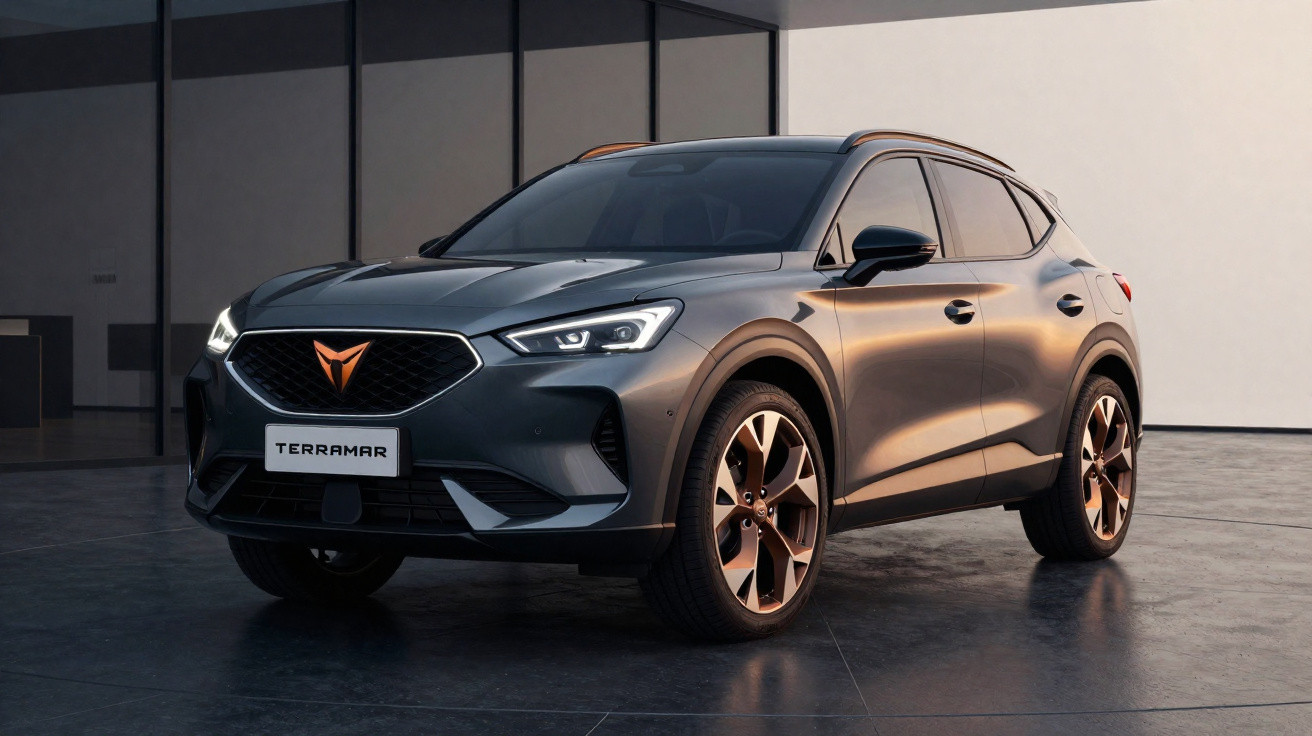
CUPRA needed a more grown-up SUV that could appeal to families. We find out whether the Terramar is the answer.
Since its launch, the Formentor has been a sales success and has, almost single-handedly, put CUPRA on a growth trajectory that few believed could be achieved so quickly.
While the Formentor is aimed at drivers after a sportier crossover, the Terramar adopts a more conventional, SUV-style silhouette, placing family space and versatility ahead of the Formentor’s dynamic credentials.
On paper, it is an almost perfect formula, particularly when you consider the Formentor’s strengths. But is it really that straightforward in the real world? Probably not. We travelled to Barcelona, Spain, to find out. Watch the video:
A question of size
One look at the Terramar is enough to show that it follows CUPRA’s latest design language, also seen on the updated Formentor. This is immediately apparent at the front, particularly in the light signature and bumper design.
The main distinction between the two models, however, is their size. Measuring 4.52 m long, 1.87 m wide and 1.58 m tall, the Terramar is 7 cm longer and 5.4 cm taller than the Formentor, with a direct benefit for interior room.
Rear-seat space, for instance, is greater than in the Formentor, although it does not surpass that of the electric Tavascan, the largest model in the young Spanish brand’s line-up.
And, when family requirements are involved, the boot matters too. Its capacity varies considerably according to the powertrain selected and the position of the rear seats, which can slide forwards and backwards.
In plug-in hybrid (PHEV) versions, boot capacity ranges from 400 litres to 490 litres. In the combustion-engined models, it spans from 540 litres to 642 litres when the underfloor compartment is included.
A striking interior
With the space question addressed, another important strength of this SUV is its perceived cabin quality. The finishes are very similar to those in the Formentor, for example, but the Terramar takes things a little further in terms of precision. Being built in the same factory as the Audi Q3 may have played a part in this.
Then there are the copper-coloured and matt-grey details, familiar from other models produced by the Martorell brand, which help distinguish CUPRA interiors from rival offerings.
For technology, CUPRA has fitted two displays: a 10.25-inch digital instrument cluster and a 12.9-inch infotainment screen. These can optionally be paired with a head-up display.
No diesel for the CUPRA Terramar
Everything suggests that the Terramar will be CUPRA’s final new model to offer internal-combustion powertrains, although developments across the industry could still change that.
The Terramar is offered with markedly different options, allowing it to cover a broad range of uses. There is no diesel engine, despite this undoubtedly being something many customers would still like to see, but petrol, plug-in hybrid and mild-hybrid powertrains are available.
The range begins with the 150 PS 1.5 eTSI, equipped with a 48 V mild-hybrid system. Above it sits a plug-in hybrid powertrain combining a four-cylinder petrol engine, the 1.5 TSI, with an electric motor integrated into the six-speed DSG gearbox and a 19.7 kWh battery.
The result is a combined maximum output of 272 PS, the highest in the range - a 204 PS PHEV version is also available - along with 400 Nm of peak torque and up to 120 km of range.
This was the exact powertrain I had the chance to drive during this first test, and the hybrid system’s smooth operation impressed me. It is genuinely one of this SUV’s greatest assets, especially in a market such as Portugal’s, where company and fleet buyers dominate.
For more details on this hybrid system, the best option is to watch the video:
How does it differ from the Formentor?
We already knew this hybrid system was capable, having tested it in the brand-new Volkswagen Tiguan, for instance. But what about its dynamic behaviour? Does it deliver the same experience as the Formentor? The simple answer is no.
From behind the wheel, the CUPRA Terramar cannot disguise the fact that it is a larger, heavier proposition with a greater focus on comfort. Even so, it feels more agile than the vast majority of SUVs in this segment.
CUPRA’s engineers have certainly struck a sound balance between comfort, ride quality and dynamism, especially in versions with adaptive suspension. Even so, buyers seeking an SUV that is entertaining on a more twisting road will find the Formentor has the advantage.
The Formentor sits more securely on the road, controls its body movements through corners more effectively and, above all, feels slightly sharper. As I explain in the featured video, while the Terramar loses out in this respect, it makes up for it elsewhere.
Is it worth paying more?
The first examples of the new CUPRA Terramar will reach the Portuguese market during November, with prices starting at €42,075 for the 1.5 eTSI. The 272 PS 1.5 e-HYBRID starts from €55,492. The 204 PS 1.5 e-HYBRID will arrive slightly later, but its price has already been announced, starting at €50,863.
There is a price difference of around €2,000 between the tested Terramar 1.5 e-HYBRID 272 and a Formentor with the same powertrain and equipment. The gap is smaller for the 1.5 eTSI version and larger for the 204 PS PHEV variant.
Does the Terramar warrant the higher price? It depends. I know that is not the answer many people want to hear - or read, in this case - but it is the most accurate one.
For those who place greater value on a sportier image and more engaging driving, the Formentor is the choice that makes more sense. However, for anyone who prioritises comfort and needs the additional space, the Terramar is the CUPRA SUV best able to meet those requirements.
And what about the CUPRA Ateca? Yes, the arrival of the Terramar has not meant the Ateca’s retirement. All three CUPRA SUVs occupy the same segment and will coexist for at least the next three years.
It is a decision I struggle to understand. The Ateca already clearly looks like an outdated option: firstly, because it is showing its age, both outside and in the cabin; and secondly, because it has only one powertrain, the 300 PS 2.0 TSI.
Do not get me wrong, I love this engine, but does that alone justify CUPRA keeping this model in its range? Probably not.
Comments
No comments yet. Be the first to comment!
Leave a Comment