
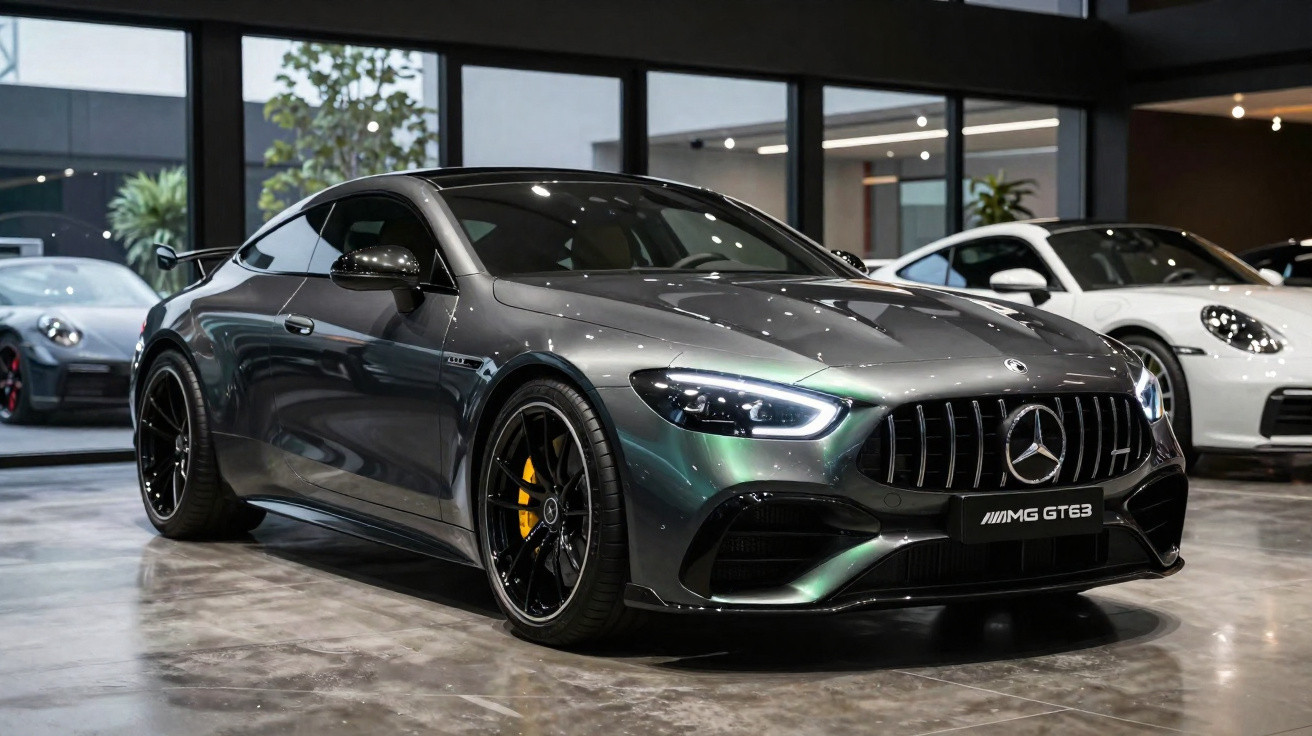
On paper, the AMG GT 63 Pro sits suspiciously close to the Porsche 911: a 2+2-seater, coupé proportions and ferocious performance. Yet Mercedes-AMG presents a very different reality. The Affalterbach brand says buyers do not even compare its latest model with the Zuffenhausen icon; almost all of them are already Mercedes-AMG customers.
Why Mercedes-AMG customers do not want to switch to the 911
Speaking at the Australian market launch, Mercedes-AMG painted a clear picture. The typical GT 63 Pro buyer is not an undecided sports-car shopper weighing up an AMG against a Porsche. In most cases, they already own an AMG and intend to remain with the marque.
According to Mercedes-AMG, the GT 63 Pro buyer is more likely to come from a G63 or E63 than from a 911 cockpit.
Jerry Stamoulis, who handles media relations for Mercedes-AMG in Australia, describes this audience as loyal to the brand and highly certain about what it wants. Many people ordering a GT 63 Pro have previously had a G63 or E63 on their drive, and now want a “proper” sports machine, whether as an addition or a replacement.
The thinking behind this is straightforward: AMG is selling more than a vehicle; it is selling a particular way of life. Buyers drawn to the brand's raw, bass-heavy V8 character and its crisp, angular styling often remain loyal. However much respect the 911 commands, it can therefore feel like a wholly different philosophy rather than a direct step up.
Front-mounted V8 versus rear-mounted flat-six: two distinct approaches
One fundamental aspect separates these cars: their architecture. The Porsche 911 is rightly regarded as an exception in sports-car engineering. Its engine remains at the rear, a layout that has a major influence on handling, traction and driving feel, and has thrilled enthusiasts for decades.
The Mercedes-AMG GT 63 Pro follows another route. Its V8 is mounted at the front, well behind the front axle, in a classic front-mid-engined configuration. This changes the weight distribution and balance, delivering different turn-in characteristics, different feedback at the limit and a different sense of space in the cabin.
Both cars wear the clothes of a sports coupé and provide 2+2 seats, but they embody two entirely different philosophies.
For purists, the 911's rear engine and iconic flat-six may remain beyond question. AMG followers are attracted by precisely the opposite formula: a muscular V8 at the front, a long bonnet, a broad rear end, four-wheel drive and the signature AMG soundtrack, which feels more like a power station than a precision instrument.
610 PS, four-wheel drive and 3.1 seconds: the GT 63 Pro in numbers
Whatever the philosophical differences, the GT 63 Pro delivers performance figures that quickly bring the discussion back to reality. Beneath its bonnet is the familiar 4.0-litre twin-turbo V8, long established internally at AMG as something of a brand signature.
- Power: 610 PS
- Torque: 850 Nm
- Extra output over the GT 63: +26 PS and +50 Nm
- Drivetrain: four-wheel drive (AMG Performance 4Matic+)
- Gearbox: 9-speed automatic
- 0–100 km/h: 3.1 seconds
- Top speed: 317 km/h
This puts the GT 63 Pro squarely in the high-performance class, precisely the territory occupied by the leading 911 versions. Interestingly, in pure output terms, the AMG sits almost exactly between two 911 derivatives.
| Model | Power | Torque |
|---|---|---|
| Porsche 911 GTS T-Hybrid | 535 PS | 609 Nm |
| Mercedes-AMG GT 63 Pro | 610 PS | 850 Nm |
| Porsche 911 Turbo S | 711 PS | 800 Nm |
The bare figures show that the AMG lands directly between the GTS and Turbo S. It produces more torque than either, while remaining below the Turbo S's extreme peak output. In real-world terms, however, the deciding factor is less likely to be the final tenth of a second and more likely to be which package appeals most strongly to the driver.
Why GT 63 Pro buyers rarely move across
From Mercedes-AMG's perspective, the GT 63 Pro has a clearly defined place in the firm's range. It is not intended to tempt 911 owners away, but to offer progression within the brand. Drivers who have used a G63 as a powerful SUV or an E63 as a business express can find the GT 63 Pro to be the right plaything for weekends and track use.
The GT 63 Pro serves as the “logical next step” for AMG drivers seeking greater extremity and sportiness.
Many of these buyers already have a strong emotional attachment to the marque. The pattern appears in other segments, too: a BMW M driver rarely switches on impulse to Lexus, just as an RS enthusiast does not simply move to Cadillac-V. For many AMG buyers, changing to Porsche would mean not merely choosing another sports car, but making an abrupt break from a familiar brand identity.
There is also a more straightforward consideration: sound and presence. The 911's legendary flat engine clearly has its admirers. AMG's V8, in contrast, is defined by its deep rumble, the hard bark on upshifts and a sense of thrust that seems present even at idle. Those accustomed to this soundscape tend to regard it as “home” rather than simply engine noise.
AMG versus Porsche: two fan bases, two mindsets
Ultimately, two clearly defined camps face one another. On one side sits the Porsche contingent, which values precision, agility and the 911 DNA refined over decades. On the other is the AMG community, attracted to raw power, visual impact and the distinctive combination of luxury and forcefulness.
Both groups respect the other's cars, but neither is constantly looking over the fence. Anyone deliberately ordering a Mercedes-AMG GT 63 Pro today generally does not want “almost like a 911, just different”, but a distinctly different character:
- more front-engined GT character rather than rear-engined purism
- more V8 rumble rather than flat-engine sound
- more AMG design language rather than the classic 911 silhouette
- often an existing AMG ecosystem on the drive
Brand continuity matters especially at higher price points. Many customers assemble a kind of personal “brand collection”: a G-Class plus a GT, rather than a G-Class plus a 911. That creates a more cohesive overall picture and gives their own vehicle collection a clear direction.
How does a GT differ from a 911 in everyday use?
For buyers weighing up the two concepts, everyday use is worth considering. A front-engined GT such as the AMG generally feels more spacious and closer in character to a luxurious grand tourer, albeit with enormous punch. You sit “behind the bonnet”, the front axle feels clearly readable, and long motorway journeys are covered with ease.
The 911 feels more compact and even more focused, particularly on narrow country roads. Its rear-engine layout creates a different experience of traction and cornering dynamics, at times more intense and at times more demanding. Those planning frequent track days and watching lap times will often favour the Porsche layout. Those who value the blend of rapid long-distance travel, everyday usability and occasional track work often see the GT as having the advantage.
Hybrids, fleet emissions and the future of the V8
The coming years will make the comparison particularly interesting. Porsche has already taken a noticeably electrified route with hybrid systems in the 911 GTS T-Hybrid, while Mercedes-AMG still offers a very traditional performance proposition with the 4.0-litre V8 in the GT range. Over the medium term, both manufacturers face pressure to reduce fleet emissions and meet stricter regulations.
This gives prospective buyers an interesting risk assessment. Anyone placing a GT 63 Pro on their drive today may be buying one of the last generations of classic, purely combustion-powered V8 sports cars from Mercedes-AMG. That could enhance its emotional and collector appeal, especially for enthusiasts who grew up with this engine sound.
Strategically, then, there is plenty to suggest that AMG customers will continue along their established path: first a performance saloon or SUV, then the GT 63 Pro as the crowning model. The 911 remains, in parallel, the benchmark for the classic rear-engined sports-car layout. Both concepts can coexist without difficulty, but in the minds of most AMG drivers this contest simply does not take place. They made their choice long ago.
Comments
No comments yet. Be the first to comment!
Leave a Comment