
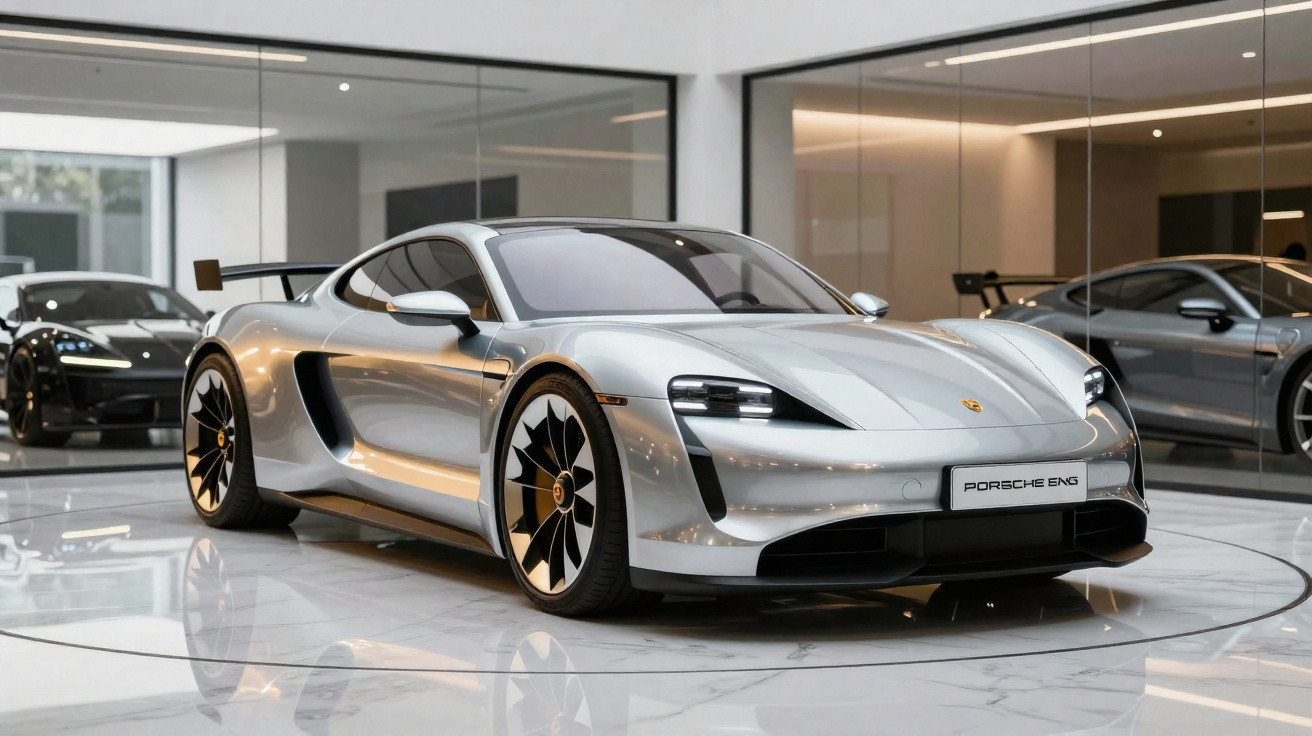
It is not exactly a secret, yet not everyone knows that Porsche does more than build some of today’s finest sports cars. It also has a consultancy arm focused on engineering solutions: Porsche Engineering.
Its work spans aviation and construction, factory planning, the development of parts and accessories, ergonomic studies, and countless other projects - including… scooters that travel underwater.
Yes, really. This expertise helped the brand survive the turbulent 1990s and fund its ambitious motorsport programme, at a time when the Porsche 911 was not selling and the transaxle models were in the same position, “same again, quotation marks and all…”
With that in mind, here are some of the projects that have benefited from Porsche’s particular touch over the years.
1 – Audi RS2
Porsche’s involvement in developing the legendary Audi RS2 is probably one of motoring history’s worst-kept secrets.
Launched in 1994, this performance estate featured a Porsche-prepared 2.2-litre five-cylinder engine producing 315 bhp beneath the bonnet. Porsche’s work also covered the Brembo braking system, suspension set-up, six-speed gearbox ratios, alloy wheels and the “borrowed” door mirrors.
The practical outcome was the arrival of the fastest estate car on the market.
2 – Mercedes-Benz 500E
Known as “the Autobahn missile”, the Mercedes-Benz 500E was another car that was not a Porsche but owed far more than a small contribution to the Stuttgart manufacturer - Porsche had almost a full hand in it.
Both manufacturers assembled it by hand, with cars moving between the Mercedes-Benz and Porsche plants; each one required 18 days to build.
The engine, however, remained the responsibility of the three-pointed-star brand: the same 5.0-litre, 32-valve V8 used in the Mercedes-Benz SL. With 326 bhp, it delivered 0–100 km/h in 6.1 seconds. It was Mercedes-Benz’s answer to the all-conquering BMW M5.
3 – Volvo 850 T5 R
A Volvo with Porsche engineering? That came as news to some people, including members of our own editorial team.
Few realise that the iconic Volvo 850 R received Porsche support during development. In what areas? The engine and transmission, along with several interior revisions - most notably Alcantara-trimmed seats.
Its ability to sprint from 0 to 100 km/h in under six seconds also relied on Pirelli P-Zero tyres, which were certainly not inexpensive.
4 – Volkswagen Beetle
The fact that the Volkswagen Type 1, or Beetle, was designed by Porsche founder Ferdinand Porsche is unlikely to be a secret to any car enthusiast.
Less widely known is that Ferdinand was courted at the time by both Adolf Hitler and Josef Stalin, a situation that could have sent the Beetle to the other side of the “Iron Curtain”.
Germany was ultimately chosen, where Ferdinand went on to lead both Beetle production and construction of the Wolfsburg factory. Hitler reportedly wanted to call it the “Porsche Factory”, an idea the Austrian engineer declined.
5 – Skoda Favorit
The Favorit was the final model built by the Czech brand before it joined the Volkswagen Group. Skoda spared no effort in developing the Favorit, assembling a dream team: Italy’s Bertone handled the design, respected firm Ricardo Consulting worked on the engine, while Porsche was responsible for the front suspension and also assisted with engine installation. The result was a car that proved light, easy to drive and economical.
6 – SEAT Ibiza
An essential model in the Spanish manufacturer’s history, the SEAT Ibiza earned its reputation not only through Giugiaro’s design, but also because of the famous “System Porsche”. At the time, this meant an engine and gearbox developed jointly with the German marque.
That is how the first Ibiza became the most successful model in the Catalan brand’s history, selling more than 1.3 million units.
7 – Mercedes-Benz T80
This was one of Ferdinand Porsche’s many projects before he devoted himself fully to his own marque. Developed with the stated aim of setting a new land-speed world record on a section of motorway near Dessau, Germany, the Mercedes-Benz T80 used an extraordinary 3,000 bhp Daimler-Benz DB 603 V12 engine. The outbreak of the Second World War meant it was never given its final test, during which it was expected to reach its claimed top speed of 600 km/h.
8 – VAZ-Porsche 2103
The VAZ-Porsche 2103 emerged from a three-year agreement between Porsche’s then chairman and the head of the Soviet motor industry, under which the German company would assist with the development of future Ladas.
The Stuttgart manufacturer was tasked with developing the suspension, interior and exterior. The project nevertheless ended before it began, because the proposed changes were not accepted - or, at least, not at that time.
9 – Lada Samara
After the VAZ-Porsche project was rejected, Porsche was invited to develop the engine for another Lada: the Samara. Introduced in 1984, it was also sold in Portugal. It even competed in the Paris-Dakar, with the Lada Samara T3 using the four-wheel-drive system from the Porsche 959 as well as the 3.6-litre engine from the Porsche 911.
10 – C88 China Car
Following the success of Germany’s “people’s car”, Porsche had another chance to create a basic, affordable vehicle, this time for China: the C88 China Car.
Unveiled in 1994, the model was also intended to fit the state’s one-child-per-couple policy, providing only one child seat in the rear. The scheme did not progress beyond the display car, which was the sole example produced.
11 – McLaren MP4
The Formula 1 single-seater that became well known on track with drivers such as Andrea de Cesaris, Niki Lauda and Alain Prost, the McLaren MP4/1, MP4/2 and MP4/3 used a 1.5-litre TAG-Porsche V6. The team and Porsche’s Stuttgart engineers developed it throughout the 1983 season.
Success, however, only arrived in the following 1984, 1985 and 1986 seasons. In 1987, the MP4/3 finished the championship in second place, before the TAG-Porsche engine gave way to Honda’s much-decorated unit for the following season.
The 1.5-litre TAG-Porsche V6 also found another remarkable home: a Porsche 911.
12 – Linde Forklift
Porsche Engineering’s influence is not confined to the automotive industry, so its long-standing partnership with forklift company Linde cannot be overlooked. It has involved supplying gearboxes and propulsion systems, as well as contributing to the design of these vehicles.
The German forklift manufacturer has even won the Red Dot Award thanks to the design excellence of its vehicles, which it describes as comparable to that of sports cars. The driver is protected by a safety cell that must also provide room, visibility and easy access. It is the Porsche 911 of forklifts…
13 – Airbus Cockpit
Since we are discussing unusual projects, Porsche’s role in jointly developing Airbus aircraft cockpits must also be mentioned. For the first time, displays were used in place of analogue instruments, with an emphasis on simplifying procedures and improving the ergonomics of the entire avionics system.
14 – Cayago Seabob
Having established itself on land and in the air, Porsche could hardly remain absent from the water. Its partnership with German company Cayago, maker of underwater scooters capable of reaching 20 km/h and diving to depths of up to 40 metres, ensured that it was not.
For these products, the Stuttgart brand supplied the engine management system, controls and electric battery management. You could say Cayago has them everywhere!
15 – Harley Davidson V-Rod
Porsche developed the first liquid-cooled engine in Harley-Davidson history: a V-twin - naturally - producing 120 bhp. It was the fastest Harley on the market, accelerating from 0 to 100 km/h in 3.5 seconds and claiming a top speed of 225 km/h.
16 – Scania
Now both owned by the Volkswagen Group, Porsche and Scania began working together in 2010, shortly after the Stuttgart brand had been “swallowed up” by the German giant in 2009.
The two companies have since collaborated on a new generation of truck cabs. Porsche has contributed its expertise in ultra-lightweight construction and fuel-consumption reduction solutions. Although most of the results remain out of public view, what is known already shows Porsche’s influence, particularly in development and production processes.
17 – Terex Cranes
Another unlikely and little-known activity for the Stuttgart manufacturer is its participation in developing crane cabs. The German company’s influence can be seen in the ergonomic, functional and mobility aspects of Terex’s proposals.
18 – Tanks
Perhaps a better-known undertaking, although one entirely abandoned today, is Porsche’s - and more specifically Ferdinand Porsche’s - involvement in developing war machines.
More precisely, he worked on the German tanks used during the Second World War: the Tiger, Tiger II and Elefant. The latter was initially named Ferdinand.
19 – Opel Zafira
Although the market knew it as an Opel-badged medium people carrier, the Zafira was in fact the product of cooperation between the Rüsselsheim manufacturer and Porsche. As you might expect… we have also written about Porsche’s involvement in the design of the Opel Zafira.
Comments
No comments yet. Be the first to comment!
Leave a Comment