
Audi’s participation in the North American Trans-Am championship in 1988 marked a turning point for the four-ring brand in that key market.
That was particularly true after it secured the title that season with a 200 powered by the iconic turbocharged inline five-cylinder engine, here with a 2.2-litre capacity and, naturally, quattro four-wheel drive.
The Americans did not take kindly to the humiliation, banning ‘foreign’ engines and four-wheel drive. Audi therefore chose to turn its attention to the IMSA GTO category the following year, in 1989.
Using the Audi 90 as its starting point, the company took advantage of the category’s more liberal regulations to extract a maximum output of 720 hp. Naturally, the quattro all-wheel-drive system remained.
With little time available, the drivers, teams and even the cars’ liveries were retained. There was no championship title on this occasion, but its impact was immense and instrumental in the brand’s subsequent performances in series such as the DTM, the German Touring Car Championship. It was a memorable chapter for Audi.
Four decades after those events, a team of young designers at Audi’s styling centre in Neckarsulm decided to pay fitting tribute to the Audi 90 quattro IMSA. Their first expression of that homage was the RS 6 GTO concept, unveiled in 2020.
A farewell gift
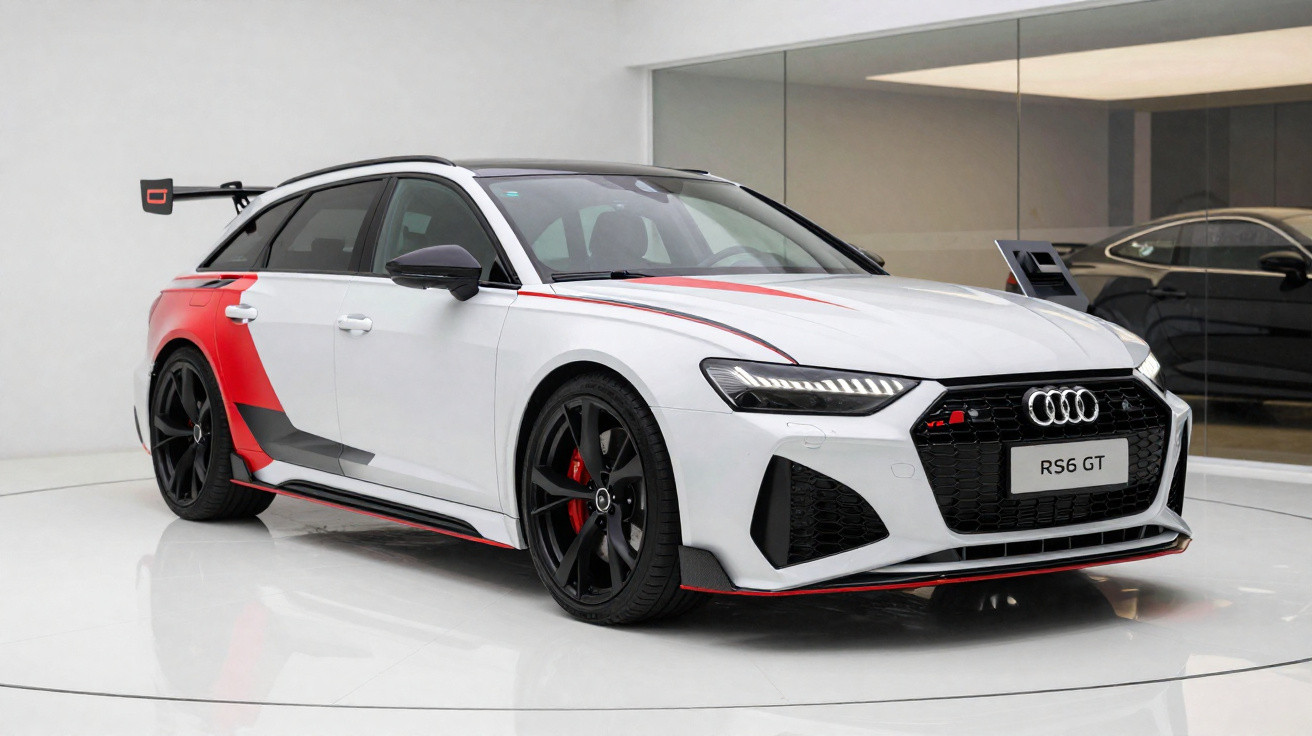
The 90 quattro IMSA and RS 6 GTO have now both inspired the new Audi RS 6 Avant GT, particularly the version wearing the Audi Sport livery.
More than simply a commemorative edition, the RS 6 Avant GT also serves as something of a farewell present for this model, which will not remain in production for many more years.
Compared with the existing model, the visible changes include a new front grille with gloss-black air intakes, vertical blades in the front apron and a prominent front lip integrated into the bumper.
For the first time, Audi Sport has fitted a carbon-fibre bonnet, finished in the colours of the German marque’s sporting division. The use of this material does not end there: the wings and 22-inch wheels are also made from carbon fibre.
At the rear, the highlights are a functional diffuser with a vertically centred reflector, making the Audi RS 6 Avant appear even wider, and a twin rear wing derived from competition cars.
As Juergen Loeffler, head of exterior design, explains, there are two possible bodywork liveries: “one, paired with the Arkona White finish, combines the traditional black, grey and red colours and always features white wheels. Alternatively, the decals can be black and grey when paired with Nardo Grey or Mythos Black body colours. In that case, the wheels will be gloss black or matt black”.
Inside, this more exclusive RS 6 Avant features full bucket seats trimmed in leather and Dinamica fabric, with red stitching in a honeycomb pattern. Their structure is carbon fibre.
The red seat belts stand out, as does the individual number assigned to each of the 660 cars planned for production.
Audi RS 6 Avant GT is Audi’s most powerful ever
A car this special required an equally exceptional engine, as Nils Fischer, the project’s technical director, confirms:
“The four-litre V8 appears here in its most powerful form ever, with 630 hp. It is also the most powerful engine of any produced by Audi Sport”.
- Nils Fischer, project technical director
It is therefore no surprise that the performance is breathtaking: a 305 km/h top speed and 0–100 km/h in 3.3 seconds. Reaching 200 km/h takes just 11.5 seconds, half a second less than in the RS 6 Avant. The 50 kg weight saving helps.
The eight-speed Tiptronic automatic gearbox and electronic locking differential - which in this case favours the rear axle more strongly - are fitted in their latest specification. They distribute torque with a 40:60 split, front to rear, although this can vary according to grip levels, with up to 70% sent to the front wheels or 85% to the rear.
For the first time, and exclusively on the Audi RS 6 Avant GT, adjustable coilover suspension is available. It lowers the ride height by 10 mm compared with the ‘normal’ RS 6, enhancing dynamic behaviour without compromising comfort.
The springs are firmer too, the dampers offer three-way adjustment, and the anti-roll bars are stiffer - by 30% at the front and 80% at the rear - to reduce body movement.
Alternatively, the Audi RS 6 Avant GT can be specified with RS plus sports suspension with Dynamic Ride Control (DRC), or adaptive air suspension.
Very limited production in Neckarsulm
Around two-thirds of the 660 cars scheduled for production are expected to remain in Europe, with Germany alone receiving 191 units. Seven employees, working solely on fitting this version’s bespoke components, will require a full day to complete each car.
Audi RS 6 Avant GT production will take place throughout 2024 and 2025 on the Boellinger Hoefe assembly line, beside the Neckarsulm factory. This facility is intended for lower-volume models such as the Audi R8 and e-tron GT.
Orders open on 6 February, today, and each example will cost €220,000 in the German market.
Comments
No comments yet. Be the first to comment!
Leave a Comment