
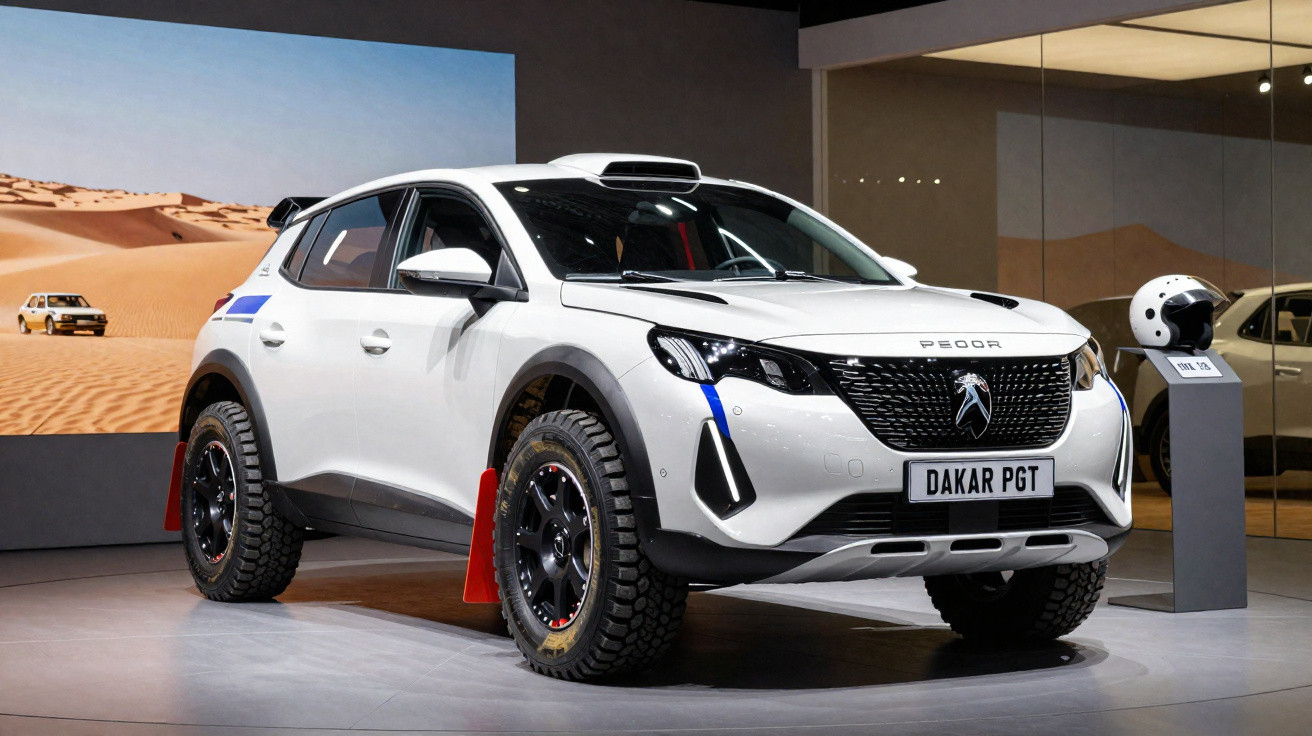
After the Dakar trucks, it is now the turn of the Dakar cars. Let us travel back to the distant year of 1987, when many of us had not even been born.
That was not the case for me, I must admit. In 1987, I was already one year old. I could walk unaided, swallow AAA batteries (it happened once), and say such complex words as “dada”, “tweet-tweet”, “goo-goo” and “limited-slip differential”.
The purpose of this trip through time? To explore Peugeot’s history at the Dakar.
After all, this is the last year (editor’s note: at the time this article was published) in which Peugeot is competing at the Dakar as a works team - some say it is because the marque is heading back to the 24 Hours of Le Mans. That is another excellent reason for this 31-year journey. Perhaps it will be worth ten minutes of your time. Perhaps…
1987: arrive, see and win
Peugeot did not exactly have a plan to race in the 1987 Dakar. It simply happened. As you will know, Group B was abolished in 1986 - a subject we have already covered. Suddenly, the French manufacturer had Peugeot 205 T16s sitting in its “garage”, with no clear idea of what to do with them.
That was when Jean Todt - now FIA president, founder and long-standing head of Peugeot Talbot Sport - had the idea of entering the 205 T16s in the Dakar. An excellent idea.
Broadly speaking, Peugeot’s Dakar debut was like my birth… it was unplanned. Of those two events, only one went well. Can you guess which one?
Ari Vatanen, who knew the Peugeot 205 T16 better than anyone, was Peugeot Talbot Sport’s spearhead. The responsibility for carrying the French marque’s colours in the Dakar rested squarely on Vatanen’s shoulders. It could hardly have begun more badly. During the prologue itself - a largely ceremonial stage used to determine the starting order - Ari Vatanen crashed.
Thanks to this triumphant opening, Vatanen’s Peugeot began the Dakar’s first stage in a magnificent 274th place overall.
Yet nobody at Peugeot threw in the towel - Mr Todt would not have allowed it. Despite a spectacular-but-not-really debut, the Peugeot Talbot Sport operation, made up of seasoned professionals from the World Rally Championship, soon found its rhythm in the legendary African event.
By the time the Dakar reached Africa, Ari Vatanen was already chasing the event leaders. After more than 13,000 km of competition, beside the Atlantic Ocean, the Peugeot 205 T16 was the first car to arrive in Dakar. Mission accomplished. Arrive, roll over and win. Or, in Latin, “veni, capoti, vici”.
1988: Catch that thief!
For a second consecutive year, Peugeot burst into the Dakar. The Peugeot 405 T16 - an evolution of the 205 T16 - began by winning in France and never relinquished the top of the standings. Until something unexpected happened…
Jean Todt had planned everything, or at least everything that can be planned in a competition full of unforeseen events. Ari Vatanen held a comfortable Dakar lead at the 13th stage (Bamako, Bali) when his car was stolen overnight. Someone had the brilliant notion of stealing a competition car and thinking they could get away with it. It is a Peugeot, right? Nobody will notice…
Needless to say, neither the thief nor Ari Vatanen got away with it. The thief abandoned the 405 at a scrapyard, while Vatanen’s Dakar was over. By the time the authorities found the car, it was too late. Vatanen was disqualified for failing to reach the start on time, and victory went to his supporting driver, Juha Kankkunen, who was driving a Peugeot 205 T16 fast-assistance vehicle.
1989: A matter of luck
In 1989, Peugeot arrived at the Dakar with an even more formidable line-up, comprising two further-developed Peugeot 405 T16 Rally Raid cars. Producing more than 400 hp, they could accelerate from 0 to 200 km/h in little more than 10 seconds.
At the wheel were two legends of motorsport: the irrepressible Ari Vatanen and… Jacky Ickx! A two-time Formula 1 World Championship runner-up, six-time winner of the 24 Hours of Le Mans and 1983 Dakar winner.
It goes without saying that Mitsubishi, the only team capable of challenging Peugeot, was left watching the battle from the lowest step of the podium. Up front, Ari Vatanen and Jacky Ickx fought for victory at more than 200 km/h. It was all or nothing.
The balance between Peugeot’s two drivers was so close that the 1989 Dakar became a sprint.
Jean Todt made a serious mistake: he put two cockerels in the same henhouse. Before this fratricidal contest handed victory on a plate to Mitsubishi’s “snail”, the team director decided to settle the matter by tossing a coin.
Vatanen was luckier, called the right side of the coin and won the Dakar, despite rolling the car twice. The two drivers completed the event less than 4 minutes apart.
1990: Peugeot’s farewell
In 1990, the story repeated itself: Peugeot won the Dakar, with Ari Vatanen at the controls. A navigation error and a close encounter with a tree nearly ruined everything, but the Peugeot 405 T16 Grand Raid still managed to finish the event.
It was the glorious end of an era of Peugeot’s absolute dominance. An era that began as it ended: with the taste of victory.
It was also the final event for the legendary Peugeot 405 T16 Grand Raid, a car that won every competition it entered. This included Pikes Peak, with Ari Vatanen driving - who else! That Pikes Peak victory led to one of the most sublime rally films ever made.
2015: testing the waters
After a 25-year break, Peugeot Sport returned to the Dakar. The world applauded on its feet. Peugeot Sport brought more than two decades of experience from Formula 1 world championships (that did not go well), rallying and endurance racing. Even so, the comeback proved difficult.
With the Peugeot 405 T16 Rally Raid serving as a “museum piece”, the newcomer Peugeot 2008 DKR had to defend the manufacturer’s colours. However, the two-wheel-drive car, powered by a 3.0-litre V6 Diesel engine, was not yet up to the task.
Armchair experts laughed… “going to the Dakar in a rear-wheel-drive car? Idiots!”.
The 2008 DKR was driven by a dream team: Stéphane Peterhansel, Carlos Sainz and Cyril Despres. Star names who nevertheless received a monumental beating.
Carlos Sainz’s Dakar lasted just five days, ending after a dramatic accident. Stéphane Peterhansel - also known as “Mr Dakar” - finished in a disappointing 11th place. Cyril Despres - a two-wheel Dakar winner - could manage no better than 34th due to mechanical problems.
It was not the comeback anyone had expected. But, as the saying goes, he who laughs last laughs best. Or in French, “celui qui rit le dernier rit mieux” - Google Translate is a wonderful thing.
2016: lessons learned
What starts badly will stay bad, sooner or later. Peugeot did not believe that old saying and, in 2016, retained its “faith” in the 2008 DKR’s original concept. Peugeot believed the formula was right; the execution had simply been disastrous.
As a result, Peugeot entered the 2016 Dakar with a completely reworked version of the 2015 concept.
Peugeot listened to its drivers’ complaints and addressed the car’s weak points. The 3.0-litre twin-turbo V6 Diesel engine now delivered stronger power at low revs, considerably increasing its traction capability.
Meanwhile, the 2016 chassis was lower and wider, improving stability over the 2015 model. The aerodynamics were also comprehensively revised, while the new bodywork provided even better approach angles over obstacles. The suspension was not overlooked either: it too was redesigned from a blank sheet, with the aim of distributing weight more effectively across both axles and making the 2008 DKR less demanding to drive.
A fourth member joined the magnificent trio of drivers: 9x World Rally Champion Sébastien Loeb. The legendary Frenchman attacked the Dakar from the outset, until he realised that to win the Dakar, first you have to finish it.
Loeb’s accident meant that victory ultimately went to the wily Stéphane Peterhansel, who won the Dakar by a comfortable 34-minute margin. This followed a very cautious start from Peterhansel, in marked contrast to Loeb’s attacking approach. Peugeot was back - and back in force!
2017: A stroll through the desert
Of course, 2017 was not a stroll through the desert. I lie; actually, it was… Peugeot completed a clean sweep by placing three cars in the top three positions.
I could say it was a “sweaty” victory, but it was not… for the first time in Dakar history, Peugeot fitted air conditioning to its cars.
In 2017, the car’s name also changed: the Peugeot 2008 DKR became the Peugeot 3008 DKR, in reference to the brand’s SUV. Naturally, these two models are about as alike as Dr Jorge Sampaio, former President of Portugal, and Sara Sampaio, one of Victoria’s Secret’s “angels” - the Pininfarina equivalent of women’s underwear. That is to say, they share a name and little else.
In addition, because of 2017 Dakar regulation changes, Peugeot modified the engine to reduce the adverse effects of the intake restriction imposed on two-wheel-drive cars. Despite the rule changes, Peugeot’s crushing dominance over its rivals continued - in spite of the power loss and the air conditioning.
The 2017 Dakar also offered a fine re-enactment of the Peugeot Sport team’s fratricidal battle in 1989 - remember? - this time with Peterhansel and Loeb in the leading roles. Victory again went to Peterhansel. This time, there were no team orders or “coin tosses” - at least according to the official version of events.
2018: One last lap, lads
As I said at the beginning of this article, 2018 will be Peugeot’s final year in the Dakar. One last lap for the “wonder team” of Peterhansel, Loeb, Sainz and Cyril Despres.
The 2018 Dakar will not be as straightforward as the previous edition. The regulations have tightened again, while four-wheel-drive cars have been given greater technical freedom to balance competitiveness - specifically more power, less weight and more suspension travel. Any engineer’s wet dream.
Rear-wheel-drive cars, meanwhile, received greater track width. Peugeot once again reworked the suspension, and Sébastien Loeb has told the press that the new Peugeot 3008 DKR 2018 “is more stable and easier to drive”. Shortly after telling the press that, he rolled it! Seriously…
The 2018 Dakar starts the day after tomorrow. And, as Sir Jack Brabham once said, “when the flag drops, the bullshit stops!”. We shall see who comes out on top, and whether Peugeot can recreate its 1990 farewell. It will not be easy, but do not bet against the French…
Did Peugeot manage to leave the 2018 Dakar as winners?
Comments
No comments yet. Be the first to comment!
Leave a Comment