
What is this about?
In May 2001, Haruhiko Tanahashi, the programme leader for a proposed sports car, prepared an internal document in a secluded part of Toyota Motor Co's engineering division. Its purpose was to set out the car's objectives for senior management, so it needed to make a compelling case. The cover featured a Toyota F1 car alongside a Toyota 2000GT.
That proposal would eventually lead to the Lexus LFA. As history shows, Toyota's F1 campaign, which carried so much promise in 2001, ended disgracefully before the LFA completed its protracted development. Here, though, the focus is the other Toyota on that cover: the 2000GT.
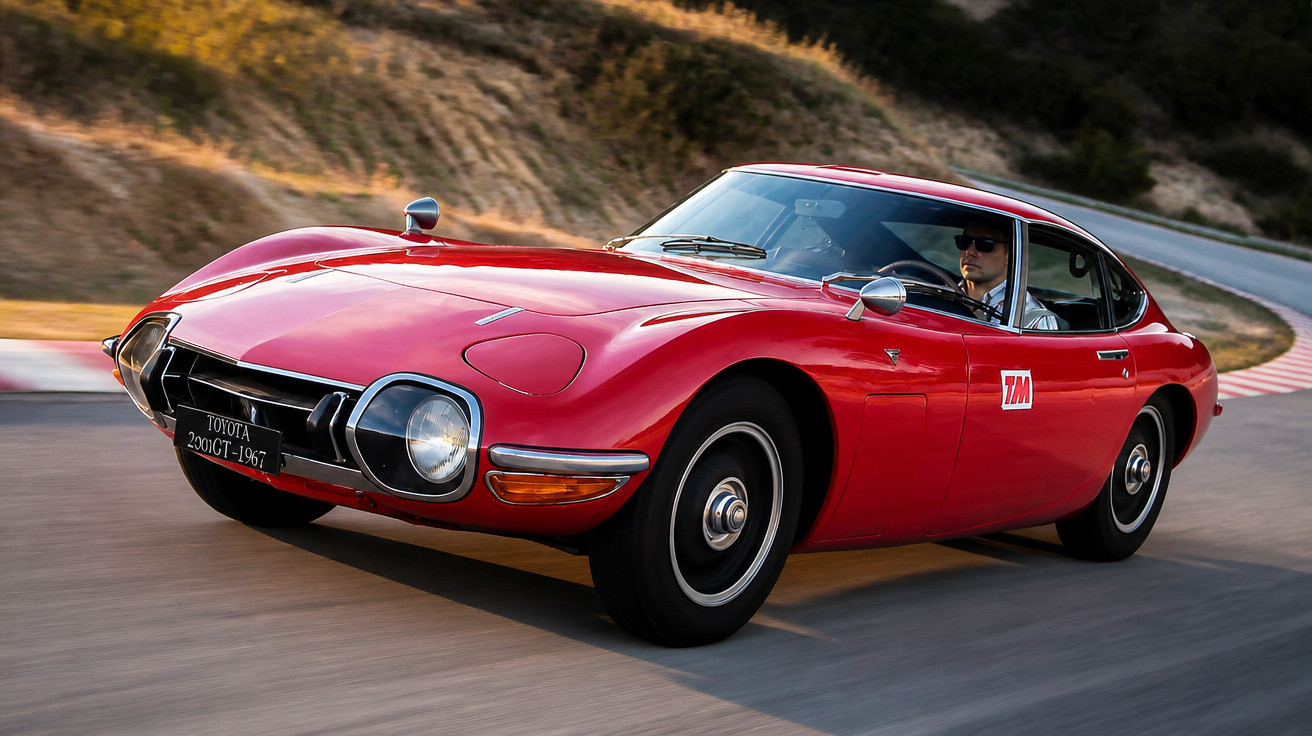
For Toyota in the mid-1960s, it represented a genuine moonshot. Its engineering was remarkably thorough, its performance beautifully resolved, and it was far more than a barely civilised, noisy track machine. It combined sophistication, refinement and striking visual appeal, qualities the LFA would later share. Its price was equally astonishing: considerably more than a 911 in the late 1960s, and now approaching £1m.
Like the LFA, the 2000GT enhanced the standing of both the company and Japanese industry internationally. Equally significant in Japanese culture, it earned the greatest respect within Toyota itself.
Toyota 2000GT history
The 2000GT debuted at Tokyo's 1966 World's Fair before reaching the market in 1967. Consider the impression it made in the US, where Toyota had only been selling cars for a decade. Production was always intended to be exceptionally limited, and just 337 examples were made.
Its best-known screen appearance came when Sean Connery drove a bespoke convertible in the Bond film You Only Live Twice. Aston Martin, then, was not the only marque to create special machinery for 007.
Albrecht Graf von Goertz, the designer behind the BMW 507, carried out the initial styling work. What is less widely known is that Yamaha had commissioned him, intending to present the design to Nissan for use with a Yamaha engine.
Nissan withdrew from the project, prompting Yamaha to approach Toyota instead. As Yamaha had hoped, Toyota awarded it the contract to build the 2000GT. Yamaha also built the LFA engine. Toyota's managing director of racing, Jiro Kawano, took charge of development with a very small team that included chief designer Satoru Nozaki. The resulting car was extraordinarily beautiful.
Although notably refined, the 2000GT was developed with competition in mind. It proved capable in racing, including in the US with a team run by Carroll Shelby. It also set numerous long-distance speed records, among them 10,000 miles at an average of 128.87mph.
What technology did it use?
The engine looked as appealing as it was technically interesting. It was a twin-cam straight-six with a watchmaker-small 2.0-litre capacity and three twin-choke carburettors. Output was 148bhp at 6,600rpm, while the red line sat at 7,000rpm. Its exposed precision recalled Japanese motorcycle engines; a Honda CBX comes to mind, although its cam drive and take-off were at the end rather than the centre. A five-speed manual gearbox sat behind it.
Viewed from above, the steel-sheet chassis formed an X, much like that of the original Lotus Elan. The engine and gearbox sat between the X's front forks, with the differential at the rear. Double-wishbone suspension featured at every corner, complemented by four disc brakes. Ferrari, incidentally, only adopted independent rear suspension in that same year.
The rolling chassis was clothed in exquisite aluminium bodywork, helping limit weight to 1,120kg. At only 1,170mm tall, the car stood 50mm lower than the lowest E-Type coupé.
What is the cabin like?
It is low and narrow, requiring you to fold yourself into place, but it is comfortable to wear once inside. Tall drivers may struggle, which might explain why Connery required the open-topped version.
By the standards of its day, the cabin was luxurious. Yamaha Motor had been spun off from the Yamaha piano company, although the two businesses were already separate by then. Even so, Toyota enlisted the piano specialists to create the handsome wooden dashboard for its new car.
Period features included a push-button AM radio and a switch-operated electric aerial. The handbrake resembles an umbrella handle. Five chrome-bezelled gauges ran across the dashboard's centre section: amps, water temperature, oil temperature, oil pressure and fuel. There were also two clocks, including an altimeter-style stopwatch.
The speedometer and rev counter sat clearly in front of the driver. Three sliders managed heating and ventilation, though air conditioning was absent; if things became warm, you simply opened a rear quarter-light.
How does the Toyota 2000GT drive?
Initially, the engine had a mechanical voice: the whirr of cams and chains over a smooth, bassy exhaust burble. As the revs rose, this developed into a pleasing growl, with the proper balance expected of a straight-six. Given this car's extraordinary value and the fact that its engine metal is six decades old, taking it to the full 7,000rpm seemed an unnecessary gamble, so the run was stopped at around 5,500rpm.
Even then, it was pulling strongly. US magazines recorded 0-60mph in just under 10 seconds when the car was new, with the standing quarter-mile completed in under 17 seconds. Those are not supercar figures, admittedly. A contemporary 911 2.2S, with closely matched power and weight, was faster from rest and around two seconds quicker through the quarter-mile despite a very similar terminal speed, entirely in keeping with superior traction.
The short gearlever provided an immediate indication of the gearchange: light in action and exceptionally precise. Think MX-5.
At a crawl, the steering carried some friction and, naturally, felt weighty at very low speeds because it lacked assistance. Once moving, however, it delivered lovely feedback and a clear understanding of available grip. That grip was unexpectedly strong given the narrow 165/15 tyres.
Pressing harder through bends brought precise responses to every input. That meant not only steering commands, but throttle adjustments too: tightening the nose into a turn or easing the tail outward. It wandered slightly under braking, yet the pedal itself inspired confidence.
The result was a car that felt both connected and sophisticated: a genuine engineering achievement.
What is the verdict?
Shakingly beautiful styling and excellence in its mechanical specification are enough to carry a car far up the classics hierarchy. Add strong build quality, an absorbing back-story and historical importance, competition credentials, a red-carpet film appearance and rarity, and the 2000GT meets every criterion.
It then supports all that with a driving experience that is delightful in every respect. The 2000GT stands as a solid-gold highlight for one of the world's most important car companies.




Comments
No comments yet. Be the first to comment!
Leave a Comment