
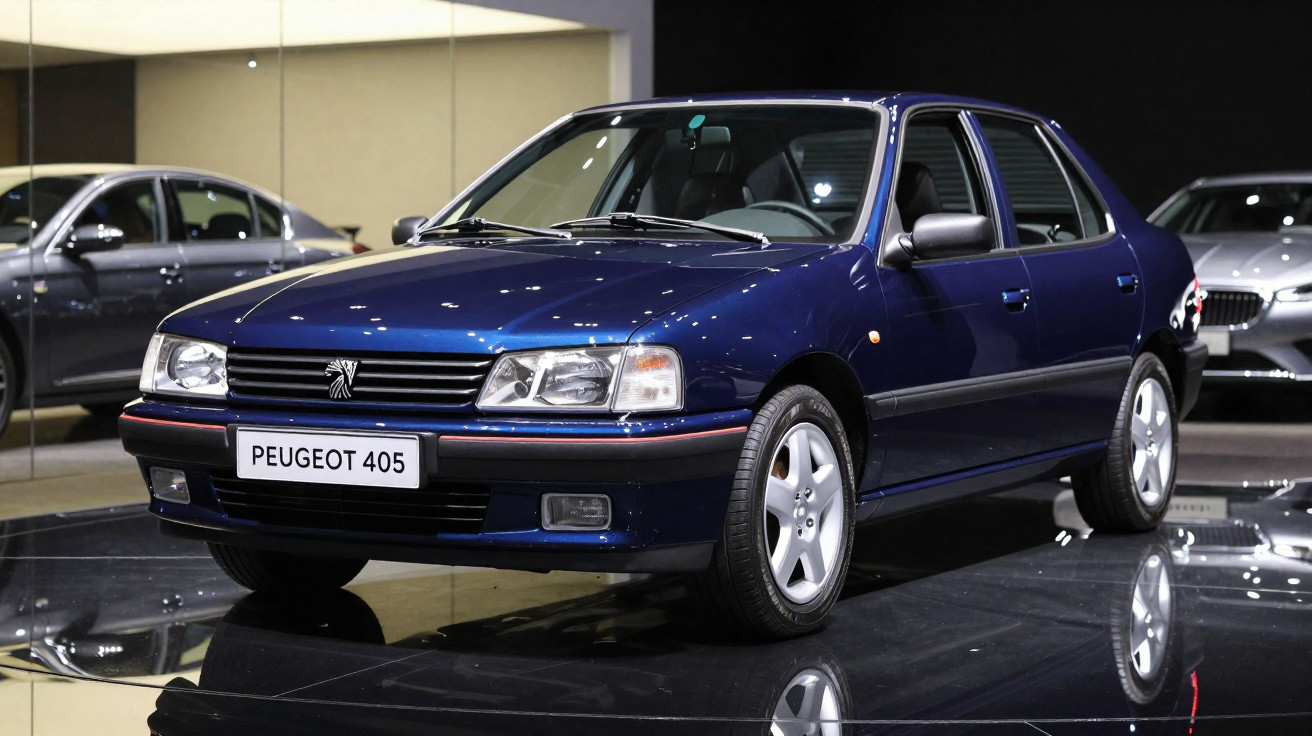
Since the Peugeot 405 was withdrawn from sale in Europe 26 years ago, we have seen the arrival of the 406, 407 and two generations of the 508.
Yet the 405 looks set to «outlive» every one of them: it is still built at four factories across four different countries, with no sign of production ending any time soon.
Its remarkable lifespan is chiefly down to Iran Khodro, an Iranian car manufacturer producing more than one million vehicles annually. As well as continuing to sell Peugeot-badged models such as the 405, the company also has its own brand, IKCO.
Iran Khodro began manufacturing the Peugeot 405 in Iran in 1990 under an agreement with the then Groupe PSA, and it has continued ever since. Geopolitical tensions in the region have forced production to stop at times, but Iran Khodro has made arrangements to build the 405 in other countries: Egypt, Iraq and, most recently, Azerbaijan in 2019.
Derivatives
Over the years, it has also been sold under several names: Peugeot Persia and Pars in Iran, plus Safir and 406 Khazar in Azerbaijan. Iran Khodro has gone further still, using the 405 platform as the basis for other vehicles. The IKCO Dena and Soren are currently produced, both saloons with their own styling.
Perhaps the most unusual Peugeot 405 offshoot is the IKCO Arisun 2. This is a light pick-up that is instantly recognisable as a 405 from the B-pillar forwards, while everything behind it is pick-up territory. It brings to mind the Portuguese-built Ford P100, which was derived from the Sierra.
Peugeot 405 engines are «old acquaintances»
Powering the 405-or rather, the Peugeot Pars-is Peugeot's «old acquaintance»: the 1.8-litre XU7 inline four-cylinder petrol engine, producing 100 hp and using only eight valves. There is even a bi-fuel version, running on petrol and CNG (natural gas), although its output is limited to 83 hp.
The Pars can also be specified with a 1.6-litre four-cylinder petrol unit of Peugeot origin, the TU5, which develops 105 hp and has 16 valves. Unlike the five-speed manual fitted to the other choices, this engine can also be paired with an automatic gearbox.
Touchscreen? It does not have one
The equipment list features front airbags for driver and passenger, ABS, electric windows and automatic air conditioning. It also gets power steering and... an interior lever for opening the boot.
A huge touchscreen for accessing the infotainment system? No. Instead, there is a CD player and a Bluetooth audio system.
The Pars and its derivatives have attracted some controversy because of their obvious lack of safety by modern standards. After all, the original design dates back to the 1980s, and many countries have sought to introduce higher safety requirements.
How much longer can the Peugeot 405 survive?
Comments
No comments yet. Be the first to comment!
Leave a Comment