
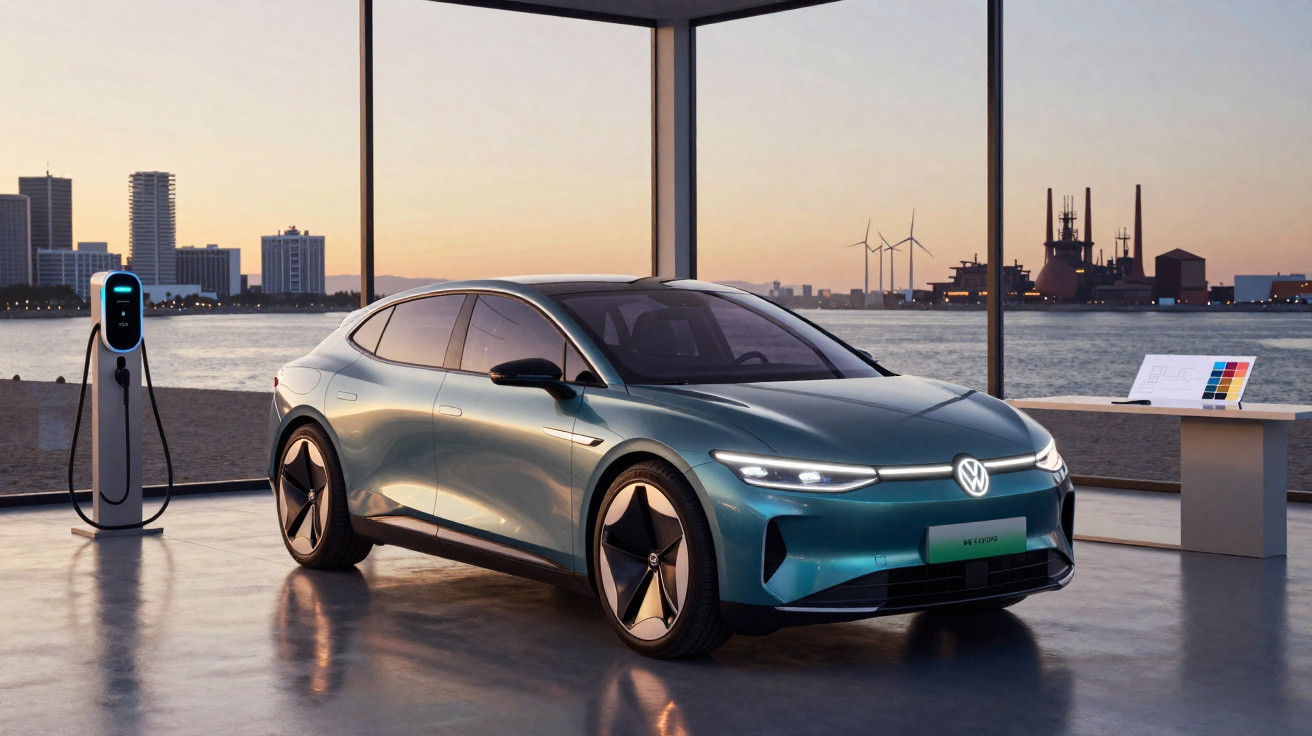
Autoeuropa and the Martorell plant are two of the Volkswagen Group’s three factories on the Iberian Peninsula. A fourth battery factory, whose construction has already begun, will soon join them - and it could have been built in Portugal.
They were established at almost the same time, given the same upbringing and are both products of a period of European Union expansion. They might be twin sisters separated at birth, yet they were founded in different years and 1,200 km apart.
Two factories, two different realities
Autoeuropa was founded in Portugal in 1995 and has prospered in an area where the scars left by 1980s unemployment and deindustrialisation can still be seen on closer inspection - scars that Autoeuropa has helped to heal.
Martorell was established in Spain in 1993, the very year in which the European Economic Community (EEC) became the European Union (EU). It has a Catalan accent and sits at the heart of Spain’s “dynamic” economic engine.
In the interests of family relations, these two sisters have even successfully attempted to reduce the distance between them through a rail connection.
Yet, rail links aside, the paths of these factories have not appeared to be converging in recent months.
While Martorell marks its thirties with plans for the years ahead, Autoeuropa’s long-term future remains less certain.
It is worth remembering that, almost 30 years after the first car left the Palmela factory’s production line, Autoeuropa remains the largest foreign investment ever made in Portugal: 450 million contos in the “old currency” - approximately €2,250 million.
That is why it is worth examining what is already known about the future of these two “sisters”.
Martorell goes hand in hand with electrification
From 2025, Martorell will begin building the Volkswagen Group’s fully electric vehicles based on its most compact platform, MEB Entry. This represents the German giant’s second wave of fully electrified products.
This project is expected to generate an economic impact of more than €21 billion in Spain. Martorell’s future is secure.
The Martorell plant will produce models for Cupra, Skoda, Volkswagen and Audi. These vehicles will drive another step forward in the Volkswagen Group’s democratisation of electric mobility.
The aim of this second phase is to offer electric cars starting at below €25,000, with a third phase potentially enabling models priced below €20,000.
This electrification plan extends beyond Martorell. It includes electrifying the Pamplona factory, constructing a new battery plant in Sagunto, Valencia, and establishing a complete supplier ecosystem.
As we have seen before, Autoeuropa appears to be on the sidelines of this electrification “mega-project”. However, that may not entirely be the case.
Autoeuropa is all about the present
Although the future is electric, combustion still defines the present. The European car sales figures are enough to show it.
In the first months of this year, fully electric vehicles accounted for just 12% of total sales.
Sales are certainly still growing, but Europe remains a long way from becoming a fully electric car market. European plans call for complete electrification by 2035.
That is why, in this combustion-powered present, Volkswagen has given Autoeuropa the best possible gift: the Volkswagen T-Roc, the German brand’s best-selling model on the “old continent”.
It is the T-Roc that enables Autoeuropa to operate at full capacity today.
In 2018, Volkswagen Autoeuropa moved to continuous operation, using its entire installed capacity for the first time in its history.
The factory covers all four stages of vehicle manufacturing - Pressing, Body Shop, Paint Shop and Assembly - and 890 cars leave its assembly line each day for European and Asian markets.
These are currently the figures that demonstrate Autoeuropa’s importance to Portugal:
However, while Martorell is already discussing its long-term future, Palmela’s outlook still carries a very strong flavour of the present.
Apart from the announcement of a €500 million investment by 2025, very little else is known about Autoeuropa’s future.
That future will most likely involve producing the second-generation Volkswagen T-Roc until 2030. The model will continue to be associated with combustion engines, although it is expected to allow plug-in hybrid versions. If this happens, it will be the first time Autoeuropa has produced an electrified model.
The future is electric - including for Autoeuropa
For the German giant, the future is 100% electric. Volkswagen has already said so, and Autoeuropa is aware of this scenario:
“Revenue streams will gradually change by 2030: from conventional combustion-engine models to zero-emission electric cars (…).”
- Autoeuropa website
If every Volkswagen Group model is to be electric in the future, Autoeuropa has no alternative: full electrification is mandatory. Otherwise, Autoeuropa has no future. Neither Portugal nor Volkswagen itself can imagine a Portugal without Autoeuropa.
“Today, we are here to mark Autoeuropa’s 30 years, and we want there to be another thirty.”
- Thomas Hegel Günther, Managing Director of Autoeuropa
These words were spoken just over a year ago, at the ceremony marking 30 years since Autoeuropa’s foundation stone was laid. It was an occasion on which the German brand was keen to underline the importance of its Portuguese production facility.
The event was attended by the President of the Republic, Marcelo Rebelo de Sousa, the Prime Minister, António Costa, and members of Volkswagen’s management board.
For all these reasons, there can be no alternative to reinforcing the commitment to Autoeuropa - and Autoeuropa’s commitment to the country. The announcement is not urgent, but it is important that this path is already being pursued in the “corridors of power”.
The way Spain has used the PRTR programme (Recovery, Transformation and Resilience Plan) - the equivalent of Portugal’s PRR programme (Recovery and Resilience Plan) - to revive electrification in the country and strengthen its position in the automotive sector offers an indication.
Portugal can, and should, learn from Spain’s example and from Martorell. After all, that is also what older siblings are for.
Comments
No comments yet. Be the first to comment!
Leave a Comment