
What is the Eccentrica Lamborghini Diablo?
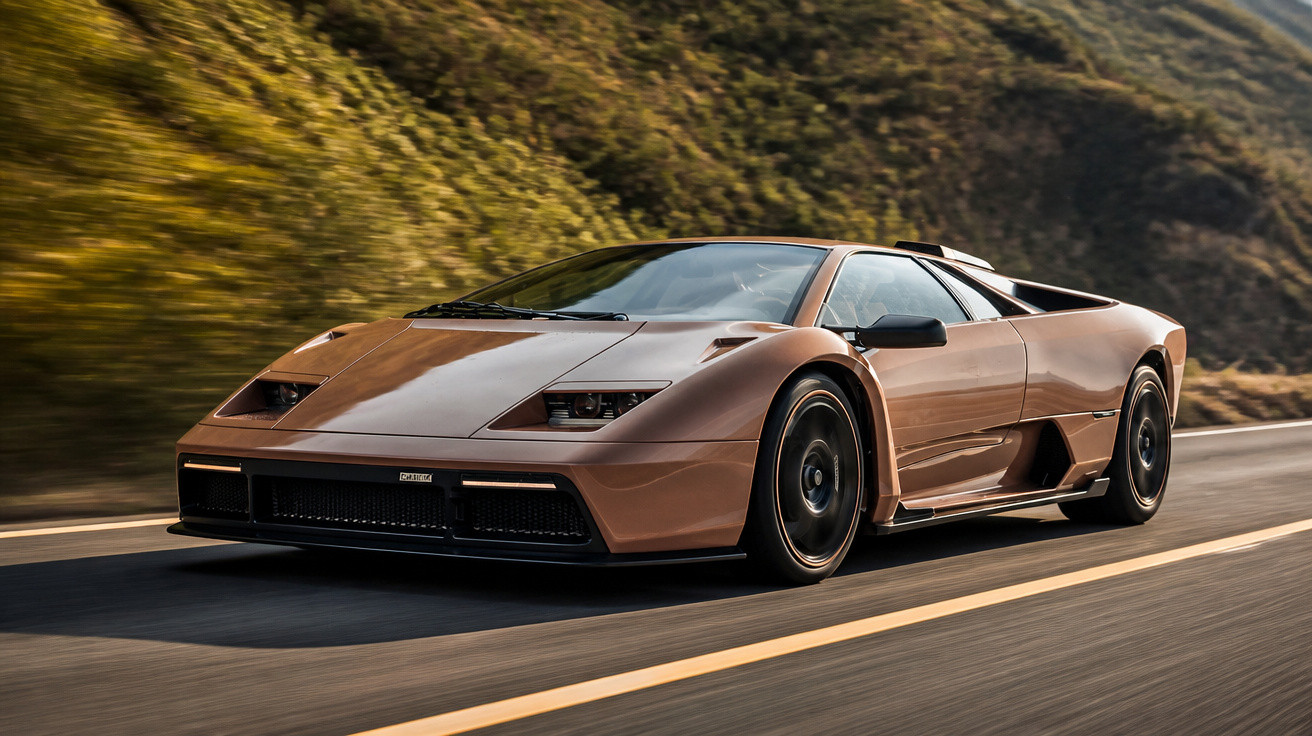
In essence, it is a restomod Lamborghini Diablo created by a company named Eccentrica Cars. Yes, it comes with several familiar promises: extensive carbon fibre, modern upgrades and an eye-wateringly high price.
This one takes a slightly different approach, though. The aim is to retain the personality of an early-1990s Diablo while refreshing it with techniques and materials developed 35 years later. There is no supercharger or pair of turbos, no dramatic power increase and no slick DSG transmission. It remains a naturally aspirated 5.7-litre V12, driving only the rear wheels through a hefty manual gearbox. The intention is for it to feel entirely like a Diablo, merely more polished and heightened.
Photography: Mark Riccioni
Why change an iconic Diablo?
Before looking at Eccentrica’s work, it is worth understanding the donor car. The Diablo is undoubtedly legendary: in the late 1980s, Marcello Gandini penned the Countach’s successor. It was intended to be more practical than that angular icon, gaining adjustable seats, electric windows and all the wonderful trimmings of the 1990s. Such as being able to climb in and out without an engine hoist and two broken legs.
The complication was that Chrysler acquired Lamborghini in 1987, disliked Gandini’s extremely sharp styling and softened the design. The result was the somewhat smoother first-generation Diablo, launched in 1990. Yet it did not receive power steering until 1993, when the VT, or ‘Viscous Traction’, all-wheel-drive model arrived; the earliest cars also lacked traction control and ABS. Early Diablos were therefore supercars that demanded real effort from their drivers before delivering their pace.
They were seriously rapid, too: a little over four seconds to 60 and a top speed beyond 200mph in 1990 were exceptional figures. However, the car evolved over the years, and later Diablos became easier to drive, even if never exactly easy. Indeed, the final-generation 6.0-litre manual is a personal hero and would unquestionably occupy a place in the lottery garage. Any Diablo receiving a million pounds’ worth of ‘improvements’, then, needs to be extremely convincing.
How has Eccentrica reshaped the exterior?
Substantially. The bodywork is now carbon fibre rather than aluminium and plastic, making it lighter while replacing rounded surfaces with more creases and edges. It looks crisper and more sharply defined. The pop-up lamps now fold down to expose LED headlights - current safety regulations are responsible for that modern update - while LED DRLs sit within the broader, more sculpted nose.
It is shorter, has larger lower air intakes and two roof scoops, and wears twin centrally positioned Capristo exhausts beneath a slimmer semi-floating rear bumper. These details echo the Diablo GT special edition - built from 1999 to 2000, with only around 83 examples produced - although that model had just one roof-mounted intake.
Is the Lamborghini Diablo more modern to use?
The exposed-gate manual remains, but the original 1990 car’s five ratios have become six. With no reverse. Well, reverse does exist, but the six forward gears - with first and second shorter than the original’s stratospheric ratios, and fifth and sixth more closely matched - have been engineered into the original casing. Reverse fills the space previously occupied by the power take-off for later VT, or ‘viscous traction’, all-wheel-drive cars.
To select reverse, choose neutral, depress the clutch and press a button that engages it electrically, then release the clutch as usual. It is not an electric reverse gear, only an electrically actuated one. That is more fiddly than simply moving the gearlever’s slot, but you would want to be deliberate when reversing a car worth more than a million pounds anyway.
What has changed inside?
It is magnificent. The original featured an enormous binnacle drooping ahead of the driver, tractor-derived switchgear and panel gaps large enough to serve as gateways to other dimensions. Its stitching was absurdly uneven, while the plastics - especially the ashtray - had a Bakelite-like feel.
Eccentrica instead provides expanses of precisely fitted Alcantara, a tidy steering wheel, a machined spherical gearknob and a brilliant retro-futuristic digital instrument display. There are hints of the Astra GTE’s digital dashboard from my childhood, but that is genuinely praise. There are also machined, highly tactile switches, levers and buttons: still substantial, yet enjoyable to use. That sums up the cabin’s feeling: fun. It remains unmistakably a Diablo - and, yes, the necessary scissor doors are present - but it has been properly resolved. In some respects, it is the car’s finest feature.
What is it like to drive?
It is vastly easier to drive than an early Diablo, although it is still no entry-level supercar. Most genuinely fast modern cars are as straightforward to operate as a contemporary hatchback if their size and limited visibility are ignored, but the Eccentrica retains some sharp edges. The major transformation is its power steering, which feels revelatory compared with the early car. Later Diablos gained it, but here it turns a 1990-specification model into something genuinely usable rather than an enforced forearm workout.
Its tyres are contemporary - wider at the front than before and marginally narrower at the rear - as is the suspension, while the box-frame chassis has received extensive composite reinforcement and sheathing. Together, these changes make the car feel far more purposeful, and give the new suspension a solid foundation against which to work. It is a substantially more assured, and more confidence-inspiring, supercar.
What it does not become is unrecognisable from its donor. The sawtooth edges may have been softened - traction control and measured power delivery come from a modified system - but the underlying physics remain largely those of the old car. It turns in more cleanly, stays flatter and reacts more consistently, but you still should not let this Diablo become too unsettled unless there is plenty of space; the Eccentrica can still bite.
Nor is it dramatically quicker. It gains a few tenths to 60 and a few extra mph. It will be slightly faster in a straight line, with a greater advantage through corners. Yet electronic throttle bodies, a lighter - though still not ‘light’ - clutch, power steering and improved visibility make it easier to drive. It also produces a mighty soundtrack, particularly through the valved Capristo exhaust.
So what is the verdict?
The Eccentrica deserves admiration for the precision of its vision and, in certain respects, its restraint. The brief was to build a Diablo that retained the feel of an early Diablo while benefiting from modern methods and technology. It has achieved that completely. This is a niche market, but the people who understand this car will love it.
It is, by definition, a restomod, yet Eccentrica has not removed the gritty intent or the soul that makes a Diablo a Diablo. Everything is improved, from materials and seats to the stereo, but behind the wheel it still has the toothy quality of a classic Lamborghini. It is not for the faint-hearted, but it is far less flimsy than a 1990s original. Still monstrously analogue and wonderfully demanding when driven quickly, it is nevertheless unlikely to disintegrate on your drive or melt in the rain. It is a Diablo, elevated.
Is it worth more than a million pounds, plus the donor car? For those able to afford such extravagance and wanting something demanding, yes. The rest of us can only look on and dream.
Specs
Price: £1,042,000 (plus donor Diablo, circa £300k)
Engine: 5.7-litre V12, naturally aspirated
Power/torque: 550bhp, 443lb ft
Performance: 0-62mph in 3.8secs, 208mph top speed
Transmission: six-speed manual, rear-wheel drive
Weight: c1,600kg
Comments
No comments yet. Be the first to comment!
Leave a Comment