
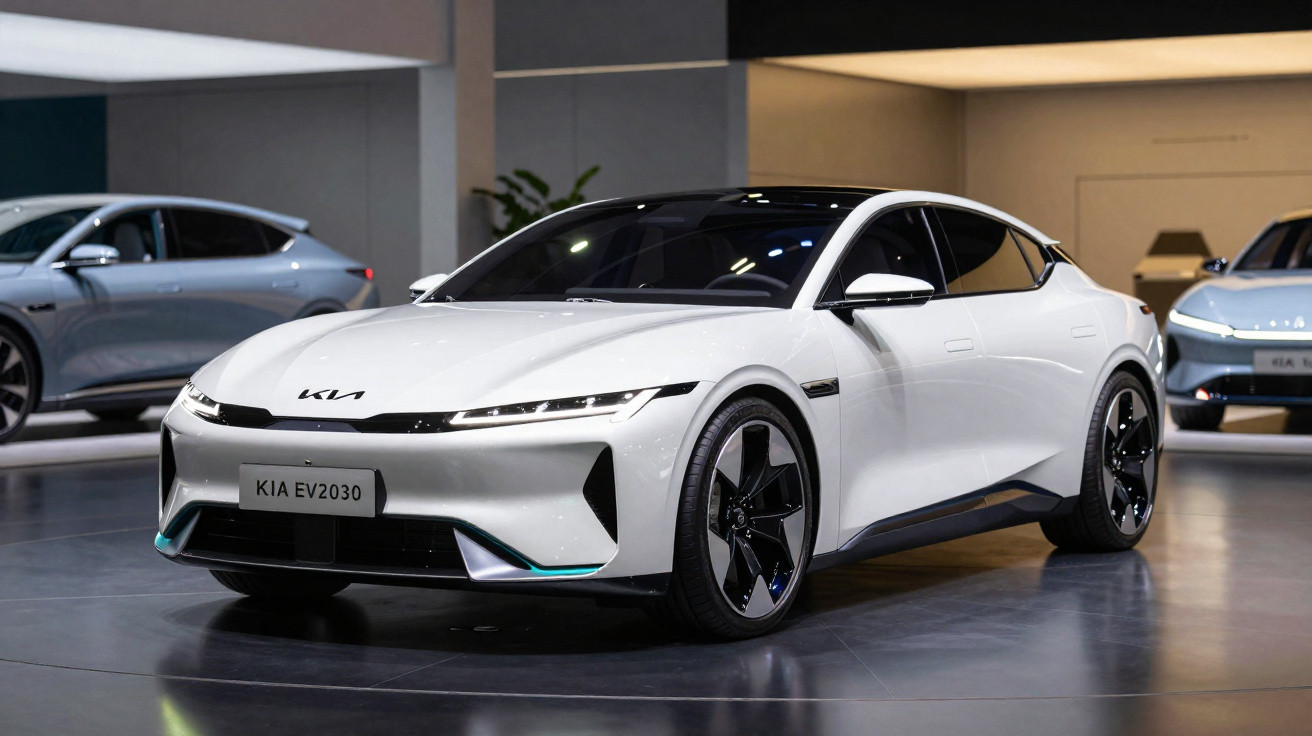
Kia is «flying». In 2025, it set an all-time sales record, delivering 3.14 million vehicles - 1.5% more than in the previous year - and has made clear that it intends to press on hard through to the end of the decade.
The aim is to keep increasing sales, which is why the company is preparing to introduce even more 100% electric models. Its current line-up includes 11 offerings, a figure set to rise to 14 by 2030. At a time when some manufacturers are easing back on electric cars, the South Korean brand is notably choosing to do precisely the opposite.
Kia EV family expanded
This year, Kia has strengthened its 100% electric range with two clearly differentiated models: the EV5, positioned in the C-SUV segment, and the EV2, aimed squarely at the core of the B-SUV market.
Measuring 4.61 m long and with a wheelbase of around 2.75 m, the EV5 has the credentials to serve as the household’s main car. It is also well suited to family holidays, offering 566 litres of boot space, plus a further 44 litres in the front luggage compartment.
Offered exclusively with rear-wheel drive and an 81.4 kWh battery, it uses a 160 kW (218 PS) electric motor and claims up to 520 km of range on the combined WLTP cycle.
EV2 takes centre stage
As Kia’s most affordable electric car, the EV2 naturally attracts plenty of attention. Having only recently arrived in Portugal, it shares the E-GMP platform used by Kia’s other electric vehicles and comes with a choice of two batteries: 42.2 kWh and 61 kWh. These deliver up to 317 km and 448 km of WLTP range respectively.
Whichever battery is selected, the powertrain remains the same, producing no more than 108 kW (147 PS). We have already driven the EV2 in Portugal, and our first impressions were favourable. Take a look:
In terms of pricing, the EV2 with the smaller battery costs €28,861 for private buyers, while business prices start from €21,850 + VAT.
EV1 is next in line
Among the new electric models Kia will introduce before the decade is out is the EV1, which will take the EV2’s crown as the brand’s cheapest electric car. It will be the South Korean manufacturer’s answer to the European Renault 5 E-Tech and Volkswagen ID. Polo.
Very little is known about this model so far, although it is expected to share the EV2’s powertrain and battery options. The EV1 will also be Kia’s first software-defined vehicle (SDV). It is due to reach the market in 2027, although it could be unveiled later this year.
Three combustion-engine models
Despite its major commitment to 100% electric vehicles, Kia has not overlooked its combustion-engine range, which has also received significant updates. First among them is the Kia K4, replacing the Ceed as that model ends its run after 20 years and three generations.
Tasked with competing against cars such as the Volkswagen Golf and Peugeot 308, it has one important advantage: price. In Portugal, it is available from €28,490.
Another significant development concerns the XCeed, which has been comprehensively updated with fresh exterior styling and newer technology.
Its engine range continues to offer versatility, with petrol and mild-hybrid choices. Technical specifications have not yet been disclosed, but it is expected to retain the current selection of engines.
The Seltos is another name that cannot be ignored in Kia’s 2026 plans. Now in its second generation, it will finally «land» in Europe to take on models including the Volkswagen T-Roc and Nissan Qashqai.
It will initially launch with a 1.6-litre, 180 PS turbocharged petrol engine. This will later be joined by a hybrid offering in two versions: a front-wheel-drive model with 154 PS and an all-wheel-drive alternative with 178 PS. The new Kia Seltos will arrive in Europe during the third quarter of this year. Prices have not yet been announced.
Comments
No comments yet. Be the first to comment!
Leave a Comment