
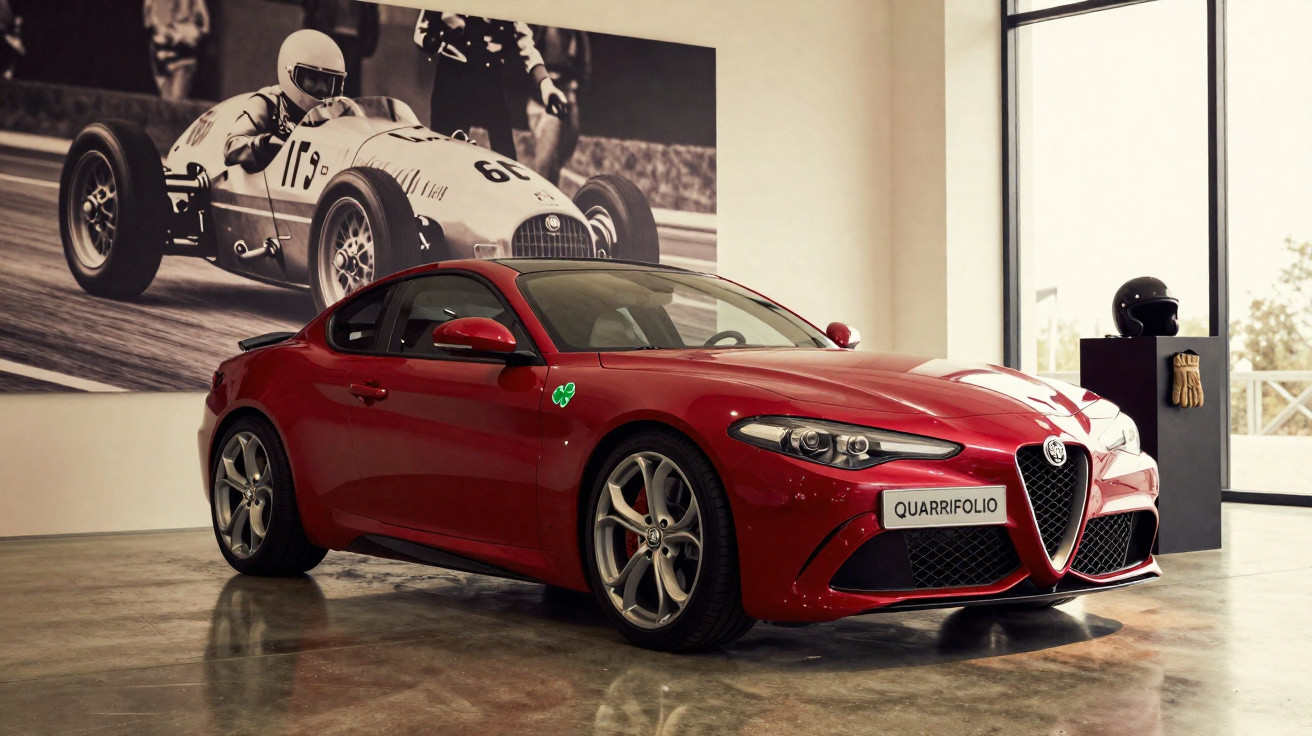
With Alfa Romeo celebrating another anniversary, we look back at one of its most recognisable emblems, which has appeared on some of its most coveted models: the famous quadrifoglio.
Simply a four-leaf clover, this symbol has more recently lent its name to Alfa Romeo’s sportiest versions. Its history, however, has been intertwined with that of the Italian marque for almost a century.
Following the end of the First World War in 1918, Alfa Romeo returned to motorsport some time later and assembled its first works team. Its line-up included four gifted drivers: Antonio Ascari, Enzo Ferrari - yes, that Enzo Ferrari - Giulio Masetti and Ugo Sivocci.
As a team, the Italian outfit seemed unstoppable, yet Ugo Sivocci was seeking better individual results after leaving motorcycle racing behind.
And if there was one event Sivocci wanted to win more than any other, it was the Targa Florio, then the most prestigious race of all.
Alfa Romeo Quadrifoglio: a matter of luck
Ugo Sivocci had already secured several second- and third-place finishes, but victory in the Targa Florio continued to elude him. In the 1922 edition, for instance, he could manage only ninth place.
Certain that he had the quickest car and plenty of ability, the superstitious Italian driver naturally decided that all he lacked was a little luck.
He therefore chose to adopt a “lucky charm”, following the example set by wartime aircraft pilots - a tradition that also gave rise to Ferrari’s Prancing Horse.
Given Sivocci’s superstitious nature, it is hardly surprising that he selected a green four-leaf clover - quadrifoglio in Italian - set within a white diamond. Four-leaf clovers are far rarer than three-leaf ones and, for a long time, finding one has been regarded as a sign of good fortune.
So, for the 1923 Targa Florio, held on 15 April, Sivocci took no chances and painted his new “lucky charm” on the side of his Alfa Romeo RL Targa Florio - particularly as his car carried the number 13.
Victory at the 1923 Targa Florio
The Targa Florio was a demanding event, run through the mountains of the Italian island, where many of the roads were unpaved. Naturally, cars were also considerably slower 100 years ago.
After seven hours and 18 minutes - at an average speed of 59 km/h - Ugo Sivocci was crowned winner of the 1923 Targa Florio. The quadrifoglio appeared to have done its job.
Not only did Sivocci take his first Targa Florio win, but he also delivered Alfa Romeo’s first victory in the important event.
Sadly, his good fortune did not last long. Later that same year, on 8 September, he was killed in an accident during practice for the Monza Grand Prix at the wheel of an Alfa Romeo P1 - superstition aside, the car he was driving did not have a quadrifoglio painted on it.
A fitting tribute
After Ugo Sivocci’s death, Alfa Romeo chose to honour the driver by applying the quadrifoglio to all of its racing cars.
There was, however, a small alteration. On Sivocci’s car, the green four-leaf clover stood against a white diamond, whereas Alfa Romeo began placing the quadrifoglio inside a triangle. The missing point of the diamond symbolised the loss of one of the Alfa Romeo team’s four drivers.
From racing emblem to road-going performance models
Over the years, the quadrifoglio ceased to be exclusive to racing cars and was also displayed on Alfa Romeo’s sportiest road models.
These include the relatively recent Giulia Quadrifoglio and Stelvio Quadrifoglio, phenomenal machines that have already passed through Razão Automóvel’s garage.






Comments
No comments yet. Be the first to comment!
Leave a Comment