
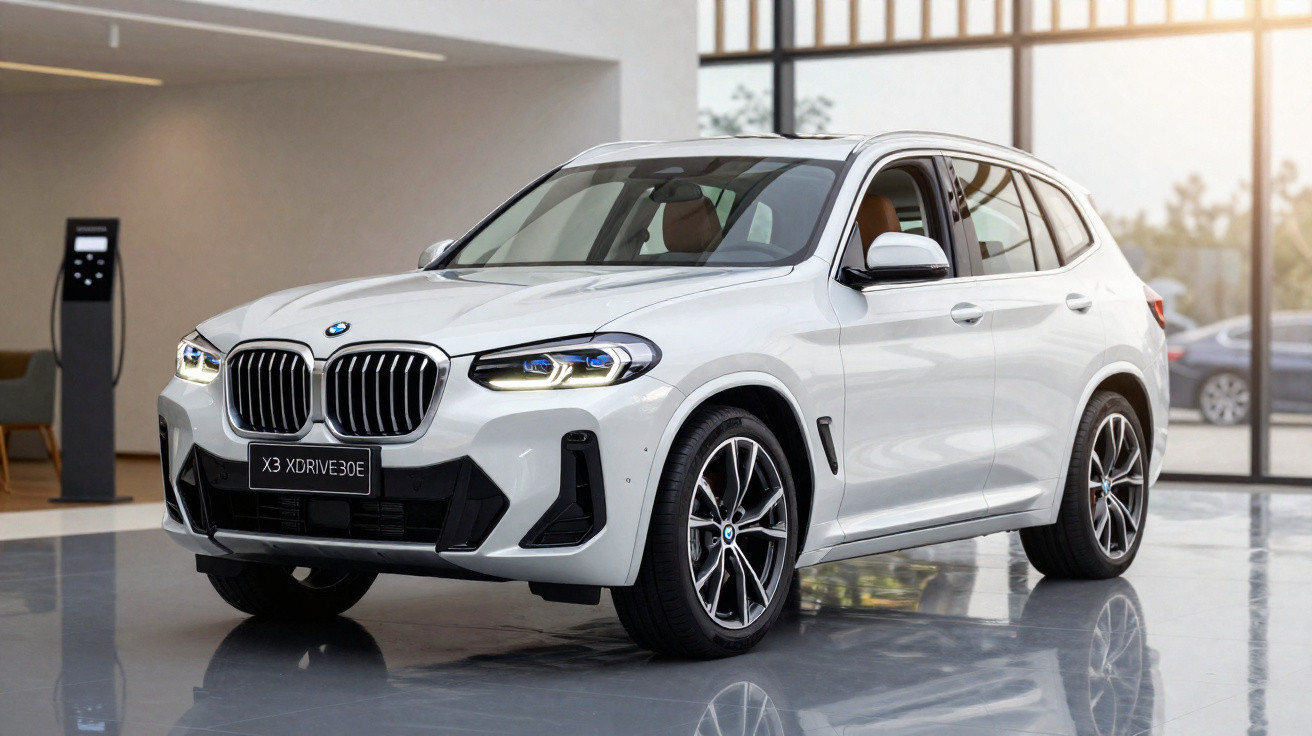
A kind of link between the ‘regular’ X3 models and the new iX3, the BMW X3 xDrive30e is one of the Bavarian brand’s many plug-in hybrid models, aiming to combine the best of both worlds.
On the one hand, it offers an electric motor and between 43 km and 51 km of all-electric range on the WLTP cycle - a clear advantage, particularly for urban driving.
On the other, there is a 2.0-litre, four-cylinder in-line petrol engine producing 184 hp, allowing longer journeys without having to worry about the location of the next charging point.
That may sound like the ideal formula on paper, but does the X3 xDrive30e deliver everything it promises in real-world use? What happens once the battery is depleted? Does it lose most of its appeal, or does it remain a compelling proposition?
Naturally, there was only one way to answer those questions, so we put the new BMW X3 xDrive30e to the test.
Is it a plug-in hybrid? You would barely notice
Starting with the X3 xDrive30e’s appearance, only the most observant are likely to realise that this version has added electrons to its diet.
Apart from a subtle badge and the charging flap, the X3’s plug-in hybrid variant is virtually indistinguishable from the rest of the range. It retains the restrained styling and the famous ‘double kidney’ grille in what can still be considered “normal” proportions.
Personally, I like the BMW model’s slightly traditional design. It remains understated yet imposing - I saw several heads turn as it passed - without appearing dated or overly familiar.
Inside, quality is in the air
As with the exterior, the BMW X3 xDrive30e’s cabin is almost identical to that of the combustion-only versions. The interior therefore has a sober design, with quality clearly taking centre stage.
It uses soft, pleasant-to-touch materials and the assembly feels solid. Even when travelling along an unpaved road in silent electric mode, the X3 xDrive30e lives up to the brand’s reputation in this area.
From an ergonomic perspective, it is worth noting that the X3 xDrive30e remains faithful to physical controls - there are still plenty of buttons throughout the cabin - which makes it quicker to get used to. In addition to the climate controls and radio, the infotainment system also has a physical controller, the well-known iDrive, which is an asset when navigating its many menus and submenus.
There is, however, one area in which this plug-in hybrid version loses out to its petrol- or diesel-only counterparts: space. Passenger room remains unchanged, with sufficient space for four adults to travel comfortably, but the same cannot be said of the boot.
To house the 12 kWh battery beneath the rear seats, the fuel tank had to be relocated above the rear axle. The result? Boot capacity, previously 550 litres, falls to 450 litres, and that space must also accommodate the large, heavy charging cable.
Economical with battery power…
As expected, while the battery supplying the 109 hp electric motor integrated into the eight-speed Steptronic automatic gearbox has charge, the X3 xDrive30e can achieve impressive efficiency. In normal driving, real-world range in fully electric mode is around 40 km.
Using mainly the hybrid mode, consumption was between 4 and 4.5 l/100 km, while the plug-in hybrid system’s effective management of the battery charge proved impressive.
Even so, its performance while there is battery charge is what stands out most. Combined maximum output is 292 hp and combined maximum torque is 420 Nm, so this BMW X3 xDrive30e moves along with pleasing ease.
… and without it
Although fuel consumption with a charged battery meets expectations, the figures achieved once it has run out of charge - in reality, the battery is never fully discharged, partly to safeguard its condition - are a pleasant surprise.
On a route made up of around 80% road/motorway driving and 20% city use, the X3 xDrive30e returned between 6 and 7.5 l/100 km. It made use of every descent and deceleration to replenish the battery, especially in the “Normal” and “Eco Pro” driving modes.
Dynamically, it is unmistakably a BMW
If there is one area where it makes little difference whether the BMW X3 xDrive30e has battery charge or not, it is dynamics. The German model honours BMW’s well-established dynamic credentials, even taking into account this plug-in hybrid’s weight of more than two tonnes.
It has direct steering with a good weight to it, although it may feel a little heavy in “Sport” mode, along with a chassis that encourages engaging driving. Together, these qualities make the BMW X3 xDrive30e genuinely enjoyable to drive.
When the pace drops, the German SUV repays its driver with high levels of refinement and cabin quietness, even on the motorway, where it feels “completely at home”.
Is it the right car for me?
The greatest compliment that can be paid to the BMW X3 xDrive30e is that, more than simply being a plug-in hybrid, it is a typical BMW. It combines all the qualities associated with the German brand’s models with the advantages offered by this type of powertrain.
Well built and comfortable, this version gives the X3 urban capabilities it did not previously possess, courtesy of the electric motor. Beyond the city, it has a capable plug-in hybrid system that delivers good fuel economy while allowing the driver to enjoy one of the segment’s most dynamic SUVs.
In true BMW fashion, some equipment that should not be optional is instead found on the extras list, including lane-keeping assistance, adaptive cruise control and traffic-sign recognition - especially in a model whose price starts at more than €63,000.
For anyone looking for a premium SUV that is well made, reasonably spacious and able to operate in urban areas without consuming vast quantities of fuel, while doing so in a more environmentally responsible way, the BMW X3 xDrive30e is one of the leading options to consider.

Comments
No comments yet. Be the first to comment!
Leave a Comment