
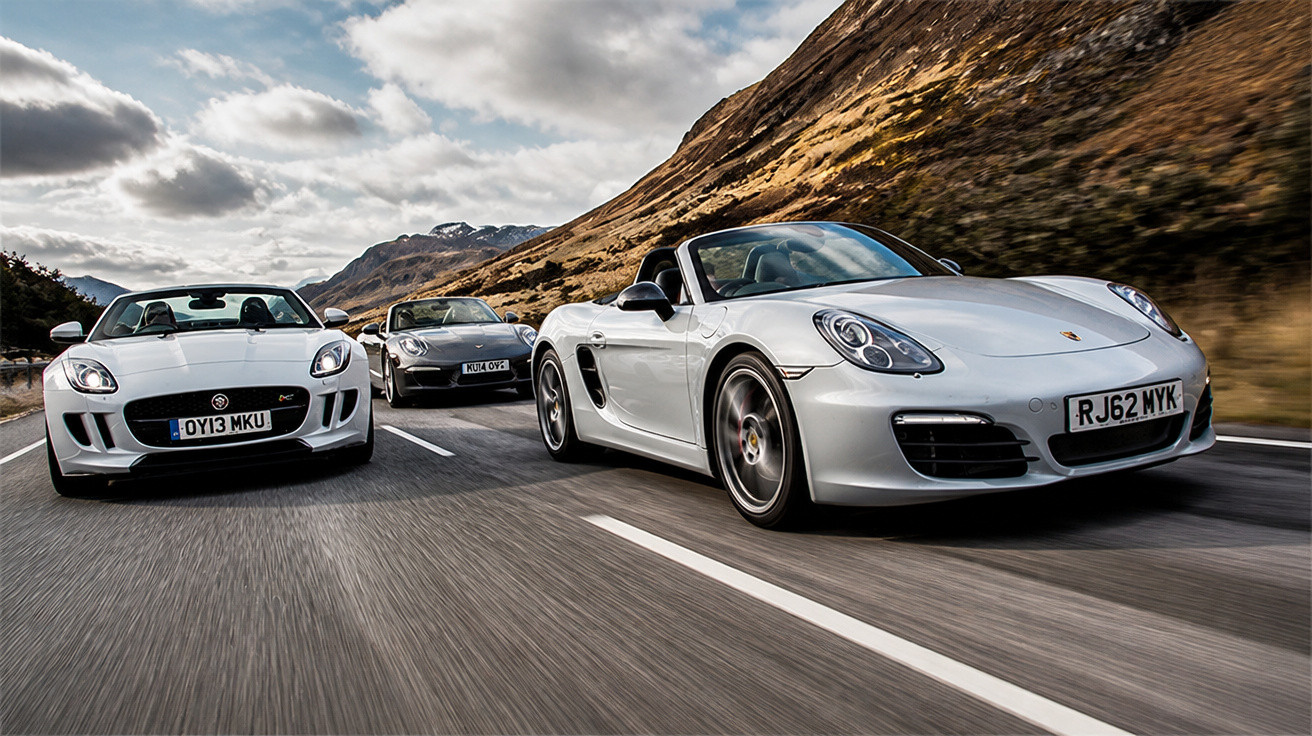
Jaguar’s marketing people will tell you, with no little pride, that the Jaguar F-Type Convertible has no direct rivals: it is, they claim, an entirely singular offering. The ‘singular offering’ line is plainly a touch silly, especially as Jaguar was building front-engined, rear-wheel-drive two-seat convertibles 60 years ago. Yet the F-Type range does occupy an unusual no-man’s-land on price. At the entry point, the £58,000, 335bhp V6 appears costly beside similarly potent BMW Z4 and Audi TT RS models. At the other end, though, the £80k V8 provides considerably more pace for much less money than an Audi R8 or Aston Martin V8 Vantage. More unusual still is the £67k, 375bhp V6S, the sweet spot of the F-Type range. Its position on the price-versus-power chart is an odd one: no other maker offers anything remotely similar. A car with no rivals is a pleasant thing to have.
The drawback of having no obvious head-to-head opponent, however, is the risk of being attacked from the sides. That becomes particularly relevant when the two-pronged assault is delivered by the Porsche 911 and Boxster. In both price and performance, the V6S F-Type sits almost precisely between Porsche’s two best cars. It costs 22 grand more than a Boxster S, yet 24 grand less than a 911 Carrera 2S Cabrio. The F produces 64bhp more than the Boxster and only 20bhp fewer than the 911. Put all three through a 0-62mph sprint and the manufacturers’ figures say the rear-engined 911 gets there first; the front-engined F-Type follows two-tenths behind, with the mid-engined Boxster another two-tenths back. Does that make the F-Type a bargain alternative to the 911, then, or an alarmingly expensive Boxster competitor? Scotland alone has the answer...
Jaguar F-Type Convertible versus Porsche 911
Climb into the 911 and its considerable price premium immediately begins to make sense. Our test car features an advanced, cutting-edge piece of equipment found only in high-end exotica: a manual gearbox. Yes, really. Nor is it an ordinary manual, but a seven-speed unit, a layout so unusual that the gear lever needs a diagram on top resembling a millipede missing several legs. Seven is at least three gears too many, particularly when third will carry you to Autobahn speeds. But after only a few minutes with the 911 and its clutch pedal, it becomes clear how unfortunate it is that Jaguar does not offer a manual F-Type. It would have underlined the sporting purpose of its smallest and sharpest model, while a three-pedal arrangement also brings you far nearer to the engine’s inner workings.
Even so, 80 per cent of buyers will choose their 911 with Porsche’s twin-clutch PDK transmission. Remove the clutch pedal from the equation and the 911 and F-Type become remarkably closely matched. The Jaguar takes the honours for sound. The 911’s flat-six delivers a wonderfully mechanical howl beyond 5,000rpm, but it cannot quite equal the theatre of the F-Type’s mad soundtrack: part Saving Private Ryan fusillade, part metallic buzz-saw shriek as it cuts through a gas main.
The Porsche may steer a fraction - only a fraction - more sweetly than the F-Type, but the gap is tiny, certainly smaller than it would have been before Porsche adopted electric steering for the 991. There is no question that the 911’s brakes, throttle and steering feel marginally less frantic than the F-Type’s ultra-quick controls. That calmness suits the 911’s on-road character, too, as it tends towards mild understeer when pushed hard. That is perfectly agreeable to me. The F-Type feels as though it is ready to oversteer at the limit, excellent if you possess plenty of track space and considerable talent, but rather unsettling for the rest of us on greasy roads or icy mornings.
You know what comes next, and we make no apology for revisiting it: the elephant in the boot, the ancient engine-in-the-wrong-place argument. The familiar saying that Porsche put the engine in the wrong position and has spent the past half-century trying to solve the resulting problem remains as relevant as ever. Moving the rear axle rearwards and the engine forwards has undoubtedly subdued the 911’s traditional tendency to pivot around its tail, but the distinctive 911 rear-end bounce has not vanished.
Drive the C2S hard through a broad, fast curve and you can sense the weight above the rear axle pressing gently on the outer wheel, like bowling balls rolling about in the boot. Unless a huge bump appears mid-corner, it is never enough to disturb the car, but it makes the 911 feel fractionally less settled where the Jaguar feels pinned down. With its standard adaptive dampers, the V6S has outstanding body control, dealing with everything from manhole covers to 30cm crests with scarcely a tremor.
This is not to suggest that the 911 is poorly sprung or damped; it is simply impossible to defeat the physics of a fairly substantial engine sitting over rear wheels that are constantly moving about. The effect only matters on the quickest, roughest roads, but Scotland has plenty of precisely those. On these rapid, frost-damaged stretches, the F-Type shows its worth - and its British heritage - to great effect.
The new 991 911 is an excellent machine, then, but rough Scottish tarmac combined with cabriolet form does not reveal it at its absolute best. Jaguar has created a highly persuasive 911 alternative in the F-Type, costing 25 per cent less, provided you do not need to carry children or luggage larger than a small packet of crisps. The Jaguar is undoubtedly a far bigger occasion, attracting enormous attention while the Porsche fades into the scenery. As a value-led alternative to the 911, it has succeeded.
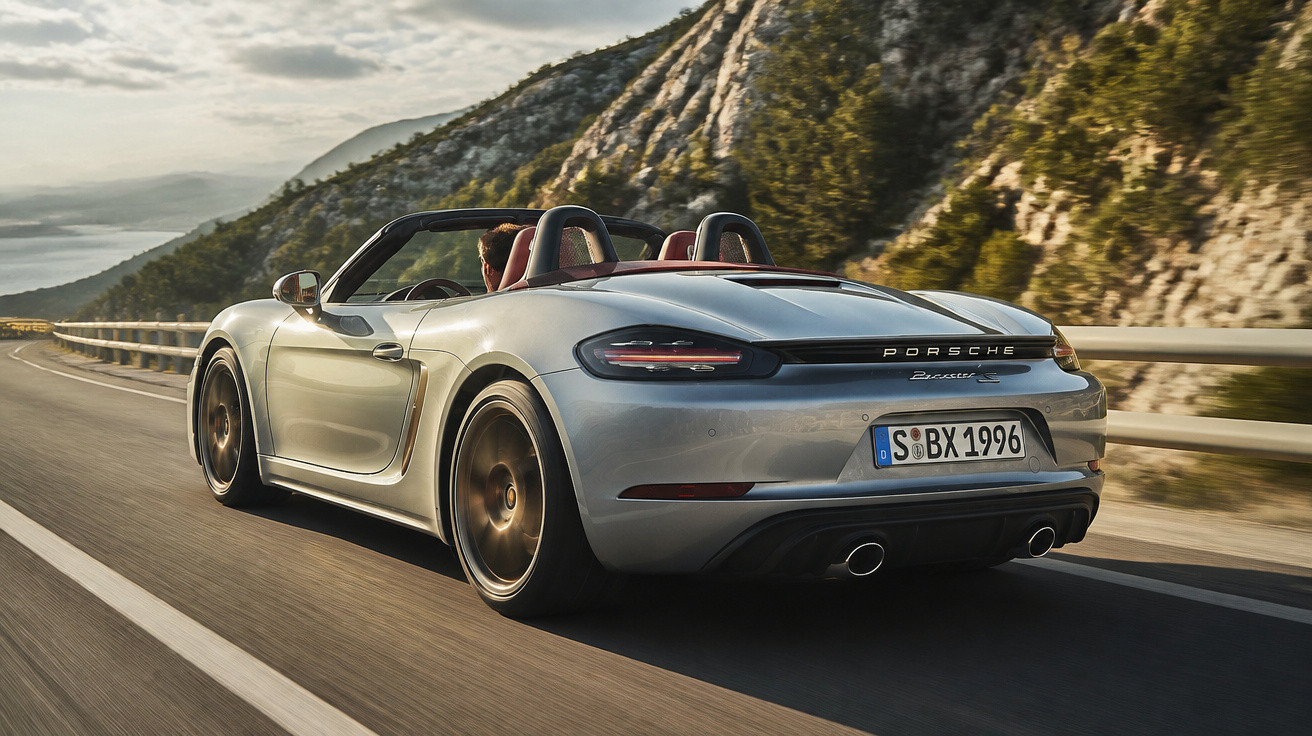
Porsche Boxster S on Scotland’s roads
If the F-Type can unsettle a manufacturer’s flagship sports car, you might assume it would comfortably defeat that company’s entry-level model. If one car is better than an Audi R8, logic dictates it must also be better than a TT RS. Beat an SL63 and there is no need to try an SLK. But the Porsche world does not operate that way.
This is the procedure for your first drive in a Boxster. 1) Walk up to the driver’s door. 2) Fold yourself down into the very, very low seat. 3) Start the 3.4-litre boxer engine. 4) Lower the roof. 5) Press the Sport and Noisy Exhaust buttons. 6) Start driving. 7) Take the first corner. 8) Instantly begin considering what you could sell, steal or embezzle to keep one in your life permanently.
Seriously. For a driver of average ability - and I am as average as they come - stepping from the F-Type into the Boxster instantly turns you from a slow-thinking human into an F1 hero. Its balance is so flawless, and it communicates even the slightest loss of grip so clearly, that you immediately feel able to take the small Porsche right to its limits. The steering is slower and slightly more reassuring than the F-Type’s rapid rack, pairing neatly with the Boxster’s longer-travel throttle and calmer brakes. Every control has evenly judged weighting, while the six-speed manual is shorter and crisper than the 911’s.
It suits Scotland’s narrower roads much better than the broad-hipped Jaguar. The Boxster is a packaging masterpiece: smaller but more useful than the storage-starved F-Type. For a few amusing minutes, find a non-car-loving friend, show them a Boxster and ask where the engine is. They will probably inspect the front boot first, only to find a generously sized luggage compartment beneath the bonnet. The rear boot? No, that is another modest luggage space. The Boxster’s flat-six lives deep below the roof mechanism, somewhere directly behind your backside.
In fact, while driving a Boxster it is almost impossible to identify where the engine’s weight is positioned. The chassis is so perfectly resolved that you barely notice the suspension at work. However hard you lean on it, there is no impression of mass shifting in any direction - merely absolute composure and neutrality. On fast, bumpy roads, it skips about far less than the 911, delicately stepping across bumps that the F-Type simply smooths over.
And, damn it, the Boxster carries its 311bhp with remarkable ease. That is a substantial power advantage over a Vauxhall Astra VXR - although it reaches the road via the correct axle - yet it is delivered so progressively that it never feels likely to bite. The Boxster’s boxer engine is neither as feverish under acceleration as the F-Type’s V6 nor as forceful in the mid-range as the 911’s, but that only means you must rev it harder and higher, which is hardly an inconvenience.
Jaguar F-Type Convertible character and Boxster appeal
Sorry, that became slightly starry-eyed. We recognise that a sports car is about more than charging around the countless corners of Scotland’s empty Highlands, and away from Loch Carron there is plenty to favour the F-Type over the Boxster. The Porsche emits a healthy collection of booms, crackles and growls, but it does not sound as spectacular as the unhinged F-Type. Its interior also takes the whole ‘understated class’ approach right to the point where it meets ‘actually rather boring’. There is little overt flair to see, certainly nothing comparable with the F-Type’s rising air vents and copper-coloured gearshift paddles.
The Jaguar is also quieter while cruising than the Porsche, which matters on a 800km motorway journey. Beside the flamboyant F-Type, the Boxster is not especially attractive either. Yet the biggest reason you may not buy one is that, well... it is a Boxster: the car adored by Cheshire’s Ladies Who Lunch, more suited to latte-drinking luvvies than proper Oversteer Enthusiasts.
Ignore the image. If your sole aim is to attack the many bends of Scotland’s beautifully deserted Highlands, the Boxster S - the £45,000 Boxster S - remains unbeatable. Jaguar deserves no criticism for failing to land a knockout blow, especially as it comes extremely close. Until the Cayman arrives in the UK - not long, folks! - the Boxster is the finest sub-£60k sports car money can buy. Actually, forget that restriction. It may simply be the best sports car available, full stop.
"Jaguar benchmarked the 911 for performance," noted the sage-like Paul Horrell at the end of our day testing the F-Type against the two Porsches. "And I'd say it's succeeded in that. Problem is, it benchmarked the wrong Porsche..."
So, back to that question. Is the F-Type a great-value 911 alternative or a seriously expensive rival to the Boxster? Erm, it is both. And if that gives anyone thinking of buying an F-Type a headache, imagine how the poor Porsche salesmen feel...
Comments
No comments yet. Be the first to comment!
Leave a Comment