
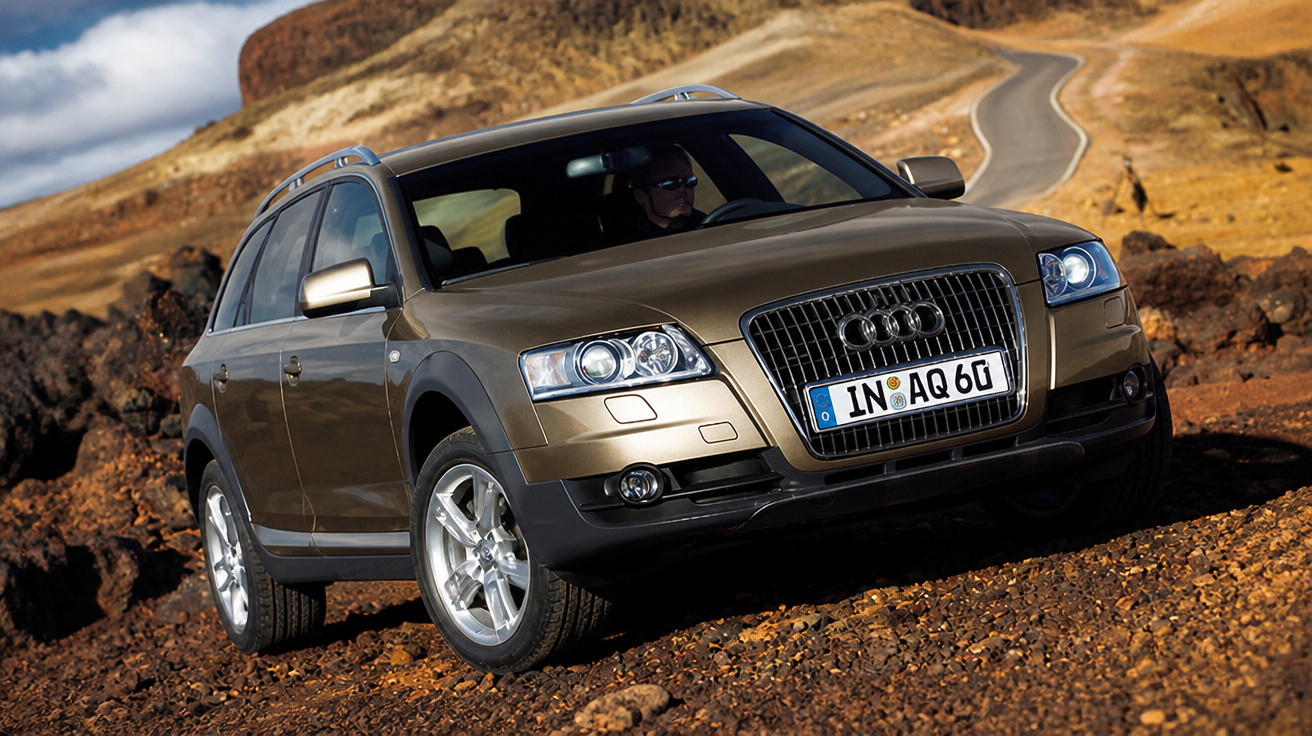
Marketing hyperbole - a particularly infectious disease within the motor industry - is thankfully in limited evidence at the launch of the completely new Audi Allroad.
That may reflect Audi's new, straightforward approach to car sales. More probably, though, a vehicle such as this leaves very little room for nonsense.
The opening press presentation includes a restrained helping of jargon about the car's broad range of talents, while later that evening one German saddled with the difficult job of selling the Allroad to a sceptical British journalist mutters something about an executive niche into his gazpacho.
Audi has, however, avoided any grand lifestyle campaign, and a glance at the numbers makes the reason obvious.
The previous A6 Allroad, introduced in 2000, sold only 6,151 examples in the UK across its full five-year lifespan. For anyone unfamiliar with the shadowy business of automotive sales targets, that is alarmingly close to the traditional Fanny Adams.
The harsh reality, then, is that it is not especially obvious who the Allroad ought to be aimed at.
Corner an Audi executive and ask who will purchase one in an SUV-focused market - particularly when Audi also offers the marginally dearer Q7 - and the discussion soon becomes awkward.
The uncomfortable fact is that most buyers seeking a four-wheel-drive car care much more about an SUV's commanding height, perceived safety and elevated social status than they do about traction or genuine off-road capability.
And if improved grip on the road is all you need, a standard A6 Quattro can be specified for substantially less money.
Audi Allroad: a car for a narrow audience
What, then, will persuade anybody to choose the new Allroad? Probably little beyond the factors that persuaded 6,151 people to buy its predecessor. That does not mean it is anything other than a good car.
Indeed, for the right buyer, it is outstanding. It delivers proper Audi build quality, the familiar tasteful and restrained cabin, plus the capacity to raise the body by as much as 65 millimetres beyond the height of a regular A6 Avant.
Audi's adaptive air suspension is a genuinely smart piece of engineering, with five driving settings selected through the on-board computer. Dynamic drops the body to cut drag and sharpen handling; Automatic sits 15mm higher, although it lowers again when you are pressing on; and Comfort is intended for relaxed motorway travel.
For more challenging terrain, Allroad mode raises ground clearance to 175mm, then progressively reduces it as speed increases. The last setting is Lift, which provides 185mm of manually selected clearance at low speeds, without any subsequent adjustment.
That arrangement also gives the car a 300mm wading depth - an excellent answer to any lingering long-term concerns about global warming.
Suspension, off-road ability and engines
There is a penalty for that suspension, though. The added mass of all the sophisticated hardware brings worse fuel consumption, slower acceleration and a reduced maximum speed. Throw it through bends and the Allroad feels far more cumbersome than an Avant, precisely the trait many estate-car buyers choosing one over an SUV would hope to escape.
Yet the Allroad is not aimed at most buyers. It is not really aimed at many buyers at all. It is intended for a peculiar group who occasionally require the benefits of extra ground clearance but do not want an SUV's image, cost or size. They may well be onto something, too. The point is that the Allroad provides all the SUV capability most of us will ever require.
It remains suitably imposing with the optional 18-inch wheels, exposed stainless-steel underbody protection and extended wheel arches. New details, including the deeper grille and LED brake lights, also set it apart effectively from the previous model.
It is capable of dealing with virtually every off-road situation most drivers are likely to face, while also accelerating and braking better than an SUV and, in theory, being kinder at the fuel pumps.
Both 3.2-litre V6 and 4.2-litre V8 petrol engines are offered, although the nature of this car suggests the V6 diesels will account for the majority of sales. They provide the appropriate compromise between performance and economy, while their additional torque is better suited to those off-road outings.
The 2.7TDI is priced from £33,530 and the 3.0TDI from £36,380, putting it just below the Q7.
The Allroad is also capable of matching an SUV for luxury. Consider leather upholstery and the Bose stereo upgrade, and be sure to select the excellent six-speed tiptronic automatic gearbox.
The cabin is quiet and comfortable, impeccably assembled and likely to prove as hard-wearing as the typical off-roader. Even so, this remains a sizeable case of caveat emptor.
The old Allroad was purchased as a status symbol by a substantial proportion of its owners, but with the Q7 now on sale, Audi has a vehicle to fulfil the poseur's requirements. As a result, this second-generation model could sell even less well than the first. That would be quite an achievement.
The person who wants one now will need it for a distinctly unusual and demanding role. At least they can be confident it will fulfil that role, doing so with polish and relative understatement.
Perhaps Audi ought to promote the Allroad more aggressively, with a little more smoke and mirrors, because it is a capable product that should suit more buyers than the unwieldy and ungainly Q7.
However, the fact that journalists driving the Allroad have been spared the usual spin accompanying a new-car launch implies Audi recognises there is little value in trying.
This is niche in the way that dubious top-shelf magazines with obscured covers are niche. Few people will buy them, but the faithful minority will absolutely adore them.


Comments
No comments yet. Be the first to comment!
Leave a Comment