
A noble species facing extinction
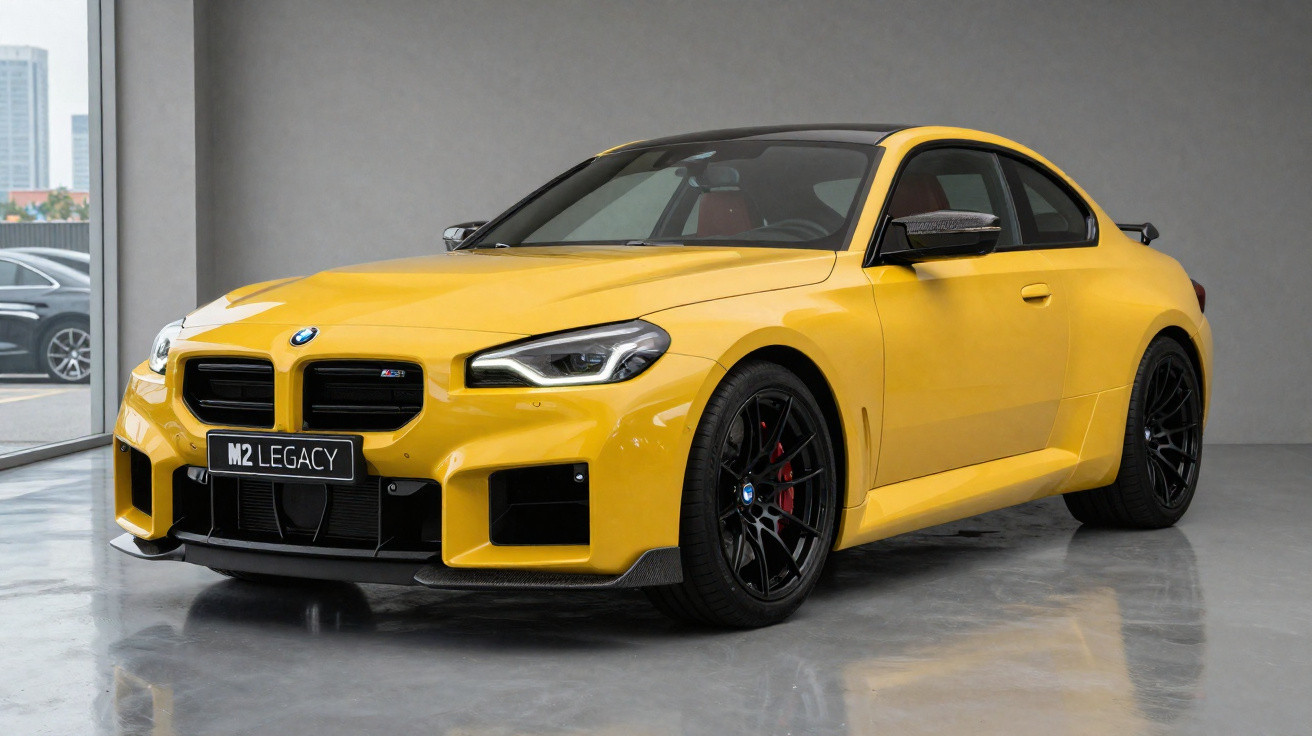
The new BMW M2 is, in itself, cause for celebration. Unless something changes dramatically, it will be among the final petrol-powered sports cars without any electric motor assistance to leave BMW’s Munich factory.
But as I said at the outset, this is not a moment for farewells; it is a time to celebrate. And there is plenty to celebrate in this new BMW M2 (G87).
A 50-year legacy
The new M2 (G87 generation) faithfully follows BMW’s compact sports car tradition: rear-wheel drive, a distinguished engine and finely honed dynamics.
This recipe dates back to 1973 and the 2002 Turbo, a car that earned an outstanding reputation among sports car enthusiasts and still occupies a place in our collective imagination today. The rest, as we know, is history.
Back in the present, the new BMW M2 has rivals even within its own family. The M240i is one, as is the unavoidable M4, which is more powerful than the M2.
Having driven the new M2, I can say that it may be the best choice for anyone seeking a more compact and agile sports car. Power is not everything, and this M2 reminded me precisely of that. First, though, let us consider the styling… seduction begins before we take the wheel.
Dressed to seduce
Its front grille does not have the oversized proportions seen on some of the Bavarian brand’s latest models. That is a positive. Beyond its balanced dimensions, it stands out because it is frameless and features horizontal bars.
The bonnet bulge found on every 2 Series, including the mild-mannered 220i, is larger here, signalling the presence of the straight-six engine. Its appearance is also more aggressive than that of the rest of the 2 Series range.
At the rear, the twin exhaust outlets, subtle rear spoiler and more pronounced bumpers take centre stage. The tracks are 3.6 cm wider at the front and 1.2 cm wider at the rear - the same as those of the M4 Coupé. This is not merely an aesthetic decision; it also benefits the car dynamically.
BMW M2: larger and heavier
The BMW M2 has gained both length and weight, neither of which would initially seem desirable in a sports car. Automatic versions have risen from 1650 kg to 1800 kg, a considerable increase. To offset this, output has climbed from 410 hp to 460 hp.
It is lower, on the other hand, which has helped reduce the centre of gravity in a model that puts “all its chips” on dynamic ability.
According to BMW’s engineers, structural reinforcements also contributed to the M2’s extra mass, delivering a 40% increase in structural rigidity. Around ¼ of that improvement was already present in the M240i compared with the preceding generation.
Those wanting to lower the centre of gravity further while sharpening the M2’s sporting appearance can specify a carbon-fibre roof for 2700 euros. Is it worthwhile? When sports cars are involved, not everything needs to be rational.
A modern cabin for an extrovert exterior
Unsurprisingly, the BMW M2’s interior is based on that of the regular 2 Series, although its 12.3” instrument display and 14.5” infotainment screen sit side by side in a curved arrangement, as first seen in the X7 and i4.
It also uses the latest Operating System 8, while retaining several physical controls between the seats, avoiding the need to work through menus and submenus. I like that.
As is customary in BMW’s sportier models, the small-diameter, thick-rimmed steering wheel has the two familiar M buttons, M1 and M2, for saving settings that can then be called up with great speed and ease.
The seats are trimmed in synthetic leather (Sensatec) and Alcantara, but can be upgraded to more sports-focused items that hold occupants more securely and incorporate integrated head restraints.
They can also be replaced with competition bucket seats featuring a structure partly made from carbon-fibre-reinforced plastic. These save 11 kg and, if they are identical to those in the M4, are very firm and require a degree of agility to get in and out of the car.
In return, they grip the body like limpets to rock and position our waist closer to the ground.
A “mini” BMW M4?
Rear-wheel drive is “mandatory”
In this new generation, the 2 Series Coupé is no longer intrinsically connected to the 1 Series, which has adopted front-wheel drive. Instead, it has become something of a shrunken 4 Series, retaining rear-wheel drive to the delight of the brand’s many enthusiasts.
The 3.0-litre twin-turbo straight-six is the same S58 engine used by the M3 and M4, but with its output reduced to preserve the established “hierarchy”.
Maximum power is now 460 hp, exceeding the 450 hp produced by the previous M2 CS engine.
There are two transmission choices: an eight-speed ZF automatic and a six-speed manual - the latter is a 2328-euro option in Portugal.
As we know, this platform can accommodate four-wheel drive, as demonstrated by the M240i xDrive. That is the configuration chosen by its arch-rivals, the Audi RS 3 and Mercedes-AMG A 45, both of which use a dual-clutch gearbox exclusively.
BMW has taken a different route, choosing rear-wheel drive only for this most extreme M2 version. Fun benefits, as does the overall weight of the package.
A thoroughly revised chassis
The suspension has been reworked with firmer springs at the front and softer ones at the rear. Variable damping is also fitted, using dampers from the M3 Touring to deliver greater agility and enjoyment through corners.
This choice of variable damping helps recover some of the restraint in lateral body movement sacrificed by adopting those softer springs.
As in the M3 and M4, the brake pedal has two settings: one more comfortable for road use and another more aggressive for track driving. The discs are steel, using a tougher alloy with greater heat-dissipation capacity.
Anyone intending to take it to the track more regularly can add the M Drive Professional system, introduced on the M4. It includes M Traction, which allows the stability-control system to be adjusted across 10 levels, and M Drift, which records and assesses statistics from rear-end drifting through corners.
Emotions running high
This first dynamic encounter with the new M2 happened in two distinct stages: first over eight laps of the Salzburgring circuit in Austria, then on public roads in Arizona, USA.
Even on the road, the deep note produced by the exhaust system makes an impression within the first few hundred metres. It is always possible to keep the decibels more civilised and select the softer damping programme, although our instincts tend to favour something else…
Both manual and automatic versions have their respective virtues: the former is more qualitative, the latter more quantitative.
The eight-speed automatic shifts faster and enables a 0–100 km/h time of 4.1s - compared with 4.3s for the manual - while allowing the driver to “dress” as a racing driver and focus entirely on performance.
Titanium paddles also help keep both hands on the steering wheel, making it possible to enjoy the highly accurate and communicative M Servotronic steering to the fullest - especially in its sportiest setting - which combines speed-sensitive assistance with variable steering ratio.
In 80–120 km/h acceleration runs in 4th and 5th gear, the excellent ZF transmission even beats the manual by more than one second and almost two seconds respectively. Only in certain kickdown situations is there a slight hesitation.
With two fewer ratios, the manual gearbox creates greater “intimacy” between driver and car, particularly as its selector is quick and precise, even if engaging gears requires a certain firmness.
Either way, performance in the new BMW M2 is always at an excellent level. Every burst of acceleration is marked by an almost immediate “shot” across the rev range, with only an almost imperceptible delay at lower revs - the familiar turbo lag - until the full 550 Nm becomes available at 2650 rpm.
From that point, torque seems endless - and in fact only begins to “fall away” after 5870 rpm - while the four menacing exhaust outlets celebrate these adrenaline-fuelled moments with a soundtrack rich in low frequencies.
The fuel cut-off arrives at 7200 rpm, although power delivery is already declining above 6250 rpm, where it peaks.
The typically BMW-like, even front-to-rear weight distribution and wider tracks make the handling more precise and stable still. The front end is exceptionally eager to turn and, with measured throttle and steering inputs, there is no sign of understeer, which is good for gaining seconds per lap.
However, the driver must remain alert, because the BMW M2 gives little warning before reaching the limits of grip, at which point the rear can abruptly bring us back to reality. It can make us smile or make us sweat.
In the more “forgiving”, or even “libertine”, traction and stability-control modes, the rear end seems to develop a mind of its own. They are therefore only advisable for circuit use or more secluded places…
Whatever the setting, it remains an intense driving experience, even on public roads. Even something as mundane as starting the engine feels special. The active exhausts and six cylinders never allow us to forget that we are at the wheel of something special.
After handing back the BMW M2 key, I am left with the clear feeling that the BMW M4 once again has a formidable opponent in its younger sibling. When it comes to sports cars, more power is not always synonymous with a more intense experience. That may be the biggest lesson of this no-longer-quite-so-small BMW M2.
Comments
No comments yet. Be the first to comment!
Leave a Comment