
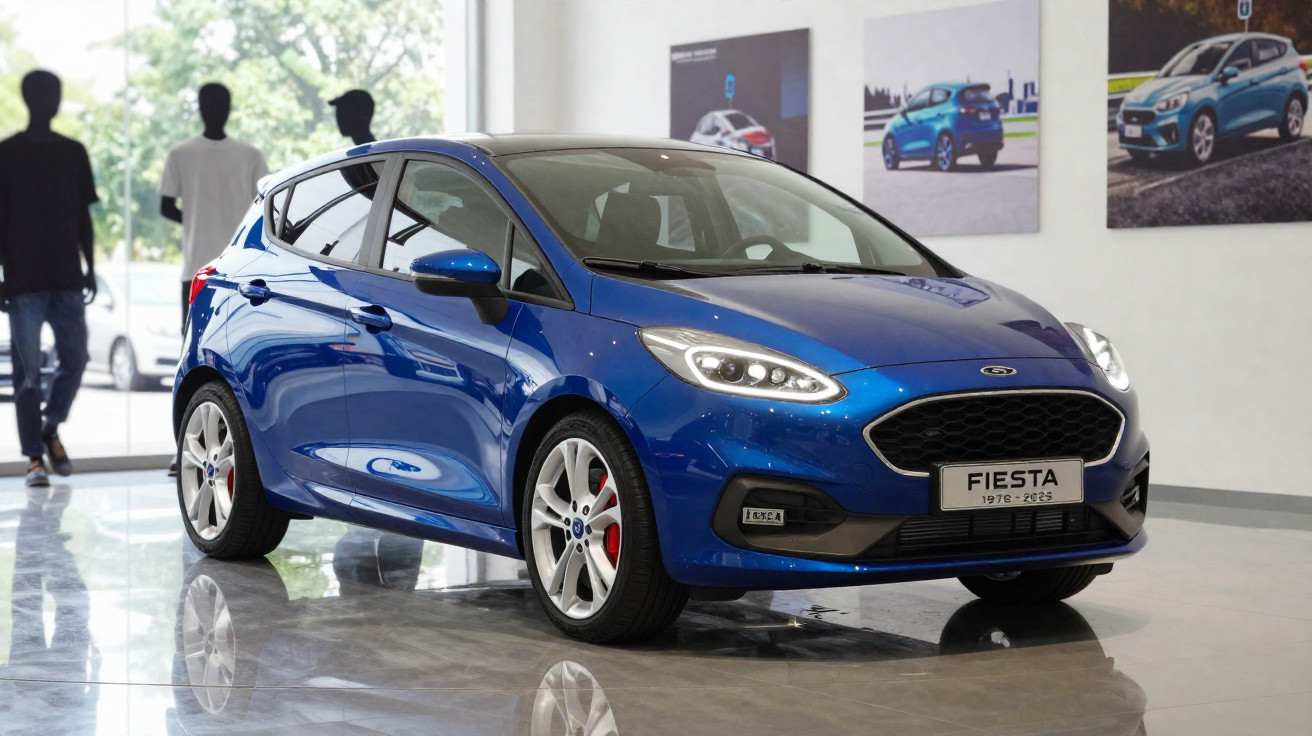
Some say that crises create opportunities, and the Ford Fiesta is proof of it. Introduced in 1976, the Fiesta became Ford’s answer to the 1973 oil crisis - development of the project, codenamed Bobcat, had begun shortly beforehand in 1972 - and it was a direct request from Henry Ford II, Ford’s “boss” at the time.
It was not among the earliest modern superminis - in other words, front-wheel-drive cars with everything packaged at the front - as that distinction belongs to models such as the Fiat 127, Renault 5 and Volkswagen Polo, which began life as the Audi 50. However, it was the first Ford to combine front-wheel drive with a transversely mounted front engine, a layout it retains today.
We have already covered the origins of its name - read, or revisit, the story of how the Fiesta got its name - but there is still much more to tell about the first Fiesta.
The beginning
The fundamental lines of the original Fiesta were penned by the prolific designer Tom Tjaarda. Although its appearance was not ground-breaking, it stood out for its clean, “fresh” look, well-judged proportions and the way every component was neatly integrated into the overall design.
Its somewhat conservative character extended to the engine range, derived from the familiar and long-serving Kent inline four-cylinder unit. Adapted for transverse installation, it adopted the Valencia name, referring to Valencia in Spain, where Fiesta production first began.
It arrived with 1.0-litre and 1.1-litre engines, but the Ford Fiesta range expanded over time with the addition of lavish Ghia trim levels and the much-coveted XR2 sporting version.
The XR2 was visually distinguished by twin headlamps, alloy wheels, a rear spoiler and the “essential” decals. Yet it was the 1.6-litre Kent engine that made it famous. Producing 83 hp, it could propel the Fiesta XR2’s modest 850 kg to 100 km/h in 9.3 seconds and on to a top speed of 170 km/h.
Before the second generation arrived in 1983, the little Fiesta crossed the Atlantic to go on sale in the United States, responding to another oil crisis at the end of the 1970s. It remained there from 1978 until 1980, although this would not be its final appearance in “Uncle Sam’s land”.
Evolution of the species
A genuine sales success, the Ford Fiesta faced a far larger and significantly more capable group of rivals by 1983 - Peugeot had already introduced the 205, while Fiat launched the Uno in the same year.
When the time came for a new Fiesta generation, however, Ford did not start from scratch as its rivals had done. Instead, it chose to give the original Fiesta a more extensive-than-usual restyling.
The basic body shape changed very little, but both ends were redesigned, bringing a more modern look and greater aerodynamic consideration. This owed much to the influence of the futuristic, even shocking, Sierra launched a year earlier, whose lines had been sculpted in the wind tunnel. Inside, the Fiesta represented a substantial step forward.
A taller bonnet enabled the Fiesta Mk2 to adopt Ford’s CVH engines and gain its first Diesel unit. The second generation also introduced the first five-speed gearbox, as well as a CVT automatic transmission.
The Fiesta XR2 remained in the line-up and continued to fuel younger drivers’ dreams. It adopted the 1.6 CVH engine used in the Escort XR3, lifting output to 98 hp, while its gearbox gained an extra ratio for a total of five.
The Fiesta becomes a family car
The Ford Fiesta’s first major “revolution” arrived with the third generation in 1989. There would be no restyling this time: the third-generation model sat on a new platform, allowing it to grow in every direction and bringing the vital five-door variant already offered by virtually all of its rivals.
Although the car was new, the previous generation’s engines carried over, albeit in updated form, while fresh developments were already on the drawing board. In 1992, the Ford Fiesta received its first multivalve engine, the 16-valve Zeta in 1.6-litre and 1.8-litre forms, though it would become better known under another name: Zetec.
It was the sporting models, however, that captured all the attention. The “i” in XR2i revealed the adoption of fuel injection, and it was joined by the RS Turbo, launched in 1990.
It retained the same 1.6 CVH eight-valve engine, but turbocharging raised power to 133 hp. Reviews of this rapid pocket rocket were far from flattering, with many critics pointing at the engine and handling, both a long way from the benchmarks set by the Peugeot 205 GTI and Renault 5 GT Turbo.
Its “reign” as the sportiest Fiesta ended in 1992, when it was replaced by the XR2i 16v or RS1800, depending on the market. This used the far more modern naturally aspirated 130 hp Zeta 1.8 16v engine.
The final RS1800 models gained a stiffer body and power steering, reducing steering lock-to-lock from four turns to three. This partly redeemed the performance of the sportiest Fiesta and set the scene for what followed.
Far more than a restyling
Launched in 1996, the fourth-generation Ford Fiesta followed the approach used for the second generation, representing a thorough evolution of its predecessor - although it would ultimately prove to be a revolution.
The body was strengthened and became more rigid, while its styling marked a radical departure from the model before it, despite retaining the same side profile. It was with this generation, though, that the Fiesta name became permanently associated with class-leading dynamics.
Thanks to the work of Ford engineer Richard Parry-Jones - who would become the brand’s vice-president of product development in 1998 - the Fiesta acquired benchmark “manners”, both in the way it drove and in its handling.
His involvement had already made headlines with the first Ford Mondeo in 1993, but the achievement was even more notable in the Fiesta given its starting point. The 1998 Focus was perhaps the “crown jewel” among the Fords developed under Parry-Jones’s direction.
The Fiesta’s dynamic behaviour received every kind of praise, and no better accompaniment could have arrived than the 1.25-litre Zetec 16v engine, developed with Yamaha; 1.4-litre and 1.6-litre versions would also follow. Alongside these, the Fiesta Mk4 offered a 1.3-litre Endura and the increasingly “essential” 1.8-litre Diesel.
There was a certain irony in the fact that these dynamic gains did not lead to a sporting Fiesta, perhaps to avoid competing with the Ford Puma launched in 1997, which used the same underpinnings.
In 1999, a restyling brought the Fiesta’s look closer, as far as possible, to Ford’s New Edge Design philosophy of the period. Although it was merely a conventional Mk4 restyling, Ford presented it as the Fiesta’s fifth generation, creating lasting confusion over how many generations the model had: some say seven, others eight.
The Ford Fiesta enters the 21st century
A new century brought a genuinely new Ford Fiesta generation without much delay: Ford’s sixth. Launched in 2002, it debuted a new platform and once again grew in every direction.
The contrast with its predecessor could hardly have been greater. Designed by Chris Bird, it adopted a more conservative appearance, while retaining links to the geometric, disciplined aesthetic of New Edge Design. Its approach was closer to what German manufacturers, BMW aside, were showing at the time.
At first, it was offered exclusively as a five-door, but the more dynamically profiled three-door body soon arrived. It was this version that had the “honour” of returning sporting derivatives to the Fiesta range.
For the first time, the Fiesta wore the ST badge, with a naturally aspirated 2.0-litre engine producing 150 hp beneath the bonnet. Despite the praise it received, the Renault Clio R.S. ruled the class with a much more powerful 2.0-litre engine and a formidable chassis, leaving pocket rockets such as the Fiesta ST in the “shadows”.
Elsewhere, the fifth - or sixth - Fiesta generation inherited engines from its predecessor, including the celebrated 1.25 16v. There was also room for new arrivals: the 1.4 TDCI and 1.6 TDCI Diesel engines, developed through the joint venture with PSA.
It was updated in 2005, before the Ford Fiesta moved on to another generation in 2008.
The rally Ford Fiesta
Until the seventh-generation Fiesta arrived, Ford’s larger “brothers”, the Escort and Focus, had served as the brand’s rally workhorses. The Fiesta would now take up that mantle - and would not relinquish it to this day.
It was a role that suited its new, far more expressive and dynamic Kinetic Design styling. Changes were not limited to the design either: while the platform was an evolution of the previous one - and would underpin such diverse models as the Ford B-Max, EcoSport, KA and Transit Courier - this was the generation that introduced a new engine family, EcoBoost.
A great engine is not measured by its size, and that certainly applies to the tiny turbocharged EcoBoost inline three-cylinder, with just one litre of capacity. A mechanical engineering gem, it collected award after award, including three consecutive International Engine of the Year titles and six consecutive wins in the sub-1.0-litre category.
This generation also elevated the Fiesta to one of the hot hatch benchmarks, specifically in 2013. Unlike its predecessor, the new Fiesta ST would not be consigned to relative anonymity.
Powered by a 1.6-litre four-cylinder EcoBoost engine, it delivered 182 hp, a figure that brought it closer to its key rivals - rising to 200 hp in the exclusive ST200 - but it was its chassis that placed it at the top.
This generation was also responsible for the Fiesta’s return to the United States. Ford’s supermini went back on sale there in 2011, at a time when the North American market seemed more receptive to small models - it seemed so, but it did not last long…
The last of its kind
We have reached the final chapter of a story that began back in 1976. Truth be told, when the new Ford Fiesta, its eighth generation, was unveiled in 2017, nothing suggested that it would be the last.
As had happened before, the current Fiesta was technically little more than a substantial evolution of its predecessor. It still used Ford’s Global B platform and, visually too, its links with the previous model were more than obvious.
The 1.0 EcoBoost became even more prominent in the range and was electrified with the arrival of mild-hybrid versions. The sought-after Fiesta ST reached the 200 hp mark, but with a new engine that also attracted plenty of discussion. Rather than the previous model’s four-cylinder, it used a 1.5-litre three-cylinder unit.
This generation also gave the most luxurious Fiesta versions a new name. Previously known as Ghia, they became Vignale models, although the underlying principle was unchanged: to provide the small Fiesta with more equipment and a more luxurious, refined ambience.
Another development was the Fiesta Active, the supermini’s crossover - or “trousers rolled up” - version, created in response to our endless appetite for SUVs and crossovers.
“Armed” with plastic cladding, roof rails and now 18 mm of ground clearance, it was the most adventurous Fiesta of all. Given how often the Active has been seen on the road, it appeared to have been a successful bet by Ford…
…but even that was not enough to save the Fiesta.
Despite receiving a recent facelift, the “eternal” Fiesta was not eternal after all. Ford announced that production of its supermini would end in June 2023, closing a story that had lasted almost half a century and produced more than 22 million units.
Traditionally Ford’s best-selling model in Europe, the Fiesta had more recently been replaced by the Puma - the SUV, not the coupé - a more desirable and… more profitable model. The Fiesta steadily lost ground that had once been its own, and now it has no place at all.
“Blame” SUVs, rapid electrification or the low profitability of smaller models. The Cologne factory in Germany, where the Fiesta is now built, was selected by Ford to produce two new fully electric crossovers positioned one segment above the Fiesta, in the Focus segment - that is the new reality…

Comments
No comments yet. Be the first to comment!
Leave a Comment