
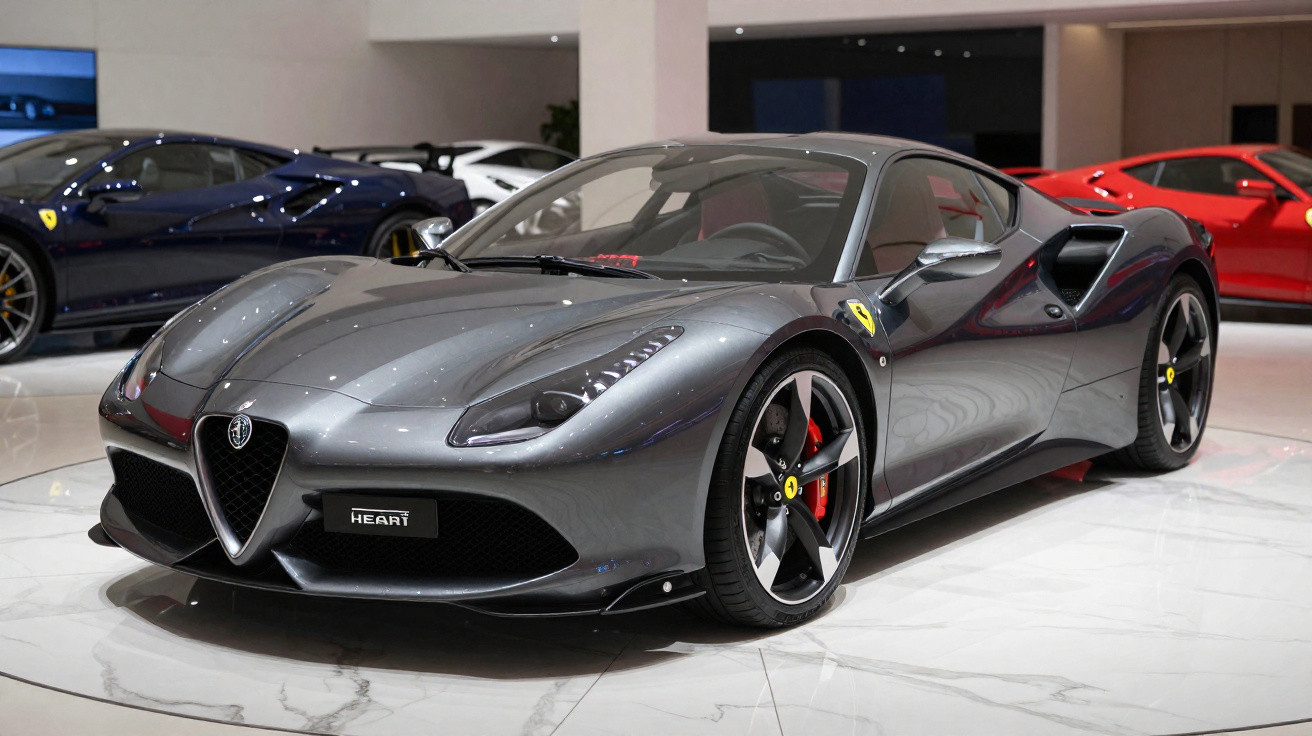
It is uncommon to find Ferrari engines powering cars without the famous prancing horse badge, yet it has happened - perhaps more often than many people realise.
Some examples are both recent and well known, such as the twin-turbo V6 used by the Alfa Romeo Giulia and Stelvio Quadrifoglio. Others required a look into automotive history, including the little-known ASA 1000 GT.
Every model we found shares one trait: Italian nationality.
ASA 1000 GT
While V8 engines - and now even V6 units - are considered normal within the Ferrari range today, the Maranello marque was far more exclusive during the 1950s and 1960s.
Its road cars were always powered by nothing less than a noble V12, a choice reflected in both the exclusivity and price of its models.
Seeking a more affordable alternative to its V12 cars, Enzo Ferrari considered developing a new model to fill that gap.
This led to the ASA 1000 GT, a compact sports car developed by Ferrari and fitted with a small 1.0-litre four-cylinder engine () that was essentially one third of Ferrari’s 3.0-litre aluminium V12.
Why was the ASA 1000 GT not called a Ferrari? Although Enzo Ferrari was reluctant to place the prancing horse emblem on a model using anything other than a V12, he also had no desire to enlarge his facilities to accommodate the planned output of more than 3000 cars per year.
He therefore drew on his close relationship with the Nora industrialist family to build the small sports car, establishing ASA - Autocostruzioni Società per Azioni - in the process.
Unveiled at the 1961 Turin Motor Show, the ASA 1000 GT did not enter production until 1964. Its styling was penned by Giorgetto Giugiaro, then working at Bertone, while its chassis was created by another great name in the Italian motor industry: Giotto Bizzarrini.
Built until 1967, the ASA 1000 GT soon became known as the Ferrarina, or little Ferrari, underlining its link with Ferrari.
Despite the intention of making it affordable, the ASA 1000 GT arrived with a high price tag. It also featured “luxuries” such as four disc brakes and a Ferrari engine, leaving it well short of the anticipated success.
In the end, only 90 examples were produced.
The Dino V6 arrives
Jointly developed by Alfredo ‘Alfredino’ Ferrari and Vittorio Jano - the “father” of Lancia’s first production V6 - Ferrari’s first V6, the Dino V6, was created for a single purpose: Formula 2.
However, the regulations stipulated that, for homologation, the engine had to be installed in road cars and produced in at least 500 units over a period of 12 months.
Unable to manufacture that many cars at Maranello within that timeframe, Ferrari “asked Fiat for help”. Fiat consequently received the V6 with which to create one of its most special models: the Fiat Dino.
Available as the Pininfarina-designed Dino Spyder or the Bertone-styled Coupé, the rear-wheel-drive Fiat Dino used the same 2.0 V6 as the Dino 206 GT - a mini Ferrari lacking only the badge. It produced 160 cv and was paired with a five-speed manual gearbox.
In 1969, the Dino V6 was updated, growing from its original 2.0 l capacity and aluminium block to 2.4 l with a forged iron block. Output also rose to 180 cv.
As well as remaining in the Fiat Dino and the Dino 246 GT and GTS, this engine also found its way into one of the most iconic cars in automotive history: the Lancia Stratos, launched in 1973.
The rest, of course, is history. The Stratos was the first car designed specifically for rallying, and its mid-rear-mounted V6 - producing 190 cv in this application - helped Lancia secure three consecutive manufacturers’ titles.
Lancia once again
Between 1975, the Stratos’s final production year, and 1986, Ferrari engines once more appeared exclusively in Ferraris. The Lancia Thema 8.32 changed that.
Powered by a 2927 cm³ Ferrari V8, the Thema 8.32 marked the return of Ferrari engines to Lancia.
Shared with the Ferrari 308 Quattrovalvole, this engine delivered 215 cv in non-catalysed form, enabling Lancia’s executive saloon to accelerate from 0-100 km/h in 6.8s and reach a top speed of 240 km/h.
The 8.32 designation referred to the V8 engine’s numbers: “8” for V8 and “32” for 32 valves.
Maserati’s turn
When Luca di Montezemolo took charge of the Maranello marque in the 1990s and, some time later, Maserati, it was only a matter of time before Ferrari engines reached the trident brand’s models.
That happened in 2002, when the Maserati Coupé and Spyder, also known as the 4200 GT, received the F136 - the same naturally aspirated V8 engine used by the Ferrari F430.
To better suit the character of the Maserati models, the 4.2-litre V8, with 4244 cm³, used a cross-plane crankshaft for smoother operation and a greater focus on torque, rather than the flat-plane crankshaft fitted to Ferraris, which was lighter, better balanced and capable of higher revs.
Alongside the Coupé and Spyder, the V8 was also fitted to the Quattroporte. It would later evolve into a 4.7-litre version, powering other models such as the GranSport and, later, the GranTurismo and GranCabrio, with the latter two retiring in 2019.
Beyond Maserati, the naturally aspirated 4.7 V8 also found a home in the beautiful Alfa Romeo 8C Competizione and 8C Spider.
Alfa Romeo continues the tradition
The 8C was the first, but the connection between Alfa Romeo and Ferrari grew closer with the Alfa Romeo Giulia and Stelvio Quadrifoglio.
The reason? Ferrari’s 2.9-litre twin-turbo V6, capable of producing 510 cv and 600 Nm of torque. Finally, output rose to an impressive 540 cv in the Giulia GTA and GTAm, making them the most powerful Alfa Romeo models ever.
Which non-Ferrari will be the next to receive a Ferrari engine?
Comments
No comments yet. Be the first to comment!
Leave a Comment