
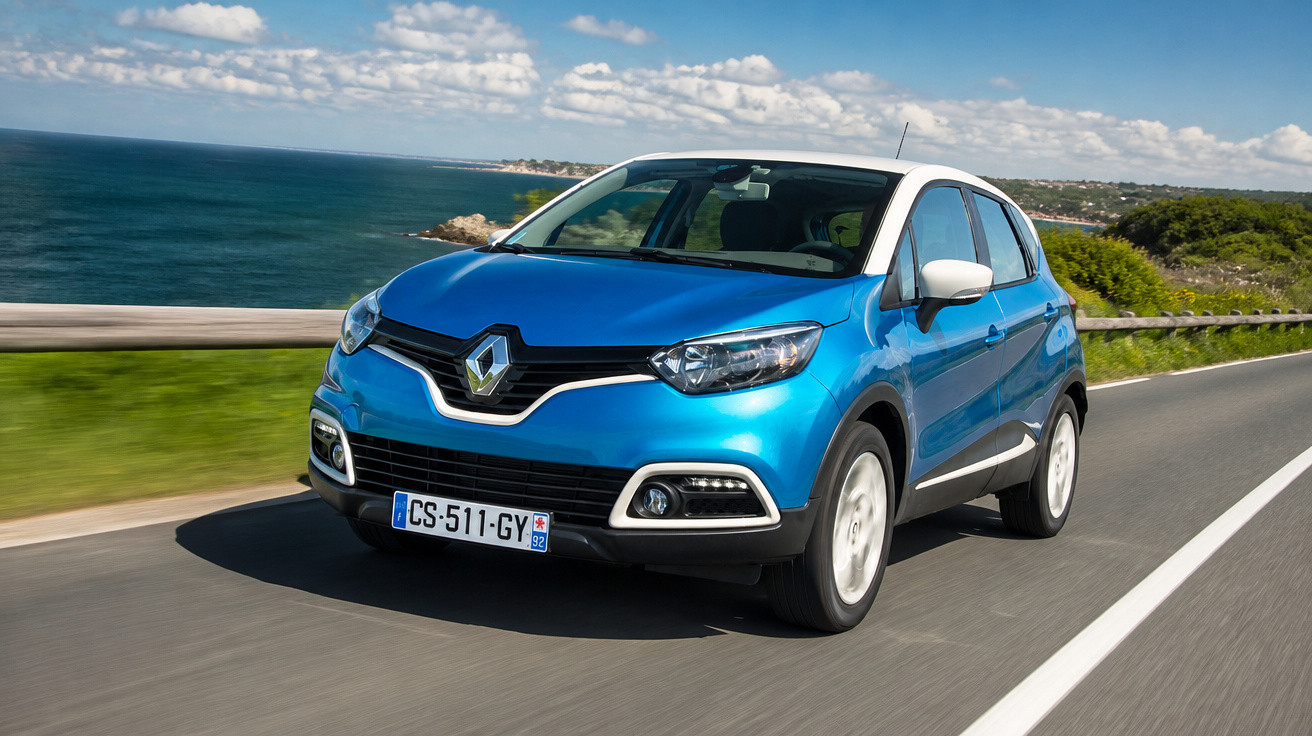
The bandwagon is gathering pace. Six entirely new small crossovers have already been announced this year alone, making the direction of travel obvious. By comparison, only three new saloons have appeared, with most aimed at China. European buyers are changing their preferences: compact SUVs are popular, while baby crossovers are the latest craze. Essentially, they are elevated superminis – generally front-wheel drive, with a higher seating position and a clear focus on young families. It is a formula established by the Nissan Juke.
Renault’s entrant is the Captur (pronounced ‘capture’), and its late arrival is perhaps the only unusual aspect of the car. The French manufacturer has a history of creating successful family-focused segments – the Scenic and Espace demonstrate that well enough – so a family-friendly soft-roader might have been expected years earlier. This is particularly true because Renault’s partner Nissan launched the Qashqai in 2007 and followed it with the Juke in 2010, setting the template some time ago. Developing the tooling for an all-new car is not a quick job, of course, but still…
There is little point grumbling now. The Captur has arrived, and Renault has ambitious expectations: it believes the model will become its second-best-selling car in the UK, behind the Clio that provides its basis.
Renault Captur engines, performance and economy
The specifications offer no obvious reason to question that prediction. At launch, the Captur comes with three turbocharged engines – two petrol units and one diesel – which will not set pulses racing but all offer worthwhile environmental credentials. The petrol range consists of an 898cc 3cyl producing 89bhp and a 1.2 4cyl with 119bhp, while the diesel is a 1.5 four pot delivering 89bhp. Every one of them is borrowed from the Clio. A dual-clutch gearbox is also offered with the more powerful petrol engine and the diesel.
None could be described as quick. No Captur completes 0–62mph in under 10 seconds, while the diesel requires 12.6secs. In everyday use, however, that is largely beside the point: it is termed a soft-roader for good reason, and it is difficult to picture owners calling at a drag strip between the supermarket and the school run.
What is more, the diesel and the 119bhp petrol both feel less lethargic than their acceleration figures imply. Each has a helpful amount of pulling power – 162lb ft in the diesel and 140lb ft in the petrol – and either can comfortably keep pace with motorway traffic. The notably low 1,170kg kerbweight plays a part here. Driving the Captur is not thrilling, but it fulfils its intended purpose.
For prospective buyers, its green credentials will matter more. The 1.5 dCi Captur achieves an impressive 76.4mpg and produces only 96g/km of CO₂. Even the higher-output petrol delivers 52.3mpg and CO₂ emissions of 125g/km respectively. An Eco button positioned behind the gearlever limits the engine torque available and adjusts the climate control as well, producing a 10 per cent reduction in real-world fuel consumption. That is a worthwhile extra.
Renault Captur comfort and family space
With all of that in mind, its lack of driving excitement should not be unexpected. You sit substantially higher than in a Clio – the Captur is 118mm taller – and the added body roll is very apparent in bends. The electrically assisted steering also provides absolutely no feedback. For buyers prioritising security over enjoyment, though, the Captur fits the brief perfectly.
Then again, potential customers are unlikely to mind. TopGear might favour something more spirited, yet the Captur is both composed and comfortable. It is quiet enough to rival any premium car: road noise is almost absent and engine sound is effectively muffled. You will not need to speak any louder than usual when telling the children to behave.
In fairness, the Captur’s priorities are firmly centred on children – blame them for the absence of the Juke’s sharper handling. To preserve cabin room, contain costs and maximise family usability, Renault chose the front-wheel-drive-only Clio IV platform. The company did consider the Juke’s 4wd foundations, but they consumed too much valuable interior space. The Juke is more energetic to drive, but its cabin is nowhere near as roomy as the Captur’s. You pays your money…
The rear accommodation really is generous. Four adults have more than sufficient headroom and legroom, while the rear seats slide backwards and forwards, allowing owners to favour either boot capacity or passenger room.
It does have shortcomings, though. The seat covers can be unzipped and removed when a child, dog or irresponsible husband soils the upholstery, but Renault appears to have missed an opportunity by not designing a more ingenious cabin. There is no underfloor storage, no bin between the front seats, and the five-litre glovebox is no more than average. When a manufacturer builds a family-centred car at the expense of driving fun, it ought to deliver in this area. Renault pioneered the useful cubbyhole with the Scenic, so the Captur almost seems to have forgotten its MPV heritage.
Renault Captur personalisation, prices and rivals
Instead, Renault seems determined to provide as much personalisation as it can. Four trim levels are offered – Expression, Expression+, Dynamique MediaNav and Dynamique S MediaNav – and each is divided further into three ‘themed collections’: Arizona, Manhattan and Miami. Has somebody at Renault been at the marketing smelling salts?
More confusingly still, those three collections are each split into a further four packs: colour, exterior gloss, interior touch and style. This creates nearly 500 possible combinations, including contemporary fashion touches such as contrasting roof colours and conspicuous alloy wheels. Ordering one may therefore take some time, although the benefit is that your Captur is unlikely to match your neighbour’s.
The problem is that it all feels like surface treatment. Customers increasingly want personalisation, even from mass-market cars, so Renault can hardly be criticised for supplying it. Yet it feels as if more effort has gone into this than into engineering details such as practical storage spaces or making the Captur more rewarding to drive. Its brochures even devote 11 pages to the ‘collections’, compared with only five pages for the engines.
For anyone shopping in this class, the Captur matches any current alternative. It looks smart enough, offers comfort, costs little to run and is affordable to purchase, with prices beginning at only £12,495. That is as inexpensive as its competitors, making it a viable substitute for a conventional supermini or MPV.
Considering the latter comparison, its lack of stronger MPV qualities is disappointing. There is limited depth beneath the styling and Americana-esque collections, while this part of the market will only expand over the coming couple of years.
Consequently, there is a concern that the Captur may find it difficult to match newer arrivals as they enter the market. Within the next 12 months, buyers will have eight of these vehicles to choose from. The Renault is currently among the best, but it is unlikely to stay there.
Comments
No comments yet. Be the first to comment!
Leave a Comment