
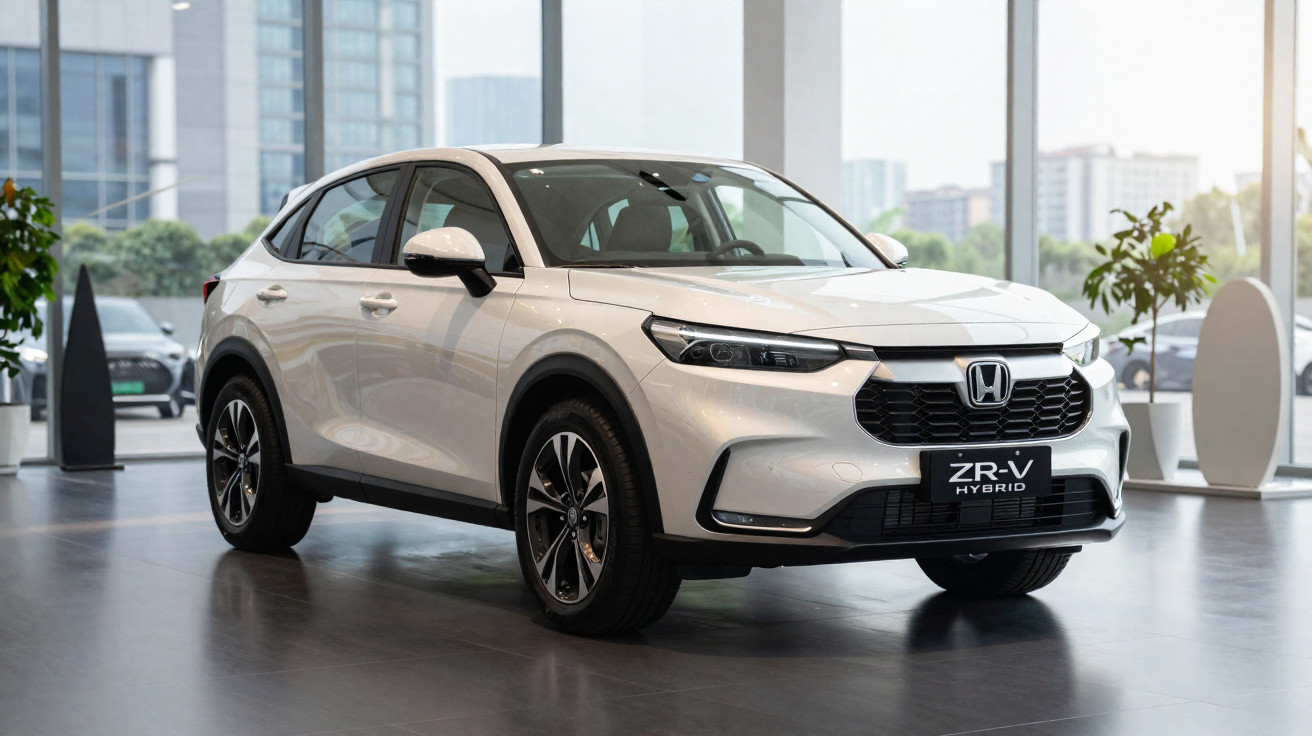
Honda will introduce three new SUVs in Europe before the end of this year. They include the all-new ZR-V, alongside the new CR-V, which will grow considerably, and the e:Ny1, a fully electric offering.
The ZR-V was the first of the trio we saw in person and drove in Barcelona, Spain. Curiously, however, it will be the last to reach the Portuguese market, with its arrival scheduled only towards the end of the year, in November or December.
Our first-drive video will be available over the coming days. Until that content arrives on our YouTube channel, this article covers everything you need to know about the Honda ZR-V.
What is it?
Positioned between the HR-V and CR-V, the ZR-V arrives with high expectations as it enters one of Europe’s best-selling segments. It is a C-segment SUV and effectively serves as a companion model to the Civic, with which it shares its platform and hybrid system.
Hybrid version only
The hybrid system is the natural place to begin, as it is one of the key strengths of this entirely new model. Honda has not unveiled a new model that was not a replacement for an existing one since the Honda e.
As mentioned above, the ZR-V uses the same hybrid set-up as the Civic. It pairs a naturally aspirated 2.0-litre four-cylinder petrol engine running on the Atkinson cycle, producing 143 hp and 186 Nm, with two electric motors. One of these provides propulsion and delivers 184 hp of maximum power and 315 Nm of maximum torque.
These figures allow the Honda ZR-V to accelerate from 0 to 100 km/h in 7.9s, while top speed is set at 173 km/h. Honda quotes combined fuel consumption of 5.8 l/100 km and CO2 emissions of just 131 g/km.
How does the Honda ZR-V hybrid system work?
The ZR-V’s hybrid system operates in three modes: EV Drive, Hybrid Drive and Engine Drive. In none of these modes do the electric motor and petrol engine both take responsibility for driving the wheels at the same time.
The system itself selects the most suitable operating mode for each situation. In urban driving, it is possible to travel almost entirely in fully electric mode, provided there is stored energy in the battery, which has a 1.05 kWh capacity, and the speed remains relatively low.
In this situation, the electric motor alone propels the Honda ZR-V, much like in a fully electric vehicle.
When the pace increases and more performance is required, the electric motor needs additional energy. The petrol engine is then brought into action as an electricity generator, capable of both supplying the electric motor and recharging the battery.
Finally, when travelling at higher, steadier speeds, such as on a motorway, the system selects Engine Drive mode, placing all propulsion duties with the petrol engine.
A fixed-ratio transmission manages this entire process, and it proved notably smooth and pleasant in operation during our first drive of the new Honda ZR-V through the streets of Barcelona. We will return to that, as well as fuel consumption, in a few days.
Less aggressive styling
Unlike the approach adopted elsewhere in the industry, Honda has chosen not to follow the trend for sharper, more aggressive lines. Instead, it has favoured softer, more rounded shapes.
Even so, one look at the front reveals that the ZR-V differs from the designs Honda has recently shown us. The grille is relatively small, while the headlights have an “L” shape.
At the rear, the horizontal light clusters and substantial bumper stand out, with the same rounded form found at the front also carried over here.
Viewed from the side, the wheel-arch cladding, 18-inch alloy wheels, typically SUV-like bodywork and generous proportions for the segment are immediately noticeable. It measures 4.56 metres long, 22 cm more than the HR-V, 1.62 metres high and 1.84 metres wide.
Honda ZR-V interior closely follows the Civic
Inside, aside from the higher centre console with its new storage areas, the cabin is almost an exact copy of the Civic’s. This is immediately apparent from the steering wheel and dashboard, which retain the horizontal design, physical controls and grille familiar from the Japanese brand’s hatchback.
The centrepiece is a 9-inch infotainment display, complemented by a fully digital instrument cluster offered in two different sizes: 7 inches in the Sport trim level and 10.2 inches in the Advance version.
In the rear, there is decent room for both legs and heads, although the doors do not open particularly wide, making access slightly more difficult. The seats are fixed and their backrest angle cannot be adjusted, but there are two USB ports and rear air vents.
What about the boot?
For me, this is one of the Honda ZR-V’s less convincing areas, as it falls short of much of the competition. The boot, which has electric opening as standard, offers 380 litres of capacity. The Advance version loses 10 litres because of the Bose sound system’s subwoofer.
Although it is wide and deep, the boot is shallow due to the battery’s position, which limits its practicality. However, the parcel shelf can be stored beneath the floor and the rear seats can be folded down, increasing capacity to close to 900 litres.
When will it arrive and how much will it cost?
The Honda ZR-V will reach Portugal at the end of the year, in November or December, in two trim levels: Sport and Advance.
Prices for the Portuguese market have not yet been confirmed, but Honda representatives in the country indicate a starting price between €45,000 and €50,000.
Comments
No comments yet. Be the first to comment!
Leave a Comment