
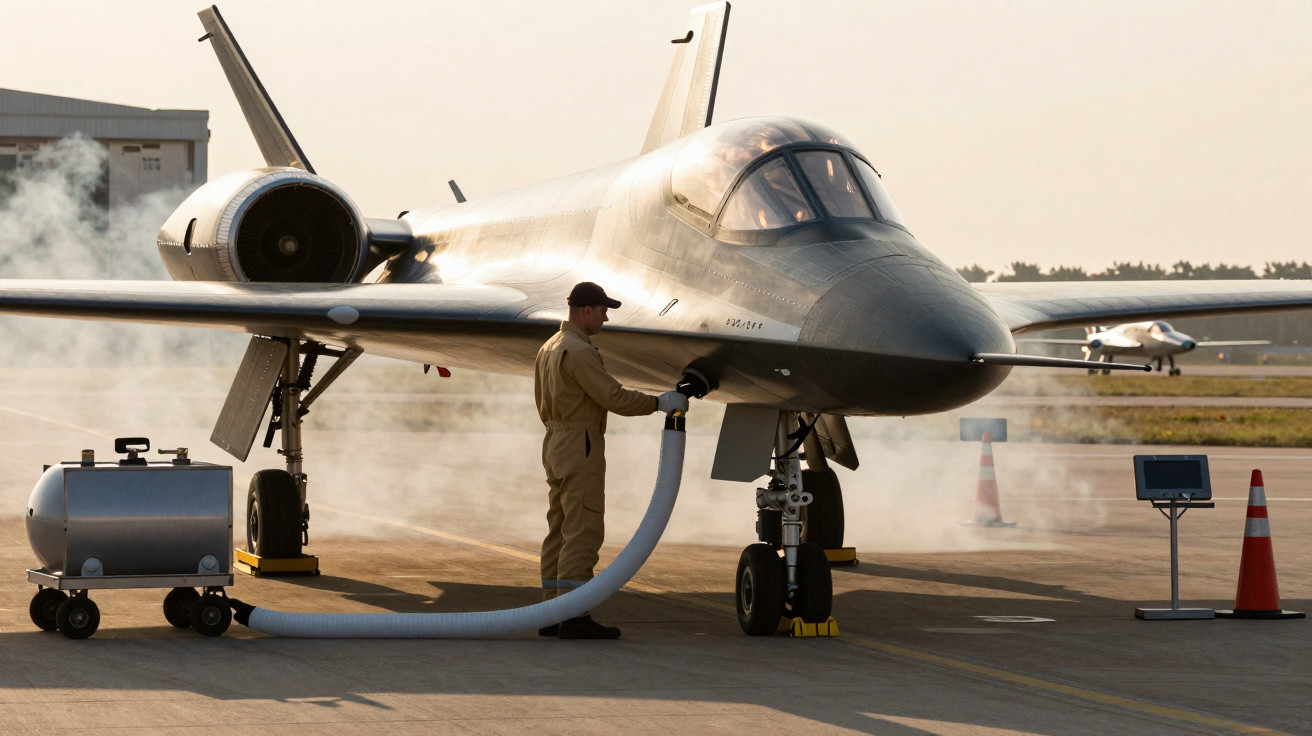
Long after the iconic SR-71 Blackbird established the standard for rapid, high-altitude surveillance, engineers are developing a successor that replaces roaring kerosene with chilled liquid hydrogen and targets speeds that seem almost unbelievable.
A hypersonic race with a new frontrunner
In Washington, Beijing and Moscow, hypersonic weapons command attention in both briefings and budgets. Glide vehicles, manoeuvrable warheads and advanced missiles tend to dominate the news. However, Australian start-up Hypersonix is pursuing a different route: a reusable aircraft driven by a hydrogen-fuelled scramjet engine.
Its ambition is easy to describe but exceptionally difficult to deliver: sustained flight from Mach 5 to Mach 10 and beyond, without carbon emissions from its engine.
Hypersonix wants a reusable hypersonic aircraft that outpaces missiles, carries useful payloads, and runs on green hydrogen instead of jet fuel.
This places the business in an unusual category. The majority of hypersonic programmes are disposable weapons using toxic propellants that ultimately become wreckage. Hypersonix instead seeks to create something more akin to an aircraft programme than a missile programme.
From Blackbird to Spartan: a different engine
The SR-71 Blackbird, which was withdrawn from service in the late 1990s, was capable of around Mach 3.2. Its titanium body and sophisticated turbo-ramjet engines continue to impress aerospace engineers. This emerging rival is intended to exceed more than three times that speed.
The 3D-printed Spartan scramjet
At the heart of Hypersonix’s technology is Spartan, a scramjet engine. A scramjet is an “air-breathing” engine that compresses incoming air at hypersonic velocity, combines it with fuel and burns the mixture while airflow remains supersonic.
In contrast with a conventional jet engine, it has no rotating compressor blades at its intake. Instead, compression is achieved solely by the engine’s geometry, using extreme speed and precisely formed inlets.
Spartan is designed for a speed range from about Mach 5 up to around Mach 12, using hydrogen as fuel and relying heavily on 3D‑printed high‑temperature alloys.
Additive manufacturing is used to produce the engine, enabling engineers to print complex internal cooling passages and strengthened metal structures. This is essential when surface temperatures may exceed 1,800 °C.
- Engine type: hydrogen-fuelled scramjet
- Speed range: roughly Mach 5–Mach 12
- Construction: 3D-printed high-temperature alloys and advanced composites
- Fuel: liquid hydrogen, ideally produced as green hydrogen
DART AE: demonstrating clean hypersonic flight
To prove the concept extends beyond presentation slides, Hypersonix is preparing a demonstrator named DART AE. Measuring about 3.5 metres in length, the vehicle is intended to assess a complete hypersonic flight profile, covering engine operation, thermal stresses and guidance at extreme velocity.
DART AE is scheduled to launch from NASA’s Wallops Flight Facility on the east coast of the United States. A rocket booster will initially accelerate it to the altitude and speed at which the scramjet can ignite. Spartan can then assume propulsion and accelerate the aircraft into the hypersonic range.
Should DART AE fly as intended, it would rank among the first hypersonic test aircraft powered by so-called green hydrogen, made using renewable electricity rather than fossil gas.
Military, space and ultra-fast travel from one platform
Triple market: war, orbit and business travel
Hypersonix describes a “triple market” for the technology, bringing together military, space and civilian applications on one underlying platform.
Its Delta Velos concept is a reusable hypersonic aircraft that could place approximately 50 kg of payload into low Earth orbit. It would launch atop a rocket booster, ignite its scramjet after reaching hypersonic speed, then deploy a small satellite or research payload.
Away from orbital operations, defence customers are particularly interested in three principal functions:
- High-speed reconnaissance: a Blackbird successor capable of entering defended airspace, collecting intelligence and leaving before interceptors can respond.
- Hypersonic testbed: a reusable aircraft for testing sensors, materials and weapons at speed, without launching a missile on every occasion.
- Rapid logistics: transporting vital parts or equipment between continents within hours.
Commercial aviation remains a longer-term element of these ambitions. If the technology can be shown to be safe, operators already envisage New York–Tokyo in under two hours, or Sydney–Los Angeles in fewer than three.
At Mach 10, a transpacific journey that now takes half a day could shrink to the length of a long business meeting.
Why hydrogen alters the equation
At hypersonic velocity, hydrogen brings notable benefits. Its energy content per kilogram is extremely high, and its combustion is clean, producing principally water vapour.
It can also simplify thermal management. Hydrogen may circulate around the engine and airframe, absorbing heat before combustion and serving as an internal coolant. For an aircraft skin subjected to hypersonic friction, that cooling circuit could determine whether the structure survives or fails.
The challenge of storage
Hydrogen’s drawback is its low density. Carrying sufficient fuel requires either very large tanks or hydrogen maintained as a super-cold liquid at approximately −253 °C.
Cryogenic tanks have to be strongly insulated and structurally robust, while remaining light enough for flight. Boil-off or leaks waste fuel and may introduce safety hazards. Integrating large frozen tanks into a streamlined hypersonic fuselage is a major engineering challenge.
Businesses including H2 Clipper are developing wider hydrogen logistics, including long-range hydrogen transport aircraft, substantial storage facilities and even purpose-built airships. For hypersonic jets, the expectation is that lower green hydrogen costs by around 2030 could make routine operations commercially viable rather than an expensive science-project luxury.
| Year | Milestone targeted |
|---|---|
| 2025 | Test flights of the DART AE hypersonic demonstrator |
| 2027 | Development phase for reusable Delta Velos vehicle |
| 2030 | Projected drop in green hydrogen production costs |
| 2035 | Potential first tests of crewed hypersonic aircraft |
The unforgiving physics of Mach 10 flight
Travelling at ten times the speed of sound means contending with heat and with the atmosphere itself. At such velocities, air behaves less like the mild airflow familiar to airliners and more like a dense, chemically reactive fluid.
Severe compression ahead of the aircraft produces shock waves that strike its inlets and control surfaces. Behind these shocks, molecules break apart and recombine, adding heat and altering airflow around the vehicle.
To withstand this environment, engineers use ceramic matrix composites, high-temperature alloys and heat-resistant coatings normally associated with rocket engines and gas turbines. Three-dimensional printing assists by positioning reinforcement and cooling exactly where loads are greatest.
Hypersonic design is a chess game with physics: every shape change affects shock waves, heating and lift all at once.
Maintaining control at these speeds presents another obstacle. Conventional movable flaps struggle in air with this much energy. Designers are investigating small body flaps, reaction-control jets and subtle airframe shaping to retain stability without relying on large moving surfaces.
What “hypersonic” and “scramjet” really mean
Hypersonic generally describes speeds above Mach 5, meaning five times the local speed of sound. At sea level, this is approximately 6,000 km/h, though the precise figure changes with altitude and temperature.
A scramjet is a “supersonic combustion ramjet”. Whereas a standard ramjet slows incoming air to subsonic speeds before fuel is burned, a scramjet retains supersonic airflow throughout the engine. This makes substantially higher speeds possible, but the engine cannot operate at low speeds, explaining why a rocket or alternative booster is required for launch.
What this may mean for future conflict and travel
For defence planners, a hydrogen-fuelled hypersonic aircraft represents both a prospect and a concern. It offers potentially near-untouchable reconnaissance: an aircraft crossing hostile airspace in minutes, collecting radar and infrared information, then disappearing beyond the horizon before missiles have even completed their climb.
Equally, this velocity shortens decision-making times. Leaders could have only minutes to react to an unidentified hypersonic aircraft approaching their airspace, increasing the chance of miscalculation when sensor information is uncertain.
The outlook for civil aviation is more complicated. Reduced journey times are appealing, but fares, noise restrictions over land and public acceptance of high-speed hydrogen aircraft remain unresolved. An early practical role could involve premium point-to-point business services over oceans, where sonic booms affect fewer people.
A more tangible short-term possibility is access to space. Demand for small satellites is high, and a reusable hypersonic first stage with no CO₂ emissions could challenge conventional rockets for selected missions. This combination of military surveillance, green launch services and ultra-fast cargo may be where the Blackbird’s true successor finally takes flight.




Comments
No comments yet. Be the first to comment!
Leave a Comment